NASA announces twenty billion moon base & Artemis Two launch window confirmed - Space News (Mar 24, 2026)
NASA announces twenty billion moon base & Artemis Two launch window confirmed - Space News (Mar 24, 2026)
Our Sponsors
Today's Space News Topics
-
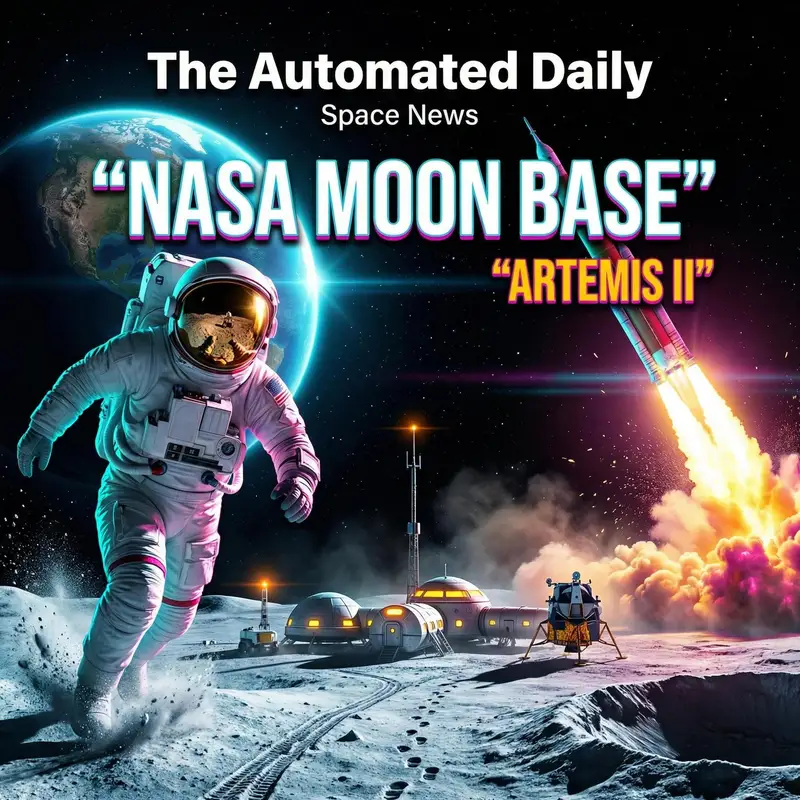
NASA announces twenty billion moon base
— NASA announced a $20 billion investment over seven years to build a permanent moon base at the lunar south pole, pausing the Lunar Gateway space station project and accelerating lunar surface exploration timelines. -
Artemis Two launch window confirmed
— The Artemis II crewed lunar flyby mission received final rollout approval with launch windows opening in early April 2026, marking the first crewed lunar mission since Apollo seventeen in 1972. -
Progress spacecraft docks with station
— The Russian Progress MS-33 cargo spacecraft successfully docked with the International Space Station on March 24 via manual piloting, delivering 2.7 tons of food, fuel, and supplies to the orbiting laboratory. -
Nuclear powered Mars mission revealed
— NASA revealed plans to launch the first nuclear-electric powered interplanetary spacecraft called SR-1 Freedom in December 2028, carrying Skyfall helicopters to Mars for surface reconnaissance and resource mapping. -
Rocket launches scheduled this week
— Multiple space missions are scheduled for launch this week including Rocket Lab's Daughter of the Stars ESA navigation satellite mission and SpaceX's Transporter-16 rideshare carrying dozens of small satellites to sun-synchronous orbit.
Full Episode Transcript: NASA announces twenty billion moon base & Artemis Two launch window confirmed
Imagine a city on the moon. Not just a brief visit, but a permanent home where humans could live and work for months at a time. Well, that just became a lot more real. Welcome to The Automated Daily, space news edition. The podcast created by generative AI. I'm TrendTeller, and today we're covering a historic shift in how America plans to return to the moon, plus updates on missions heading to Mars, the space station, and some launches you won't want to miss. Let's jump in.
NASA announces twenty billion moon base
NASA made a major announcement yesterday at their Washington headquarters. The space agency is investing twenty billion dollars over the next seven years to build a permanent base on the moon's surface. But here's what's really significant: they're completely changing their approach. Instead of building a space station that orbits the moon first, NASA is now focusing directly on lunar surface operations. NASA Administrator Jared Isaacman called this a return to the Apollo era mindset, but with a different goal. As he put it, this time it's not about flags and footprints. It's about staying on the moon. The plan divides the work into three phases. First, they'll send robotic missions to test mobility and power systems. Second, they'll build semi-habitable infrastructure for astronauts. And third, they'll establish the permanent infrastructure needed for long-term human presence. The base will be near the lunar south pole, where scientists believe water ice is abundant. NASA is also planning something remarkable: crewed landings every six months instead of once a year. They're working with commercial partners like SpaceX and Blue Origin to make this happen faster and more efficiently.
Artemis Two launch window confirmed
Speaking of Artemis, the first crewed lunar mission in fifty-plus years is nearly here. Artemis II just rolled back to the launch pad at Kennedy Space Center after being moved for maintenance. The mission is now targeting early April for launch, with the crew already in quarantine. Four astronauts will fly: Reid Wiseman, Victor Glover, Christina Koch, and Canadian astronaut Jeremy Hansen. This won't be a moon landing, but rather a flyby that takes them farther from Earth than any human has traveled since 1972. The mission will last about ten days, giving NASA crucial data about how the Orion spacecraft performs in deep space.
Progress spacecraft docks with station
Up at the International Space Station, things are running smoothly. Yesterday, the Russian Progress MS-33 cargo spacecraft successfully docked with the station. What made this interesting was that it arrived via manual docking instead of the usual automated approach. One of the rendezvous antennas failed to deploy, so Russian cosmonaut Sergey Kud-Sverchkov took manual control and brought the spacecraft home perfectly. The cargo delivery included two point seven tons of supplies, food, and fuel that the crew needed.
Nuclear powered Mars mission revealed
Here's something that caught our attention: NASA just announced it's building the first nuclear-electric powered spacecraft designed for interplanetary travel. This isn't science fiction. The mission is called Skyfall, and it's launching in December twenty twenty-eight. The nuclear reactor will power the spacecraft all the way to Mars. What's really cool is the payload: three small helicopters similar to the Ingenuity helicopter that explored Mars with Perseverance. These new helicopters will scout future landing sites, map water ice deposits, and assess whether an area is suitable for human exploration. The spacecraft itself could continue exploring beyond Mars after it deploys the helicopters, making this a genuinely flexible platform for deep space exploration.
Rocket launches scheduled this week
If you're interested in space launches, this week has some good news. Rocket Lab is launching a mission called Daughter of the Stars in the coming hours from New Zealand. This mission carries two small satellites for the European Space Agency's new navigation system. These pathfinders will test whether satellites in low Earth orbit can improve GPS-like services in challenging environments like cities and forests. Meanwhile, SpaceX has Transporter-16 scheduled for Sunday, carrying at least eighty-six payloads to sun-synchronous orbit. This is SpaceX's rideshare program, giving small satellite operators affordable access to space.
That's what's happening in space right now. We're at an inflection point where lunar exploration is accelerating, commercial partnerships are driving down costs, and innovative technologies like nuclear propulsion are opening new possibilities. NASA's twenty billion dollar commitment signals serious intent to establish a sustained human presence beyond Earth. It's an exciting time for space exploration. Thanks for tuning into The Automated Daily, space news edition. I'm TrendTeller. See you tomorrow for more from the cosmos.
More from Space News
- October 6, 2026 First exoplanet radio signal detected & Solar eruption may supercharge auroras
- October 5, 2026 X-Rays Reveal Heat Shields Burning & Surprising Soft X-Ray Merger Glow
- October 4, 2026 Milky Way Ghost Galaxy Origins & Moon Dust Magnetic Time Capsule
- October 3, 2026 First radio waves from exoplanet & Early universe metals and neutron stars
- October 2, 2026 Exoplanet radio signal detected & Crew-13 sets ISS speed record