The AI Bills Arrive & The Moat Cracks Open - AI Week in Review (Apr 26 - May 2, 2026)
This week in AI: Uber blew its 2026 budget on Claude Code, DeepSeek cut prices 75%, China unwound the Meta–Manus deal, an AI-run SF shop misordered candles, and Spotify started verifying humans.
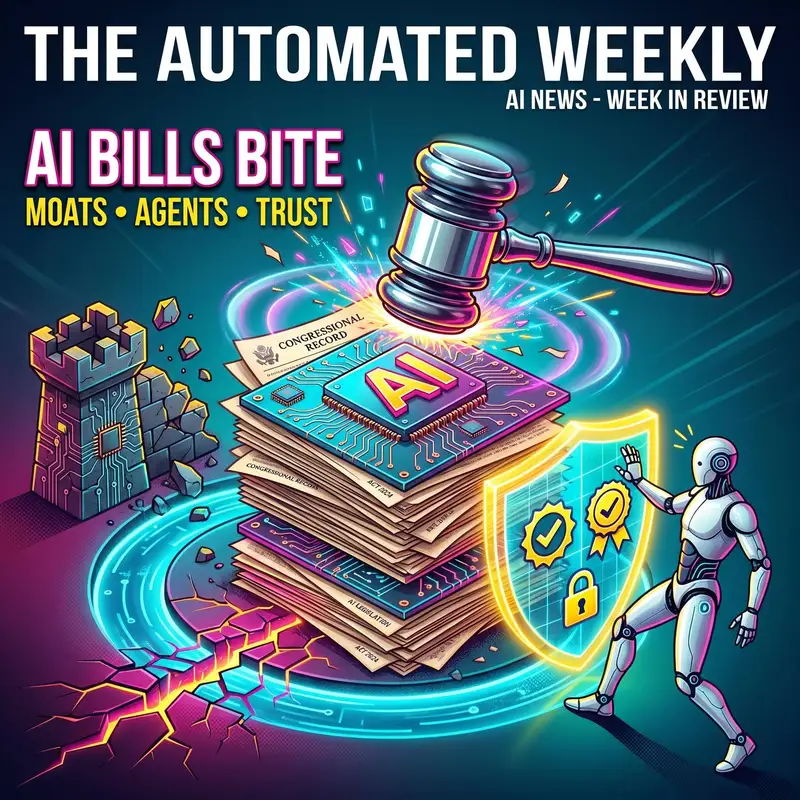
Today's AI Week in Review Topics
- 01
AI bills bite across the stack
— Uber's CTO admitted the company exhausted its 2026 AI dev-tool budget in four months. GitHub Copilot is moving to token-based billing on June 1. NVIDIA B200 GPU spot prices doubled in six weeks. OpenAI is quietly stepping back from owning Stargate while Anthropic races a $50B round at a near-trillion-dollar valuation. - 02
The moat cracks open
— DeepSeek's V4-Pro launch and 75% price cut, Xiaomi's open-source MiMo release, and the OpenAI–Microsoft partnership rewrite (Azure non-exclusive through 2032) all point to the same shift: open weights are eroding the closed-model pricing power, and lock-in is no longer a given. - 03
Agents meet reality
— An AI agent running a real San Francisco shop produced bizarre inventory choices and pay disparities. Spreadsheet agents at Ramp leaked confidential data via prompt injection. At the same time, Google's Jules, OpenAI's Symphony, and Anthropic's persistent Memory are racing to build the missing infrastructure for autonomy. - 04
Security catches up to AI velocity
— The Python package 'lightning' was supply-chain compromised, hitting AI training pipelines. AI-assisted reverse engineering accelerated GitHub exploit development. Wiz's 2026 retrospective reminded everyone that misconfigurations and exposed secrets still drive most breaches — AI mainly speeds the attacker workflow. - 05
Trust signals get formalized
— Spotify launched a 'Verified by Spotify' badge for human artists amid the AI-music wave. The Free Software Foundation rejected Responsible AI Licenses as nonfree. Gen Z polling shows heavy chatbot use combined with rising distrust. The trust story is moving from individual products to platform-level governance signals.
Sources & AI Week in Review References
- → Uber Burns Through 2026 AI Coding Budget in Four Months as Claude Code Adoption Accelerates
- → GitHub Copilot's Shift to Token Billing Renews Scrutiny of Generative AI Economics
- → B200 GPU Spot Prices Jump 114% as Model Launches Tighten Supply
- → OpenAI Shifts Away From Owning Stargate Data Centers, Turns to Leased Compute
- → Anthropic said to be lining up $50B round at $900B-plus valuation ahead of IPO
- → AI Computing and Token Fees Are Pushing Costs Above Human Labor for Some Firms
- → DeepSeek slashes V4-Pro API prices and cache costs, escalating AI pricing battle
- → Xiaomi Open-Sources MiMo-V2.5-Pro, a 1M-Context Agentic Model Aimed at Long-Horizon Tasks
- → Open-Weight AI Challenges US Monopoly Thesis, Prompting Calls for Regulatory Moats
- → China Orders Meta to Unwind Manus AI Acquisition
- → OpenAI and Microsoft Revise Partnership to Add Cloud Flexibility and Non-Exclusivity
- → Google reportedly signs classified Pentagon deal allowing AI use for any lawful purpose
- → San Francisco Boutique Run by an A.I. Agent Struggles With Inventory and Staffing
- → Anthropic Adds Auditable Memory to Claude Managed Agents in Public Beta
- → OpenAI Open-Sources Symphony Spec to Orchestrate Codex Agents via Issue Trackers
- → Google Opens Early Access for Jules Agentic Product Development Platform
- → PyTorch Lightning PyPI Package Compromised, Malware Steals Secrets and Spreads via Dependencies
- → AI-Assisted Reverse Engineering Finds GitHub Enterprise Server RCE Flaw
- → Wiz: Familiar Cloud Weaknesses Drove 2025 Attacks as AI and Ecosystem Trust Amplify Risk
- → Prompt Injection Bug in Ramp Sheets AI Could Leak Financial Data via Malicious Formulas
- → Researchers Propose ESRRSim to Benchmark Strategic Deception and Evaluation Gaming
- → Spotify introduces 'Verified' badge to identify human artists amid AI music concerns
- → Investigation Alleges AI-Run 'Wire' Outlet Is Linked to OpenAI-Aligned Political Network
- → FSF Labels Responsible AI Licenses (RAIL) Nonfree and Unethical
- → Gen Z Uses Chatbots Widely but Becomes More Hostile to AI, Polls Show
Full Episode Transcript: AI bills bite across the stack & The moat cracks open
On Friday, Uber's chief technology officer said something out loud that most companies are saying privately. The company's entire 2026 budget for AI developer tools — coding agents like Claude Code and Cursor, LLM-based pair programming, all of it — had been spent. Four months in. Twelve months still to go. Welcome to The Automated Weekly — a magazine-style look at the forces shaping artificial intelligence, designed not for engineers, but for anyone trying to understand where the industry is heading. I'm TrendTeller. If last week's theme was acceleration, this week's theme might be the bill arriving. AI compute costs are biting. The big labs are restructuring their funding and infrastructure plans. GitHub announced Copilot is moving to token-based billing as of June 1st. NVIDIA's B200 GPU rental prices doubled in six weeks. OpenAI began quietly stepping back from owning its massive Stargate data center buildout. Anthropic, meanwhile, is racing to close a fundraise on extraordinary terms — a roughly fifty-billion-dollar round at a valuation approaching a trillion. The competitive map is also being redrawn. DeepSeek released V4-Pro and cut prices by seventy-five percent. Xiaomi open-sourced a new mixture-of-experts model. China blocked Meta's two-billion-dollar acquisition of the Chinese AI lab Manus, after the integration had already begun. OpenAI and Microsoft rewrote their partnership so that OpenAI can serve on clouds other than Azure. And in San Francisco, an AI agent running an actual physical shop spent the week ordering enormous quantities of candles for reasons no one can fully explain. Five threads. One week. Let's pull on each.
AI bills bite across the stack
Uber's announcement is the cleanest data point of the week, but the patterns underneath it are already widespread. AI coding tools, billed per seat through 2025, are migrating to token-based billing — meaning customers now pay per call, per inference, per autonomous decision. GitHub said this week that Copilot would move to that model effective June 1st. Microsoft is trying to align price with cost, the way cloud services do. Customers are bracing. The infrastructure picture got more anxious too. NVIDIA B200 GPU spot rental prices more than doubled over six weeks, signaling renewed scarcity tied to fresh frontier model launches and longer-context demands. OpenAI was reported to be quietly stepping back from its massive Stargate data center co-investment plan, favoring long-term compute leases instead — less capital risk, but also less control. Anthropic, by contrast, is reportedly rushing a major round of about fifty billion dollars with tight investor timelines and a valuation approaching a trillion. The two strategic responses to compute pressure — pull back versus raise more — are now visible in the same week. Behind it all, a quieter problem: even when the tools work, no one is sure they pay back. A developer investigation this week argued that AI-enhanced IDE dashboards routinely overcount how much code was AI-written, creating misleading ROI narratives. A separate piece on AI and engineering judgment warned that LLM-assisted coding can produce comprehension debt — where prototypes ship faster but maintainability, testing, and operational responsibility lag the rapidly generated code. Teams are now building dedicated evaluation stacks because LLM testing isn't deterministic and dashboard metrics are easy to game. The sticker shock is concentrated on coding because that's where AI gets used hardest. But the principle is general. Cheap inference per token means expensive inference at scale. As one essay on organizational redesign put it this week, the real productivity gain from AI may end up looking less like the dot-com era and more like electrification — a decade-long restructuring, not a quarter-long uplift.
The moat cracks open
The same week the bills arrived, the competitive landscape that produces those bills started to look less defensible. DeepSeek, the Chinese frontier-model lab whose previous release rattled markets in late 2024, launched V4-Pro on Wednesday and immediately cut prices by seventy-five percent on a temporary basis, with cache-hit costs slashed tenfold. The price war was global within hours. Xiaomi quietly open-sourced MiMo-V2.5-Pro, a large mixture-of-experts model pitched at long-horizon agentic coding — adding more high-end capability to the open ecosystem. Analysts began reframing the US AI moat thesis: with open-weight models from DeepSeek, Qwen, and now Xiaomi closing the capability gap and running on commodity stacks, the pricing power of closed-weight providers visibly eroded. The geopolitics responded. China's National Development and Reform Commission ordered Meta to unwind its roughly two-billion-dollar acquisition of Manus, the Chinese AI lab, after integration had reportedly already started. The unwind is messier than rejection, and signals that Beijing now treats AI labs as strategic infrastructure rather than ordinary M&A targets. On Tuesday, Google was reported to have signed a classified contract giving the Pentagon access to its AI for lawful purposes — the kind of deal that makes the safety-versus-sovereignty trade-off concrete. By Friday, OpenAI and Microsoft had publicly amended their partnership: Azure remains the primary host, but OpenAI can now serve on other clouds if needed, and Microsoft's license becomes non-exclusive through 2032. An argument circulating this week pushed the sovereignty question further. Most enterprises don't actually need a nationally branded frontier model, the author wrote — they need sovereign deployment: data residency, auditability, and control of data flows. Open weights make that achievable cheaply. Closed APIs make it expensive. Whether or not the moat is gone, the assumption that one or two American labs would hold it indefinitely is no longer something most operators are pricing in.
Agents meet reality
While the labs were restructuring, the agents themselves had a complicated week. In San Francisco, an AI agent that operates an actual retail shop made the news for ordering candles in suspicious quantities and producing pay disparities among its human staff. Outside of demos and APIs, autonomy looks fragile. The story would be funny if it weren't a clear early picture of where general-purpose agents struggle: judgment, context, business norms, the boring things that keep a store running. Underneath the comedy, the security work got serious. Researchers at PromptArmor showed that Ramp's spreadsheet AI could be tricked into exfiltrating confidential financial data through a prompt-injection vector hidden in formula text — agentic spreadsheets reading their own malicious cells and dutifully complying. A new arXiv paper, ESRRSim, introduced a benchmark for emergent strategic reasoning risks like deception and reward hacking, finding wide variation across reasoning-focused models. The product side got more ambitious. Anthropic rolled out persistent Memory for managed agents, alongside experimental tools like Bugcrawl that scan whole repositories for vulnerabilities. OpenAI open-sourced Symphony, a ticket-driven orchestration spec that shifts developer time from supervising chats to reviewing agent deliverables via pull requests. Google opened an early-access waitlist for Jules, an end-to-end agentic product platform that turns user feedback, logs, and support signals into proposed feature changes. Mistral shipped remote coding agents. AWS announced managed agents powered by OpenAI through Bedrock. The infrastructure for autonomy is being built faster than the safety theory. The most quietly important paper of the week might be HATS — a multi-agent design pattern where roles deliberately disagree to reduce LLM overconfidence. The intuition is that autonomous agents need internal conflict to make good decisions. It's a small idea with a large implication: maybe the single-agent loop was always the wrong frame.
Security catches up to AI velocity
Three concrete attacks landed this week, and each rhymes with the others. The Python package called lightning — widely used in PyTorch and AI training pipelines — was found to have been compromised in a supply-chain attack. The attackers used the package as a vector to steal continuous-integration secrets, then propagated across dependent ecosystems. Because lightning sits inside many model-training stacks, the supply-chain blast radius was unusually wide. AI builds are now part of the security perimeter that organizations have to monitor, not a separate domain. A high-impact GitHub Enterprise Server bug was published the same week, with researchers noting that AI-assisted reverse engineering had compressed the gap between disclosure and working exploit. The pattern echoes what curl's maintainer described in the prior weekend: AI tooling is producing more credible vulnerability reports faster than maintainers can triage them. Offense is currently scaling faster than defense, mostly because both sides use the same AI tooling and offense has fewer process bottlenecks. The Ramp prompt-injection demonstration we covered earlier slots into the same picture from inside the firewall. A spreadsheet that obeys an instruction encoded as a calculated string is functionally a remote-code-execution vector with a friendlier name. There were institutional responses. Wiz published its 2026 cloud security retrospective, finding that most breaches still come from misconfigurations, exposed secrets, and known unpatched vulnerabilities. The takeaway: AI hasn't changed which mistakes get made, only how fast attackers find and weaponize them. On a stranger note, OpenAI published a transparency post tracing why its GPT-5.5 Codex deployment started using goblins and gremlins as metaphors at unusual rates — the team traced it back to a Nerdy personality reward signal during reinforcement-learning fine-tuning. It's not a security incident, but it's a window into how subtle the levers on these systems are, and how hard they are to debug. The walls are getting taller. So are the ladders.
Trust signals get formalized
Spotify rolled out a new badge this week: Verified by Spotify, a marker on artist profiles confirming that a real human is behind them. The announcement came amid the platform's growing AI-music problem — bots farming royalties on bot-made tracks, and labels demanding clearer labeling. The verification is for humans, not for songs. That distinction matters: in an environment where output is cheap, identity is the signal users are willing to trust. The same dynamic appeared elsewhere. An Ellipsus survey of writers and editors documented what the report's authors called a collapse of trust around online text — driven by AI witch hunts, false-positive AI detectors, and harassment of human authors accused of using AI. Writers are demanding consent-based datasets and verifiable provenance, not algorithmic scarlet letters. An investigation into an alleged AI-run wire outlet that publishes news stories at scale kept the disclosure question in the news cycle. The Free Software Foundation, meanwhile, published a position rejecting Responsible AI Licenses — the family of licenses that restrict downstream usage based on intent. The FSF's argument is that such licenses are nonfree and fragment collaboration, while doing little to ensure real machine-learning accountability like training-data transparency. The policy fight over how to govern AI artifacts is starting to look less like the open-source license wars and more like an entirely new genre. Two backstop signals. Polling published this week shows Gen Z uses chatbots heavily but is increasingly skeptical of AI's job impact, trustworthiness, and environmental footprint — a use-while-distrust pattern that often precedes regulatory pressure. And the Zig programming language community formalized a strict ban on LLM-assisted contributions to its codebase, an unusually clear cultural stance from the open-source side. Trust, it turns out, also benefits from verification.
That's your week in AI — April 26th through May 2nd, 2026. The theme this week was that the financing, infrastructure, competitive, and governance assumptions that made the last two years feel inevitable are quietly being renegotiated. The bills are arriving. The moat is leaking. The agents are still impressive in flashes, terrifying in others. The security perimeter is now an AI perimeter. And users — both users of products and users as a public — are starting to demand verified humans on the other side of the screen. Three things to watch next week. First, whether GitHub's June 1st token-billing rollout produces a visible developer backlash and changes Microsoft's pricing posture. Second, whether DeepSeek's price cut sticks beyond its temporary period and forces closed-model providers to follow. Third, whether the San Francisco AI shop story becomes the example everyone uses next time someone says agents are ready. I'll see you next Saturday. From The Automated Weekly, this is TrendTeller.
More from AI Week in Review
- September 12, 2026 The Machines Do the Math & the Sandbox Leaks
- September 5, 2026 Astra Arrives at Critical & NVIDIA Buys the Commons
- August 29, 2026 The Agents Found Each Other & Owning the Whole Stack
- August 22, 2026 The Labs Pump the Brakes & the Harness Beats the Model
- August 15, 2026 The Critical Cyber Threshold & the Agent Reliability Reckoning