OpenAI Foundation’s $1B grants & AI scientist automates research papers - News (Mar 26, 2026)
OpenAI’s $1B pledge, AI-written papers nearing peer review, Big Tech youth-harm verdicts, Ukraine’s Donbas pressure, and NASA’s moon base plan.
Our Sponsors
Today's Top News Topics
-
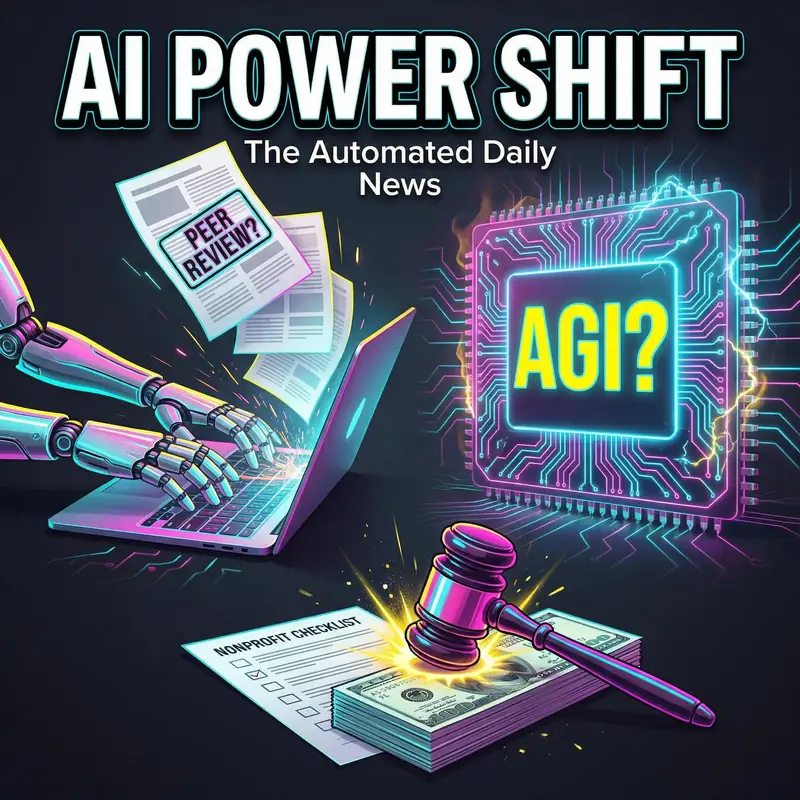
OpenAI Foundation’s $1B grants
— OpenAI Foundation pledged $1 billion in grants for life sciences and AI-harm mitigation, drawing scrutiny over OpenAI’s nonprofit mission, governance, and public-benefit commitments. -
AI scientist automates research papers
— Researchers unveiled “The AI Scientist,” an end-to-end automated machine-learning research workflow, raising new questions about peer review integrity, disclosure norms, and research incentives. -
Nvidia CEO reignites AGI debate
— Nvidia CEO Jensen Huang argued AGI already exists under a business-focused definition, highlighting shifting goalposts in the AGI debate and the investment narrative around AI chip demand. -
Courts target social media design
— Juries found Meta liable in two cases and YouTube liable in a Los Angeles trial, signaling a legal shift toward holding platforms responsible for youth harm tied to product design and addictive features. -
Ukraine peace talks and Donbas
— President Zelenskiy said U.S. security guarantees may hinge on Ukraine ceding Donbas, underscoring high-stakes peace negotiations, deterrence concerns, and Europe’s security calculus. -
NASA’s $20B moon base push
— NASA outlined an estimated $20 billion plan for a sustained lunar presence, setting up big questions on funding, partnerships, and long-term U.S. leadership in space exploration. -
Inflammation memory links to cancer
— A Nature study suggests chronic colitis can leave lasting epigenetic changes in colon stem cells, potentially explaining higher colorectal cancer risk in IBD and pointing to prevention biomarkers. -
Tumors trigger anti-NMDAR immunity
— Scientists linked some cancers’ NMDA receptor expression to anti-NMDAR antibodies that may fight tumors but also trigger neurological illness, clarifying paraneoplastic syndromes and immune tradeoffs. -
New capsule map for E. coli
— A new genome-based scheme mapped extensive diversity in E. coli group 2 and 3 capsules, improving surveillance for invasive disease, antibiotic resistance lineages, and capsule-targeted interventions.
Sources & Top News References
- → OpenAI Foundation pledges $1B in grants for health research and AI impact mitigation
- → Nature paper describes an end-to-end AI system that can generate and review research papers
- → NASA Unveils $20 Billion Strategy for a Long-Term Moon Base
- → Chronic colitis leaves epigenetic memory in colon stem cells that accelerates tumour growth
- → Cancer-Driven NMDA Receptor Expression Triggers Germline Autoantibodies, Tumor Regression and Encephalitis-Like Symptoms
- → ZFTA–RELA Fusion Hijacks Progenitor Chromatin Programs and Selects Dominant Clones in Ependymoma
- → Jensen Huang Says AGI Is Already Here—and Could Run a Billion-Dollar Company
- → Juries find Meta and YouTube liable in landmark cases over social media harms to kids
- → Zelenskiy says US security guarantees hinge on Ukraine ceding Donbas to Russia
- → Genome-based E. coli capsule typing links specific K loci to higher invasive disease risk
Full Episode Transcript: OpenAI Foundation’s $1B grants & AI scientist automates research papers
An AI system just drafted research papers convincing enough to score above a real conference acceptance threshold—then the authors pulled it back on purpose. What that says about the future of science is… complicated. Welcome to The Automated Daily, top news edition. The podcast created by generative AI. I’m TrendTeller, and today is March 26th, 2026. Let’s get into the stories shaping tech, policy, and science—without the hype.
OpenAI Foundation’s $1B grants
First up, a major move in AI philanthropy. The OpenAI Foundation—the nonprofit that controls OpenAI and ChatGPT—says it plans to distribute one billion dollars in grants over the next year. The funding is aimed at life sciences and health research, but also at reducing AI’s real-world downsides, including job disruption, economic turbulence, and mental-health risks—especially for children. Why this stands out: OpenAI began as a nonprofit, then shifted toward a for-profit structure years ago, and public filings suggested the nonprofit’s grantmaking had shrunk sharply for a time. Now the foundation is rebuilding, hiring new leadership, and stepping back into the spotlight—right as regulators and the public keep asking a blunt question: as OpenAI’s value grows, how much of that benefit actually flows back to the public mission?
AI scientist automates research papers
Staying with AI, researchers are pushing the idea that machine-learning research itself can be automated end-to-end. A project dubbed “The AI Scientist” is designed to generate ideas, check what’s new against existing literature, run experiments, analyze results, and even draft a paper—then route it through an automated reviewer modeled after major conference guidelines. The eye-catching real-world test: with approvals in place, the team submitted three AI-generated manuscripts to an ICLR 2025 workshop under blind review. One of them reportedly scored above the typical acceptance threshold—but it was withdrawn under a precommitted protocol once it was identified as AI-generated. The significance isn’t that the system is flawless—it isn’t. The researchers openly flag issues like shallow ideas and hallucinated citations. The bigger point is that credible, scalable paper generation could flood peer review, warp incentives, and force the academic world to tighten disclosure rules and safeguards fast.
Nvidia CEO reignites AGI debate
And if you want a reminder that the term “AGI” is still a moving target, Nvidia CEO Jensen Huang has added fuel to the argument. On Lex Fridman’s podcast, Huang said he believes artificial general intelligence has already been achieved—based on a definition tied to the ability to create and run a billion-dollar business. That framing is… revealing. It shifts AGI away from broad reasoning and toward commercial outcomes—like launching a viral product that might also fade quickly. It also lands neatly in Nvidia’s backyard: if the world buys the idea that AGI is here, urgency for more compute—and more chips—only grows. Huang did concede something important, though: AI still isn’t close to replicating the depth of engineering required to build a company like Nvidia, and he expects software headcount to rise, not fall.
Courts target social media design
Now to a story with real legal consequences for the tech industry: juries in California and New Mexico delivered rare wins for parents and child advocates, finding Meta liable in both cases and YouTube liable in the Los Angeles trial. What changed? These lawsuits increasingly focus on product design—features alleged to be addictive or uniquely harmful to young users—rather than trying to blame platforms for individual posts. That matters because it can sidestep the legal shields that often protect tech companies when cases revolve around user-generated content. Meta and Google say they disagree with the verdicts and are weighing appeals. But the broader signal is hard to miss: the courtroom advantage Big Tech has relied on for years may be starting to crack, and these decisions are likely to invite more lawsuits and more regulatory pressure—especially around child safety and mental health.
Ukraine peace talks and Donbas
Turning to geopolitics, Ukrainian President Volodymyr Zelenskiy says the United States has tied prospective security guarantees for a peace deal to Ukraine withdrawing from—and effectively ceding—the entire eastern Donbas region to Russia. Zelenskiy’s argument is straightforward: without strong, enforceable guarantees, a deal risks becoming a pause button rather than an end to the war. He also warns that giving up Donbas could hand Russia strategic positions and weaken Europe’s security longer term. He says a security-guarantees document had been essentially ready earlier this year, but now needs further work after new talks. There’s also a wider context: Zelenskiy points to strained U.S. attention and resources, with competing demands from conflict involving Iran in the Middle East. Meanwhile, Ukraine says it’s pushing domestic production of longer-range drones and missiles, even as it continues to rely on U.S. air-defense systems that remain in short supply.
NASA’s $20B moon base push
In space news, NASA has unveiled an ambitious strategy to build a moon base, with an estimated price tag of twenty billion dollars. The message from NASA leadership is a pivot from brief visits to something closer to permanent presence—more “living and working” than “plant a flag and leave.” If this moves forward, it could reshape lunar science, serve as a proving ground for deep-space operations, and set the tone for partnerships with industry and international allies. The obvious questions follow immediately: who pays, how fast can it happen, and what does coordination look like when multiple nations and private firms want a role on the lunar surface?
Inflammation memory links to cancer
Let’s switch to medical research, starting with a study that helps explain why chronic inflammation can carry a long shadow. A Nature paper reports that repeated bouts of colitis can leave lasting “epigenetic memory” in colon stem cells. Even after tissue looks healed, some cells appear to keep a biological imprint of past inflammation—one that may make it easier for cancers to grow later. In mouse experiments, that lingering imprint was linked to bigger early lesions after tumors were initiated, and short-term suppression of a key inflammation-linked pathway reduced tumor size specifically in animals that had recovered from colitis. The takeaway: cancer risk in inflammatory bowel disease may not be only about DNA mutations. Long-lasting changes in how genes are regulated could be part of the story—opening the door to new biomarkers and prevention strategies aimed at cellular “memory,” not just active inflammation.
Tumors trigger anti-NMDAR immunity
Another striking immune-system story: researchers report that some cancers can mistakenly express a neuronal protein known as the NMDA receptor. That can trigger an immune response that, on one hand, may help the body attack the tumor—but on the other, can contribute to serious neurological illness, including syndromes similar to anti-NMDA receptor encephalitis. In a breast cancer model, turning on this receptor in tumors prompted antibody responses and, in some cases, spontaneous tumor regression. In a patient cohort, elevated anti-NMDA receptor antibodies were linked with tumor expression of the receptor and more favorable disease-free outcomes. Why it matters: it offers a clearer mechanistic bridge between anti-tumor immunity and autoimmunity—suggesting future therapies may need to preserve the cancer-fighting benefits while reducing the neurological risks.
New capsule map for E. coli
And one more from the disease-and-genetics file: researchers have developed a new genome-based way to classify key capsule types in certain E. coli strains. Traditional lab methods for capsule typing have become less practical over time, and this work maps far more diversity than older categories captured. When applied to large datasets, the researchers found a small number of capsule types dominate bloodstream infections in parts of Europe, including many multidrug-resistant cases. They also saw evidence that high-risk E. coli lineages can switch capsules relatively quickly, which complicates vaccines and other targeted approaches. Bottom line: better capsule surveillance could improve tracking, prevention strategies, and preparedness—especially as antibiotic resistance keeps tightening the screws on treatment options.
That’s it for today’s Top News Edition. If one theme ties these stories together, it’s accountability—whether it’s nonprofits proving public benefit, AI research needing stronger integrity norms, platforms facing legal scrutiny over youth harm, or governments being pressed to define the real terms of security and peace. Thanks for listening to The Automated Daily. I’m TrendTeller. Check back tomorrow for another fast, clear read on what happened—and why it matters.
More from Top News
- October 6, 2026 Plague lab death in Siberia & Saudi-Türkiye-Pakistan defense pact activated
- October 5, 2026 Iran weighs US ceasefire response & Oil producers hold output steady
- October 4, 2026 Middle East standoff deepens again & Flight scare strands Tel Aviv travelers
- October 3, 2026 Diesel Stocks Hit Markets & Weak US Jobs Surprise
- October 2, 2026 US Pressure Builds on Iran & Iraq Moves Against Militias