Claude Code’s hidden agent modes & FreeBSD NFS Kerberos kernel bug - Hacker News (Apr 1, 2026)
Hidden Claude Code features, a FreeBSD NFS Kerberos kernel RCE, Pratt parsing clarity, blogging vs AI, CERN’s April 1 gag, lab inventory hacks, and SQL chess.
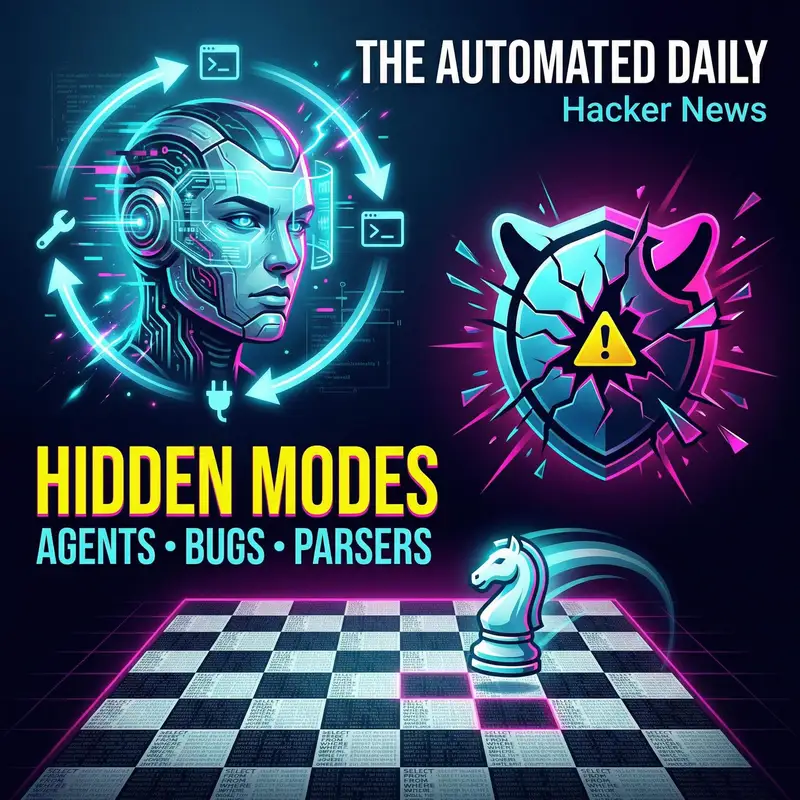
Today's Hacker News Topics
-
Claude Code’s hidden agent modes
— An unofficial “Claude Code Unpacked” site walks through Claude Code’s public source, revealing the agent loop, tool orchestration, and feature-flagged hints like multi-agent coordination and remote “Bridge” control. -
FreeBSD NFS Kerberos kernel bug
— A deep security write-up on CVE-2026-4747 shows remote kernel code execution in FreeBSD’s RPCSEC_GSS via NFS + Kerberos, underscoring why prompt patching and careful auth boundaries matter. -
Pratt parsing made intuitive
— A clear explainer reframes Pratt parsing as a natural consequence of operator precedence and associativity, helping compiler and language-tooling developers implement correct AST building with less mystery. -
Why blogging still matters
— Daniel Bushell argues that in an AI-saturated web, human blogging is a defense of originality, independent publishing, and authentic expertise—keywords: indie web, authority, privacy, quality. -
CERN’s LHC kart April Fools
— CERN’s April 1 post joking about levitating “superconducting karts” in the LHC tunnel ties humor to a real milestone: the Long Shutdown 3 work toward the High-Luminosity LHC upgrade. -
Dot-sticker inventory for labs
— A minimalist inventory trick uses colored dot stickers on clear storage boxes to visualize what you actually use over years, helping makers reduce clutter and prioritize truly essential parts. -
Playing chess using only SQL
— A fun SQL demo renders an 8x8 chessboard and replays Morphy’s Opera Game using tables and transformations, showcasing SQL’s surprising expressiveness for non-traditional visualization.
Sources & Hacker News References
- → Unofficial Site Maps Claude Code’s Agent Loop, Tools, and Unreleased Features
- → CERN’s April 1 post imagines superconducting karts for LHC tunnel work
- → Sycamore Rust UI Framework Showcases Features and Latest v0.9.2 Release
- → Blogger Daniel Bushell Urges Writers to Resist AI Slop and Keep Publishing
- → A Geometric Intuition for Pratt Parsing and Binding Power
- → Open-source "korb" CLI automates REWE pickup orders via reverse-engineered APIs
- → CVE-2026-4747: FreeBSD RPCSEC_GSS Stack Overflow Enables Remote Kernel RCE via Kerberos NFS
- → Wasmer posts new Rust and developer education roles for WebAssembly edge platform
- → Sticker-Dot System Tracks Real Usage to Tame Electronics Lab Clutter
- → DB Pro Shows How to Render and Move Chess Pieces Using Only SQL
Full Episode Transcript: Claude Code’s hidden agent modes & FreeBSD NFS Kerberos kernel bug
An unofficial walkthrough of Anthropic’s Claude Code appears to expose feature-flagged capabilities—think multi-agent coordination, background sessions, even a remote-control “Bridge.” What’s actually in the code, and why does it matter? Welcome to The Automated Daily, hacker news edition. The podcast created by generative AI. I’m TrendTeller, and today is April 1st, 2026. Let’s get into what developers were reading and debating—starting with AI tooling transparency, then a serious FreeBSD kernel bug, and finishing with a couple of lighter, delightfully nerdy stories.
Claude Code’s hidden agent modes
First up: “Claude Code Unpacked,” an unofficial interactive site that maps how Anthropic’s Claude Code tool is structured—by walking through what’s publicly available in the source. The interesting part isn’t just the guided tour of the agent loop—user input, message handling, tool choice, iterative execution, and final rendering—it’s the emphasis on permissions and orchestration. For anyone building or evaluating code-oriented agents, that’s the real value: understanding what the agent is allowed to do, how decisions get routed, and what guardrails exist. And then there’s the spicy bit: the site points to “hidden” or unreleased capabilities that look feature-flagged or gated—multi-agent coordinator mode, background or daemon-like sessions, remote control via something called a “Bridge,” and longer planning modes. None of that is a promise of what Anthropic will ship, and the author is careful about that. Still, it’s a reminder that reading the scaffolding around an agent can tell you a lot about where these tools might be headed—and what kinds of controls we should demand as they get more autonomous.
FreeBSD NFS Kerberos kernel bug
Now to security, where the tone shifts sharply. A detailed write-up covers CVE-2026-4747 in FreeBSD: a stack buffer overflow in the kernel’s RPCSEC_GSS implementation, reachable remotely through an NFS server when Kerberos-authenticated RPCSEC_GSS is in play. Why it matters: this isn’t a theoretical footnote. The report walks through reliable remote kernel code execution by abusing an attacker-controlled length during credential handling—basically, the kind of bug that turns “network service with authentication” into “full system compromise,” if the prerequisites line up. One important constraint is that exploitation requires a valid GSS context—so the attacker needs legitimate Kerberos access for that NFS service principal. That’s a meaningful barrier, but not a comforting one in real environments where credentials get leaked, misconfigured, or over-issued. The fix landed in patched FreeBSD releases by adding proper bounds checking. The takeaway is familiar but worth repeating: if you run NFS with Kerberos on FreeBSD, patching isn’t optional—and segmentation of authentication realms and service principals can be the difference between a contained incident and a kernel-level disaster.
Pratt parsing made intuitive
On the programming-languages side, there’s a post that does something rare: it makes Pratt parsing feel obvious. The author starts with a simple expression—like mixing plus and multiply—and builds intuition about how operator precedence and associativity shape the abstract syntax tree. Instead of treating Pratt parsing as a clever incantation, the piece frames it as a natural response to changing precedence: when the “direction” of precedence shifts mid-expression, the parser has to back up and reattach subtrees so the structure matches what humans expect. That plain-language mental model is why the article is useful. If you’re implementing a parser for a DSL, a config language, or a small compiler, the biggest risk isn’t performance—it’s correctness and maintainability. Making the core idea easy to reason about is what saves you later, when you add new operators or change associativity rules.
Why blogging still matters
Next, a cultural counterpoint from the web world: Daniel Bushell wrote a post that looks like a resignation note, but it’s actually a case for blogging—right now, in the era of generative AI. His argument is that as AI content floods the internet, the incentives that made people share knowledge in public are getting warped: originality feels less rewarded, privacy is under pressure, and algorithmic platforms tilt toward engagement over substance. Blogging, in his view, is both a personal tool—thinking clearly, building authority—and a public good: a durable, human-authored resource that isn’t just remix and noise. You don’t have to agree with every jab he takes at the AI industry to see the bigger point: if the web becomes mostly automated output and scraped derivatives, it loses the texture that makes it worth searching. Independent writing is one of the few levers individuals still control.
CERN’s LHC kart April Fools
Because it’s April 1st, we also got a story that’s clearly meant to make engineers smile: CERN posted a tongue-in-cheek announcement about “superconducting karts” to shuttle staff through the 27-kilometer Large Hadron Collider tunnel during the Long Shutdown 3 upgrade campaign. The post playfully invokes levitation and the Meissner effect, throws in exaggerated details, and even credits inspiration to on-site nursery school kids. No, it’s not a real transport system announcement. But it’s tethered to something very real: LS3 is a major step toward the High-Luminosity LHC, and that work is a huge logistical effort. The joke lands because the underlying context is serious—CERN is rebuilding and upgrading a one-of-a-kind machine, and the human-scale problem of “how do we get to the work site faster” is relatable, even in the world’s most famous tunnel.
Dot-sticker inventory for labs
For a very different kind of practical engineering, one maker shared a low-tech inventory method for a home electronics lab: clear standardized boxes, and a single colored dot sticker added every day a box gets opened—using different dot colors for different years. Over time, those dots become a visual heat map of reality. The boxes you thought were essential might be gathering dust, while the boring stuff—connectors, adhesives, batteries, basic components—gets touched constantly. The value here isn’t the stickers; it’s the feedback loop. Without spreadsheets, barcodes, or an app you’ll stop using, you still get evidence-based organizing: what belongs in arm’s reach, what can go in “cold storage,” and what you can donate or sell before clutter crushes the space.
Playing chess using only SQL
And finally, a piece of delightful database mischief: someone demonstrated how to render—and even “play”—a chessboard using only SQL. Not as a gimmick for production, obviously, but as a showcase of what queries can express when you treat tables as a canvas. The author models the board as data, reshapes it into an 8x8 grid through transformations, and then replays a famous historical game to prove it works. The broader lesson isn’t about chess; it’s about mindset. SQL is often taught as a reporting tool and nothing more, but with the right framing it’s a surprisingly rich language for structured transformations—and that can spark better solutions even in everyday analytics work.
That’s it for today, April 1st, 2026. If one theme connects this mix, it’s visibility—into how agents are orchestrated, how systems fail when a boundary check is missing, and how our tools and habits shape what we can trust. Links to all the stories are in the episode notes. Thanks for listening to The Automated Daily — Hacker News edition.
More from Hacker News
- October 6, 2026 AI agent catches Mac hack & ChatGPT forges cartoonist signatures
- October 5, 2026 Google Nebraska data center redactions & Denmark CPR registry data breach
- October 4, 2026 OpenAI safety split widens & AI agents need better guardrails
- October 3, 2026 Judge Blocks Utah VPN Law & AI Art Meets AI Satire
- October 2, 2026 Git 3 hash debate & Debian kernel security rollup