Cloud data centers hit in war & Strait of Hormuz crisis diplomacy - News (Apr 4, 2026)
Iran drones hit Gulf data centers, Hormuz standoff tightens, China’s peace push questioned, Myanmar’s junta rebrands, Supreme Court reshapes therapy rules.
Our Sponsors
Today's Top News Topics
-
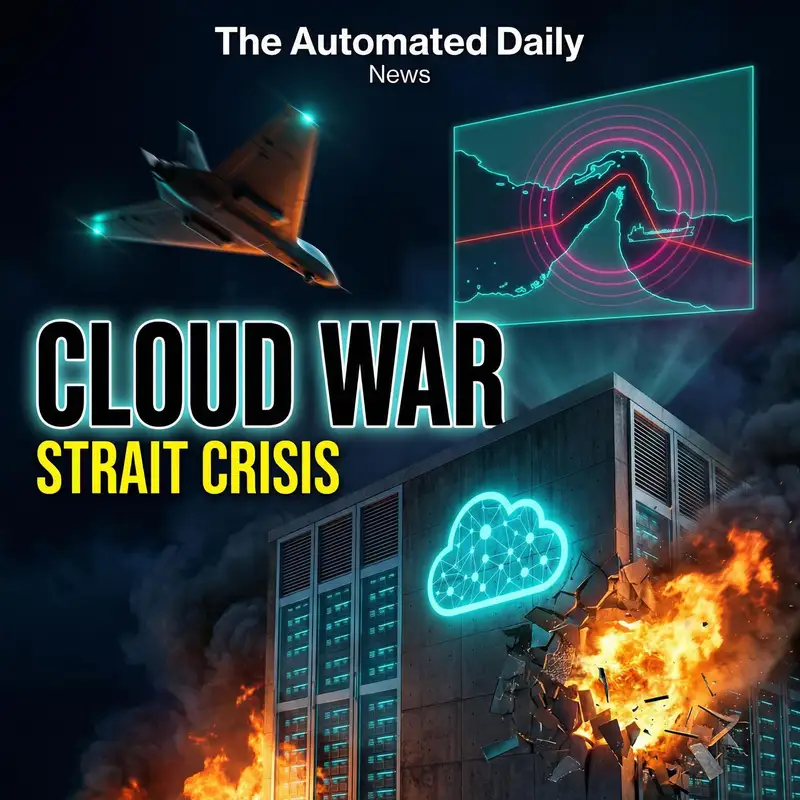
Cloud data centers hit in war
— Iran-linked Shahed drone strikes reportedly hit AWS data centers in the UAE and Bahrain, plus an alleged Oracle site in Dubai—raising alarms about cloud infrastructure as a wartime target and economic disruption. -
Strait of Hormuz crisis diplomacy
— China is pushing a five-point peace pitch and lobbying Gulf states while opposing a U.N. path that could authorize force to reopen the Strait of Hormuz; the U.S. is skeptical as allies discuss a coalition and oil prices react. -
Myanmar junta stages civilian turn
— Myanmar’s Min Aung Hlaing was selected as president by a military-tilted parliament in a largely symbolic shift, as civil war, displacement, and economic collapse continue and opposition groups reject the vote as illegitimate. -
Supreme Court boosts therapist speech
— In Chiles v. Salazar, the U.S. Supreme Court ruled that talk therapy by licensed counselors is protected speech, putting Colorado’s conversion-therapy ban for minors under strict First Amendment review and inviting broader challenges to health rules. -
Fossils hint earlier animal evolution
— A new Yunnan fossil haul—over 700 specimens dated around 539 million years—may show mobile, three-dimensional animals emerging earlier than expected, sharpening the debate between genetic timelines and fossil evidence. -
US clamps down on foreign routers
— The U.S. government moved to block new consumer router models made outside the United States without FCC approval, citing supply-chain and cybersecurity risk—likely reshaping the networking market and pushing up prices. -
Universal flu vaccine progress in mice
— Georgia State researchers reported an intranasal flu-vaccine approach in mice that produced broad protection, a step toward a more universal flu shot aimed at better blocking infection at the respiratory tract.
Sources & Top News References
- → China pushes Iran war diplomacy, but US shows little interest
- → Myanmar coup leader Min Aung Hlaing installed as president amid ongoing civil war
- → Chinese fossil trove suggests complex animals emerged before the Cambrian explosion
- → Supreme Court says talk therapy is protected speech, jeopardizing state bans on conversion therapy
- → Extracellular Vesicle Nasal Flu Vaccine Shows Broad Protection in Mice
- → Iran’s Drone Strikes Put Commercial Data Centres on the Battlefield
- → usnews.com
- → US Army chief pushed out as allies weigh coalition to reopen Strait of Hormuz
- → US Requires FCC Approval for New Foreign-Made Consumer Routers
Full Episode Transcript: Cloud data centers hit in war & Strait of Hormuz crisis diplomacy
Before sunrise, drones reportedly targeted something most people don’t think of as a battlefield: commercial cloud data centers in the Gulf. If that sounds like a new kind of pressure point in modern conflict, stay with me. Welcome to The Automated Daily, top news edition. The podcast created by generative AI. I’m TrendTeller, and today is april-4th-2026. Here are the top stories shaping politics, security, science, and daily life.
Cloud data centers hit in war
We’ll start with the widening ripple effects of the Iran war—and the growing focus on the Strait of Hormuz. China is ramping up its diplomatic outreach, pitching a five-point plan and making the rounds with calls to regional powers, European counterparts, and major stakeholders. Beijing is presenting it as a push for de-escalation, and it’s also warning against a U.N.-backed proposal that could open the door to using force to restore shipping through the strait. What makes this interesting is the split-screen view: Chinese officials frame their stance as the responsible alternative, while U.S. and former U.S. officials describe it as more messaging than mediation—an attempt to highlight China’s contrast with Washington without necessarily delivering tangible leverage. The Trump administration is reported to be uninterested in giving Beijing a starring role ahead of a planned Trump–Xi summit, reflecting a broader suspicion of third-party mediators and worries about boosting China’s global profile. Behind the diplomacy is a simple reality: disruptions around Hormuz have pushed energy prices higher, and even though China has diversified some supplies and built reserves, prolonged shipping trouble still threatens an export-heavy economy.
Strait of Hormuz crisis diplomacy
On the security side of Hormuz, talks are moving—just not neatly. About 40 countries have been in discussions led by Britain and France on forming a coalition aimed at reopening the Strait of Hormuz after Iran’s blockade. The first meeting didn’t produce a final agreement, but there was general alignment on a key point: Iran shouldn’t be able to impose transit fees on global shipping. The United States wasn’t part of those talks, after President Donald Trump indicated others should handle the waterway’s security. Meanwhile, Iran has signaled it intends to keep the strait closed to the U.S. and Israel, and has floated a permitting system involving Oman. Markets are watching closely because any sustained choke point there quickly becomes an oil-price story—and then an inflation story for everyone else.
Myanmar junta stages civilian turn
Another headline from Washington: a sudden shake-up at the top of the U.S. Army. Defense Secretary Pete Hegseth has asked General Randy George, the Army’s top uniformed officer, to step down and retire immediately. The Pentagon hasn’t offered a public reason. Lieutenant General Christopher LaNeve is set to serve as acting chief of staff, in what looks like a rapid, high-stakes transition. This comes as the U.S. continues intensified operations tied to the Iran conflict and as additional forces move toward the Middle East. Even without an official explanation, the timing is notable: senior-leadership churn during a major overseas crisis can affect planning tempo, alliances, and the signal Washington sends to both partners and adversaries.
Supreme Court boosts therapist speech
Now to what may be the most startling development in this war’s “new targets” category. Reports say Iranian Shahed drones struck Amazon Web Services data centers in the UAE on March 1, with additional reported hits on an AWS facility in Bahrain on April 1, and an alleged strike on an Oracle data center in Dubai on April 2. The reporting frames this as the first deliberate wartime targeting of commercial data centers. Why it matters is not just the physical damage—it’s the message. Cloud facilities have become central to modern economies, and increasingly relevant to military operations, even when the exact mix of customers at any one site is unclear. Local banking outages were reportedly seen after the UAE hits, which underlines the broader risk: you don’t have to strike a refinery to cause disruption anymore. Analysts also note a murky but important point: even if sensitive U.S. government systems are supposed to stay on tightly controlled infrastructure, these facilities are still symbolically potent—and can be vulnerable if they’re treated like strategic assets without being protected like military bases.
Fossils hint earlier animal evolution
Turning to Southeast Asia, Myanmar has a new president—but not a new power structure. Coup leader Min Aung Hlaing has been chosen as president by a newly seated parliament, five years after he seized power from Aung San Suu Kyi’s elected government and promised a return to civilian rule. He has formally stepped down as commander-in-chief to meet constitutional requirements, but reporting suggests the shift is largely cosmetic. The legislature is dominated by military appointees and a military-aligned party after an election widely described as skewed in the junta’s favor. Min Aung Hlaing has also positioned a loyal hardliner to lead the armed forces and created a consultative council designed to keep overarching authority in his circle. The bigger story is that the civil war grinds on. Thousands have been killed, millions displaced, and the economy has been battered. Opposition forces reject the new government as illegitimate and say they’ll keep fighting—while many civilians describe exhaustion and worsening living conditions. Analysts mostly expect the conflict to continue with few signs of compromise.
US clamps down on foreign routers
In the United States, a major Supreme Court ruling could reshape how states regulate certain kinds of counseling. In an eight-to-one decision in Chiles v. Salazar, the Court said talk therapy by licensed counselors is protected speech, not simply medical conduct. That sends Colorado’s ban on conversion therapy for minors back to a lower court under strict First Amendment review. Colorado’s law—similar to bans in many other states—bars therapists from attempting to change a minor’s sexual orientation or gender identity. Major medical groups have long rejected conversion efforts as harmful and not supported by evidence. The majority, however, focused on viewpoint discrimination, saying the law permits some counseling messages while prohibiting others. Justice Ketanji Brown Jackson dissented, warning this approach could make it harder for states to regulate “speech-only” treatments and could shift patient protections toward after-the-fact malpractice fights instead of preventive standards. Either way, the decision is expected to invite new legal challenges well beyond this single issue.
Universal flu vaccine progress in mice
Now for two science stories that put time—both ancient and modern—into perspective. First, researchers report more than 700 fossils from Yunnan in southwestern China, dated to about 539 million years ago. The collection may capture a pivotal transition from the late Ediacaran world of flatter, stranger lifeforms to more complex animals that moved, fed, and had more structured bodies. If the interpretations hold up, it could push key features of complex animal life earlier than many scientists assumed, and it adds fresh fuel to the long-running debate between genetic estimates of when lineages emerged and what the fossil record has clearly shown so far. Some experts remain cautious, but many see this as rare, valuable evidence of an evolutionary bridge. Second, in medical research, a team at Georgia State University reports a new flu vaccine approach that produced broad protection in mice, delivered through the nose. The significance here is practical: today’s flu shots can be narrowly matched to strains, while a broader, longer-lasting approach could improve preparedness and potentially reduce transmission by strengthening defenses where respiratory viruses first land. It’s early-stage work, but it’s a promising direction at a time when pandemic readiness is still very much on policymakers’ minds.
Finally, a policy move that could hit close to home—literally, in your living room. The U.S. government is moving to block new consumer router models made outside the United States unless they receive FCC approval. People can keep using routers they already own, but new products would face stricter conditions, with officials citing supply-chain vulnerability and severe cybersecurity risk. The tradeoff is straightforward: tighter control may reduce certain national-security worries, but it could also mean fewer choices and higher prices, since many familiar “American” router brands manufacture abroad. The bigger question is who absorbs that cost—companies, consumers, or both—and how quickly the market can adapt if the rules stick.
That’s the briefing for april-4th-2026. If one theme ties today together, it’s how power is being contested in unexpected places—from shipping lanes, to courtrooms, to cloud buildings that now sit uncomfortably close to the front lines. Thanks for listening to The Automated Daily: Top News Edition. I’m TrendTeller. Check back tomorrow for the next set of headlines—clearly explained, carefully weighed, and kept moving.
More from Top News
- October 6, 2026 Plague lab death in Siberia & Saudi-Türkiye-Pakistan defense pact activated
- October 5, 2026 Iran weighs US ceasefire response & Oil producers hold output steady
- October 4, 2026 Middle East standoff deepens again & Flight scare strands Tel Aviv travelers
- October 3, 2026 Diesel Stocks Hit Markets & Weak US Jobs Surprise
- October 2, 2026 US Pressure Builds on Iran & Iraq Moves Against Militias