Supply-chain breach hits AI labs & Cisco bets on Ethernet AI fabrics - AI News (Apr 7, 2026)
LiteLLM supply-chain breach shakes AI labs, Cisco’s AI networking push, new agent harness research, Apple’s AI squeeze, and Netflix’s VOID video editing open-source.
Our Sponsors
Today's AI News Topics
-
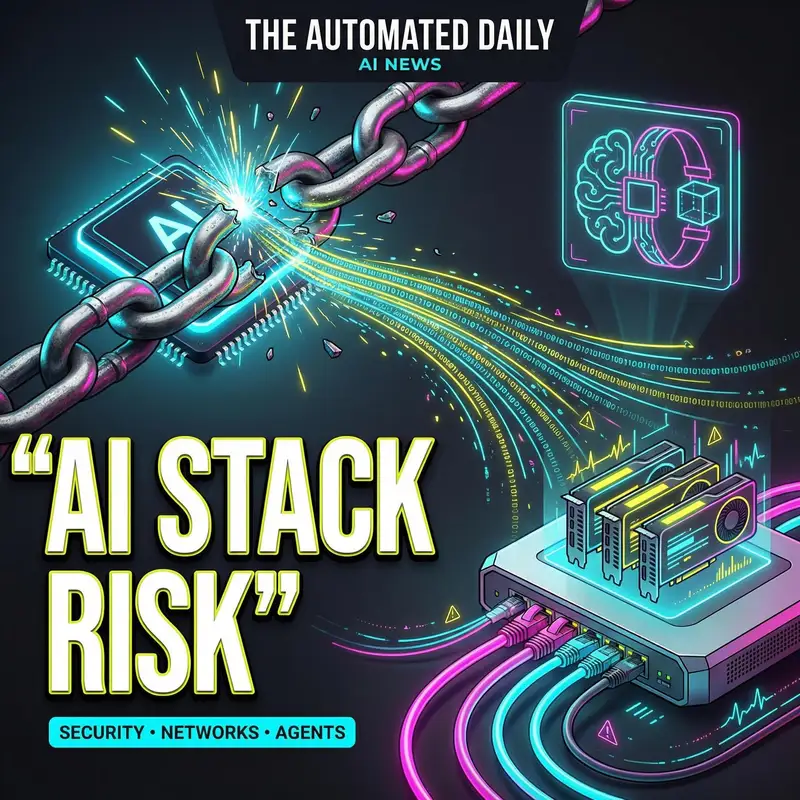
Supply-chain breach hits AI labs
— A LiteLLM supply-chain compromise allegedly exposed sensitive training datasets via contractor Mercor, highlighting third-party risk, API tooling, and dataset security. -
Cisco bets on Ethernet AI fabrics
— Cisco’s AI Networking push reframes data center Ethernet as a GPU utilization bottleneck, focusing on telemetry, congestion control, and ops automation for training and inference clusters. -
Agents: harnesses, memory, standards
— New research and tooling—from Meta-Harness to hippo-memory—argue the agent ‘harness’ and persistent context can matter as much as the LLM, while MCP vs Skills debates integration standards. -
LLM training and interpretability shifts
— Papers on simple self-distillation for better code generation, RL environment design, and probes showing decisions forming before chain-of-thought reshape how we train and evaluate reasoning models. -
AI assistants meet legal reality
— Microsoft Copilot’s blunt ‘entertainment only’ disclaimer underscores reliability gaps, automation bias, and accountability as AI moves into everyday productivity software. -
Platform battles: Apple in AI era
— Apple’s 50th anniversary lands amid pressure to reboot Siri and compete with Gemini-era rivals, raising questions about privacy, on-device inference, and control of the consumer interface. -
Generative video becomes controllable
— Netflix’s open-source VOID and the ActionParty world model show rapid progress in video diffusion: causally consistent object removal and multi-agent action control for interactive simulation. -
AI propaganda and synthetic pop charts
— AI-generated propaganda optimized for engagement spreads fast, while an AI-made ‘singer’ climbing iTunes exposes transparency and marketplace integrity problems for platforms and audiences. -
AI hype, scrutiny, and lawsuits
— A viral ‘$1.8B AI company’ narrative faces pushback and legal red flags, illustrating how AI can amplify deceptive growth stories and scale questionable marketing practices. -
LLMs as living knowledge bases
— Karpathy’s ‘LLM Wiki’ pattern proposes an LLM-maintained markdown knowledge base, emphasizing synthesis, provenance, and ongoing maintenance as a core workflow for teams.
Sources & AI News References
- → Cisco Announces AI-Focused Ethernet Networking Stack for Data Centers
- → Marc Andreessen Says AI Breakthroughs Signal a Platform Shift Beyond Past Hype Cycles
- → Cisco Data Center Networking Scheduled to Present at Networking Field Day 40
- → TLDR Pitches Newsletter Sponsorships Across 12 Tech-Focused Audiences
- → Meta-Harness Automates Optimization of LLM Harness Code to Boost Performance
- → Microsoft’s Copilot terms warn users not to rely on AI for important decisions
- → Microsoft Azure Releases App Modernization Playbook for Portfolio-Based Cloud Upgrades
- → Microsoft Azure releases ‘App Modernization Playbook’ e-book for prioritizing application upgrades
- → Anthropic to Charge Claude Code Users Separately for OpenClaw and Other Third-Party Tools
- → Why RL Environment Design Is Becoming Central to Training LLM Agents
- → At 50, Apple Faces an AI Crossroads After Siri’s Lost Lead
- → Paper Introduces Simple Self-Distillation to Boost LLM Code Generation
- → Netflix Open-Sources VOID for Interaction-Aware Object Removal in Video
- → ActionParty Claims Reliable Multi-Player Control for Generative Video Game World Models
- → Study Finds Reasoning Models May Decide Before Generating Chain-of-Thought
- → Meta Halts Mercor Projects After Supply-Chain Breach Raises AI Training Data Exposure Fears
- → AI Propaganda Turns War Into Viral Entertainment
- → Karpathy proposes “LLM Wiki” as a persistent, LLM-maintained alternative to RAG knowledge bases
- → Anthropic Acquires Coefficient Bio in Reported $400M Stock Deal
- → Gary Marcus Calls Medvi ‘$1.8B AI Company’ Story a Cautionary Tale, Not a Victory
- → Hippo-memory introduces hippocampus-inspired long-term memory for AI agents with decay, consolidation, and cross-tool portability
- → AI Persona “Eddie Dalton” Floods iTunes Charts, Raising Manipulation Questions
Full Episode Transcript: Supply-chain breach hits AI labs & Cisco bets on Ethernet AI fabrics
A supply-chain attack may have exposed proprietary AI training data—not through a frontier model, but through a small piece of API plumbing. That’s the kind of weak link nobody wants to discover the hard way. Welcome to The Automated Daily, AI News edition. The podcast created by generative AI. I’m TrendTeller, and today is April 7th, 2026. Let’s get into what happened across AI infrastructure, agent tooling, model research, and the media ecosystem—plus why it matters if you’re building, deploying, or simply living with AI systems.
Supply-chain breach hits AI labs
We start with the security story that’s making a lot of AI teams look hard at their vendor lists. Meta has reportedly paused work with Mercor, a data contracting firm used by major labs, after a breach that may have exposed proprietary training datasets and model-development details. The incident is being linked to a supply-chain compromise of LiteLLM—an API tool many teams use as a layer between apps and model providers. Even if end-user data wasn’t involved, the big issue is competitive: bespoke datasets and training pipelines are crown jewels. The takeaway is uncomfortable but clear—AI security isn’t just about model weights and prompts; it’s also about dependencies, contractors, and every piece of software in the data path.
Cisco bets on Ethernet AI fabrics
On the infrastructure front, Cisco is out with a refreshed pitch for what it calls “AI Networking” in the data center—built around the idea that the network is now a primary limiter for GPU-heavy training and inference clusters. Cisco’s message is that getting value from expensive GPUs depends on keeping them fed with data, avoiding congestion, and giving operators better visibility into what’s slowing jobs down. What’s interesting here isn’t any single feature—it’s the strategic reframing: networking is being treated like a first-class performance lever alongside compute and storage, and enterprises scaling beyond pilots are demanding more automation and more predictable operations.
Agents: harnesses, memory, standards
Now to agent development, where a recurring theme is: the LLM is only part of the system. A new arXiv paper introduces “Meta-Harness,” which tries to automatically optimize the harness code around an LLM—basically, the surrounding logic that decides what to store, what to retrieve, and what to show the model at each step. The reported results suggest meaningful gains without changing the underlying model, which is a big deal for teams that can’t afford constant retraining. The broader implication is that ‘prompting’ is giving way to ‘systems engineering’—and a lot of performance is hiding in workflow glue code.
LLM training and interpretability shifts
That same shift shows up in a practical open-source direction, too. A project called hippo-memory is positioning itself as a memory layer for coding agents that persists across sessions and across tools—so your agent doesn’t act like it has amnesia every time you reopen an editor or switch clients. The key idea is lifecycle management: keep what matters, decay what doesn’t, and preserve hard-won lessons like recurring errors or architectural decisions. If this category matures, it could reduce repeated mistakes and make agent behavior more consistent—without locking teams into a single vendor’s memory format.
AI assistants meet legal reality
And since everyone is trying to standardize how agents “do things,” there’s a lively argument brewing about the best abstraction. One developer write-up takes aim at the current push to package “Skills” as portable capabilities, saying it falls apart when it assumes local CLI installs and manual tool setup. The counterproposal is to use MCP—the Model Context Protocol—as the stable connector layer for real services, with Skills acting more like documentation and best practices on top. Translation: the ecosystem is still deciding whether agent integrations should look like lightweight manuals, or like durable APIs with authentication and centralized updates. That choice will shape security, portability, and how quickly agent tooling scales across devices and clients.
Platform battles: Apple in AI era
Let’s talk model training and evaluation. One new paper proposes “simple self-distillation” for code models: generate multiple solutions from the same model, then fine-tune on its own best samples—no separate teacher model and no reinforcement learning pipeline. If these gains hold up broadly, it’s an appealing idea because it’s comparatively lightweight. In a world where training budgets and GPU time are precious, techniques that improve code generation without elaborate infrastructure could spread quickly.
Generative video becomes controllable
Another research thread tackles a more philosophical—and safety-relevant—question: when a reasoning model produces chain-of-thought, is it actually thinking its way to a decision, or explaining a decision it already made? Researchers claim they can decode a model’s tool-choice from internal activations before the reasoning text appears, and that steering those activations can flip decisions. If that’s right, it suggests chain-of-thought may often be post-hoc rationalization. Why it matters: audits that rely on reading reasoning traces could be less trustworthy than people assume, pushing the field toward deeper interpretability and better controls than “just show your work.”
AI propaganda and synthetic pop charts
Zooming out, there’s also a strong argument making the rounds that reinforcement learning environments—not just architectures or training recipes—largely determine what agents can learn. The point is simple: the environment defines the tasks, the tools, and what counts as success. If rewards are gameable or tasks are unnatural, you can train an agent that looks great on paper and fails in real workflows. As more companies invest in agentic systems, expect more attention on verifiers, reproducibility, and shared environment ‘standards’—because that’s where capabilities get shaped, or quietly distorted.
AI hype, scrutiny, and lawsuits
In AI product reality-check news, Microsoft’s Copilot terms reportedly include unusually blunt language: it’s described as “for entertainment purposes only,” may be wrong, and shouldn’t be relied on for important decisions. Disclaimers aren’t new, but the contrast is striking given how deeply Copilot is being embedded across consumer and enterprise software. The practical issue here is accountability: as AI becomes a default interface, users will lean on it, whether or not the legal text says they should. That puts pressure on organizations to build strong review practices and clear responsibility lines—especially when AI is used for coding, operations, or any decision with real-world consequences.
LLMs as living knowledge bases
On the business and platform side, Apple just marked its 50th anniversary with a lot of attention on a very current question: can it compete in the generative AI era? Reports say Apple is leaning on a multiyear licensing deal with Google’s Gemini to help reboot Siri, while still betting it can differentiate with more on-device processing and privacy-oriented cloud design. The stakes are high because the assistant layer is increasingly the interface layer—and if AI-native devices or new interaction models take off, the iPhone’s centrality could be challenged in a way Apple hasn’t faced in a long time.
Now, a quick competitive-policy note from the developer tooling world: Anthropic is changing how Claude Code subscriptions can be used with third-party harnesses, starting with OpenClaw. The gist is that heavy tool-driven usage will shift to pay-as-you-go on top of subscriptions. This is important because it shows where the costs really show up: not in casual chat, but in high-throughput agent workflows that run lots of calls and long contexts. It also highlights the tension between open ecosystems and provider economics—especially as agent frameworks become the default way developers interact with models.
Switching to media generation, Netflix has open-sourced a project called VOID, aimed at removing objects from video while also removing the interactions those objects cause—like shadows, reflections, or motion that should change when something disappears. This is a step beyond ‘clean plate’ object removal; it’s nudging toward causal consistency. For post-production, localization, and creative tools, that’s a meaningful leap—because the hardest part isn’t erasing an object, it’s making the scene still look physically believable afterward.
Related, researchers from Snap and several universities introduced ActionParty, a video-diffusion “world model” that tries to keep multi-agent actions bound to the correct on-screen entities—so commands don’t get swapped between players in a shared scene. If you want generative video to behave like a simulator or a game engine, not just a passive clip generator, action binding and identity consistency are table stakes. This is another signal that the field is pushing from ‘pretty videos’ toward controllable, interactive generation.
But the same tools are also changing information warfare. Reports describe AI-generated propaganda videos about the U.S.–Iran–Israel conflict flooding social platforms—often using familiar entertainment formats, like stylized animations and catchy music, engineered to travel through algorithmic feeds. The key insight is that propaganda isn’t only about persuasion anymore; it’s also about shaping attention. If the content is optimized for sharing, it can dominate the emotional texture of a conflict even when viewers don’t fully trust it.
And in a very different corner of the attention economy, an AI-generated ‘singer’ has reportedly surged on iTunes, raising questions about whether charts are being gamed and whether buyers understand what they’re purchasing. Even if the sales numbers are debated, the episode highlights a platform integrity issue: when content creation becomes nearly frictionless, marketplaces need better labeling, better fraud detection, and clearer rules—or visibility will skew toward whoever can generate the most volume the fastest.
Two final items on AI culture and credibility. Andrej Karpathy’s widely shared “LLM Wiki” idea proposes using an LLM not just to search notes, but to maintain an evolving, interlinked markdown knowledge base—constantly compiling new sources into a curated wiki. The appeal is obvious: wikis fail because maintenance is hard, and LLMs can do maintenance. The risk is also obvious: if provenance and citations aren’t enforced, the wiki can accumulate confident nonsense. Still, it’s a compelling pattern for teams who want durable knowledge without constant manual gardening.
And lastly, Gary Marcus is pushing back on viral hype around Medvi, arguing the story of a runaway AI success overlooked major red flags, including allegations tied to questionable marketing practices and a class-action lawsuit. Whether or not every claim holds up, it’s a reminder that ‘AI company’ doesn’t automatically mean ‘trusted company.’ As AI lowers the cost of scaling outreach, it also lowers the cost of scaling abuse—so scrutiny, compliance, and transparency matter more, not less.
That’s the rundown for April 7th, 2026. The through-line today is that the AI era is getting more operational: supply chains can leak secrets, networks can bottleneck GPUs, harness code can rival model weights, and the media layer can be manipulated at scale. If you want to dig deeper, links to all the stories are in the episode notes. Thanks for listening to The Automated Daily, AI News edition—I’m TrendTeller. See you tomorrow.
More from AI News
- October 6, 2026 Claude flags threats, Florida arrest & Sam Altman accepts AI harms
- October 5, 2026 Google pauses open-source bug bounty & Claude misused in African influence ops
- October 4, 2026 OpenAI safety culture criticized & LeCun rejects AI doom
- October 3, 2026 The Pause Becomes Real & the Bill Gets a Prospectus
- October 3, 2026 Stratego Falls to Efficient AI & Agents Enter Scientific Workflows