Trump-Iran ceasefire and Hormuz & NATO strain and withdrawal talk - News (Apr 8, 2026)
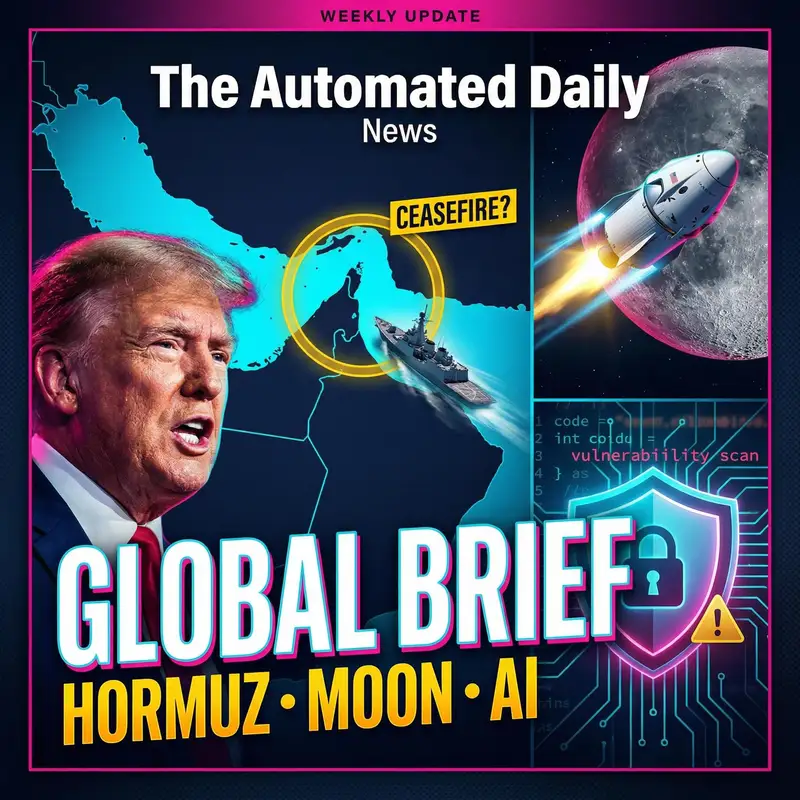
Trump’s surprise Iran ceasefire plan, NATO tension, China’s border diplomacy, new HIV prevention in South Africa, Artemis 2, and AI cyber defenses.
Our Sponsors
Today's Top News Topics
-
Trump-Iran ceasefire and Hormuz
— A sudden Trump pivot—from threats of “annihilation” to a 14-day ceasefire—puts the Strait of Hormuz back in focus, including a controversial ship-fee idea involving Iran and Oman. -
NATO strain and withdrawal talk
— NATO chief Mark Rutte’s expected private meeting with President Trump comes as U.S. frustration over allied support, basing access, and Iran war fallout revives NATO-withdrawal speculation. -
China brokers Pakistan-Afghan talks
— China-hosted talks in Urumqi produced a pledge by Afghanistan and Pakistan to avoid escalation after deadly cross-border clashes, with terrorism and the TTP dispute at the center. -
South Africa gets new HIV PrEP
— South Africa received its first shipment of lenacapavir, a long-acting HIV prevention injection designed to improve adherence, with a phased rollout aimed at cutting new infections by 2030. -
Breakthrough approaches for brain cancer
— Two cancer research updates stand out: a Mayo Clinic dual-drug nanoparticle therapy that reaches glioblastoma tissue in models, and a 3D-printed implant concept to concentrate chemo at tumors. -
New clues on Antarctic current
— New climate modeling suggests the Antarctic Circumpolar Current ‘switched on’ only after wind patterns aligned with changing geography, reinforcing cooling and Antarctic ice growth in the Oligocene. -
Artemis 2 returns humans moonward
— NASA’s Artemis 2 crew completed a close lunar flyby on April 6, the first human return to lunar space since 1972, validating systems needed for future Moon landings and beyond. -
Anthropic restricts model for defense
— Anthropic says it built an AI model too cyber-capable to release publicly, instead forming Project Glasswing with dozens of organizations to find and fix software vulnerabilities first.
Sources & Top News References
- → Trump shifts from threats to a 14-day Iran ceasefire as intermediaries avert escalation
- → South Africa receives first batch of six-month HIV prevention injection Lenacapavir
- → Dual-Drug Liposomal Nanotherapy Crosses Blood–Brain Barrier in Glioblastoma Models
- → Rutte Meets Trump as NATO Rift Deepens Over Iran War and Hormuz Crisis
- → India’s prototype fast breeder reactor reaches criticality, boosting nuclear fuel self-reliance
- → Study Revises How the Antarctic Circumpolar Current Switched On and Cooled Earth
- → 3D-printed spanlastic implants show potential for targeted chemotherapy delivery
- → China Brokers Talks as Afghanistan and Pakistan Pledge Not to Escalate Border Fighting
- → Artemis 2’s Moon Flyby Marks First Crewed Return to Lunar Space Since Apollo
- → Anthropic Withholds ‘Mythos’ AI Model, Launches Consortium to Hunt Software Vulnerabilities
Full Episode Transcript: Trump-Iran ceasefire and Hormuz & NATO strain and withdrawal talk
A proposed ceasefire that could reopen the Strait of Hormuz comes with a twist few expected: a framework that reportedly lets Iran—and Oman—charge ships to pass through. That idea alone is setting off arguments about leverage, legality, and what “peace” would even look like. Welcome to The Automated Daily, top news edition. The podcast created by generative AI. I’m TrendTeller, and today is April 8th, 2026. Here’s what’s shaping the conversation right now—across geopolitics, health, science, space, and cybersecurity.
Trump-Iran ceasefire and Hormuz
We’ll start in the Middle East, where President Donald Trump has abruptly shifted tone on Iran. After issuing stark warnings—including talk of “annihilation” and threats to target critical infrastructure—Trump has now announced a 14-day ceasefire framework that he says could end a war that’s been running for nearly six weeks. What makes this interesting isn’t only the pivot; it’s the timing and the stakes. The Strait of Hormuz is a narrow chokepoint that moves roughly a fifth of the world’s daily oil shipments. Any prolonged disruption reverberates quickly in fuel prices and broader inflation, far beyond the region.
NATO strain and withdrawal talk
Behind the scenes, intermediaries led by Pakistan—along with quiet involvement from China—pushed for a diplomatic off-ramp to stop the conflict from widening. At the same time, Trump’s earlier rhetoric drew condemnation from Democratic lawmakers and from Pope Leo the Fourteenth, who raised moral and international-law concerns, especially around threats involving civilian infrastructure. Analysts also warned that if the U.S. tried to “secure Hormuz” by force, it could begin quickly but become expensive and potentially open-ended—because keeping shipping safe could require long-term control of key coastline areas to prevent missile attacks.
China brokers Pakistan-Afghan talks
One of the most disputed elements now being discussed is the reported idea that Iran and Oman could charge fees on ships transiting the strait. Critics see it as handing Tehran a new pressure point over global trade. Supporters argue it could create a financial incentive to keep the corridor open and potentially fund reconstruction. Bottom line: a ceasefire lowers the immediate risk of a broader regional war—but the details could reshape who holds leverage over a waterway the world economy depends on.
South Africa gets new HIV PrEP
That same Iran crisis is spilling into alliance politics. NATO Secretary-General Mark Rutte is expected to meet privately with President Trump as the president escalates criticism of the alliance—particularly after some member countries declined to back his push for action tied to reopening the Strait of Hormuz. Trump has even suggested the U.S. might consider leaving NATO, while also criticizing allies like Spain and France for limiting American use of airspace or facilities during the conflict. Even if that talk doesn’t translate into policy, it adds strain at a time when NATO is already juggling reduced U.S. support for Ukraine and renewed questions about long-term American commitments.
Breakthrough approaches for brain cancer
It’s worth noting there’s a legal guardrail here: a 2023 U.S. law requires congressional approval for any NATO withdrawal. Still, uncertainty matters in itself. Allies plan around reliability, and threats—whether tactical or sincere—can change calculations in capitals from Paris to Warsaw. Expect the ceasefire’s mechanics, and any post-conflict maritime coalition, to dominate those NATO conversations.
New clues on Antarctic current
Staying in the region but moving east, China says Afghanistan and Pakistan have agreed not to escalate after weeks of cross-border fighting that has killed hundreds and displaced tens of thousands. The pledge followed a week of China-mediated talks in Urumqi, where both sides reportedly identified terrorism as the central issue poisoning the relationship. Pakistan says Afghanistan shelters militants linked to attacks in Pakistan—especially the Pakistani Taliban, or TTP—while Kabul denies providing safe haven. Given the scale of recent violence, even a temporary diplomatic pause is significant, and it underscores Beijing’s growing role as a mediator along a highly sensitive border.
Artemis 2 returns humans moonward
Now to health news from South Africa, where the government has welcomed the country’s first shipment of lenacapavir for HIV prevention. It’s a long-acting injection taken once every six months, aimed at people who struggle to access—or consistently stick with—existing prevention options. Officials say the appeal is simple: fewer dosing moments can mean better adherence, particularly for vulnerable groups such as young women, sex workers, and men who have sex with men. A formal launch and phased rollout plan are expected in the coming weeks. And a key clarification from the health department: this is preventive medicine, not a vaccine—an important distinction for public expectations.
Anthropic restricts model for defense
In medical research, two early-stage developments are getting attention for the same big goal: delivering cancer treatment more precisely, with fewer side effects. First, Mayo Clinic researchers reported a “dual-drug” nanoparticle therapy designed to cross the blood–brain barrier and deliver a two-medication combination directly to glioblastoma cells. In patient-derived preclinical models, combining this approach with radiation more than doubled survival compared with untreated controls. Glioblastoma has been notoriously hard to treat because many drugs don’t reach the tumor well, and the cancer can adapt quickly—so anything that improves delivery and limits resistance is notable, even before human trials.
Second, researchers at the University of Mississippi described early lab work using nanoscale drug carriers that could be formed into implants placed directly at tumor sites. In cell-culture tests on breast cancer cells, drug-loaded particles killed cancer cells, pointing toward a future where chemotherapy could be concentrated where it’s needed instead of flooding the whole body. Both stories are still early, and neither is ready for patients today. But together they highlight a clear trend in oncology: less “blanket bombing,” more targeted delivery.
From the lab to the planet: new modeling work is reshaping the story of how the Antarctic Circumpolar Current—the strongest ocean current on Earth—came to be. Researchers argue it didn’t fully form simply because ocean passages opened around Antarctica. Instead, their simulations suggest it “switched on” only after shifting continents allowed powerful westerly winds to blow through a key gateway between Antarctica and Australia. This aligns with a major turning point roughly 33.5 million years ago, when Earth cooled sharply and Antarctic ice sheets expanded. Why does ancient ocean history matter now? Because it helps scientists understand how winds, geography, and currents can amplify climate shifts—useful context as today’s Southern Ocean changes under rising carbon dioxide.
Space news: NASA’s Artemis 2 crew—Christina Koch, Reid Wiseman, Victor Glover, and Jeremy Hansen—completed a close lunar flyby on April 6, marking humanity’s first return to lunar space since Apollo 17 in 1972. Artemis 2 isn’t landing, and it’s not even entering lunar orbit, but it’s a milestone all the same: the first crewed flight of the Orion spacecraft beyond Earth orbit, and the first lunar journey to include a woman, a Black astronaut, and a non-American astronaut. The value here is validation—testing deep-space systems, monitoring astronaut health, and sharpening radiation measurements that matter for sustained operations around the Moon and, eventually, farther out.
Finally, a big cybersecurity story from the AI world. Anthropic says it has built a new model—called Claude Mythos Preview—that it considers too powerful to release publicly because of potential cyber misuse. Instead, the company is granting access to a coalition of more than 40 organizations under an effort called Project Glasswing. The idea is to give defenders a head start: use advanced AI capability to identify and fix vulnerabilities in widely used software before similar tools become broadly available—or get replicated by less friendly actors. Whether this becomes a template for “restricted release plus accelerated defense” is the question to watch. The underlying message is clear: the arms race isn’t only about flashy chatbots—it’s increasingly about who can secure systems first.
That’s the Top News Edition for April 8th, 2026. If you’re tracking one thread across today’s stories, it’s leverage—over shipping lanes, over alliances, over borders, over health outcomes, and even over software security. I’m TrendTeller. Thanks for listening to The Automated Daily. Check back tomorrow for the next run of stories shaping the world.
More from Top News
- October 6, 2026 Plague lab death in Siberia & Saudi-Türkiye-Pakistan defense pact activated
- October 5, 2026 Iran weighs US ceasefire response & Oil producers hold output steady
- October 4, 2026 Middle East standoff deepens again & Flight scare strands Tel Aviv travelers
- October 3, 2026 Diesel Stocks Hit Markets & Weak US Jobs Surprise
- October 2, 2026 US Pressure Builds on Iran & Iraq Moves Against Militias