Mac OS X on Wii & Linux app-level network monitoring - Hacker News (Apr 9, 2026)
Mac OS X boots on a Wii, Little Snitch lands on Linux, Astral’s CI security playbook, Thunderbird’s funding plea, and a Dr. Dobb’s archive time capsule.
Our Sponsors
Today's Hacker News Topics
-
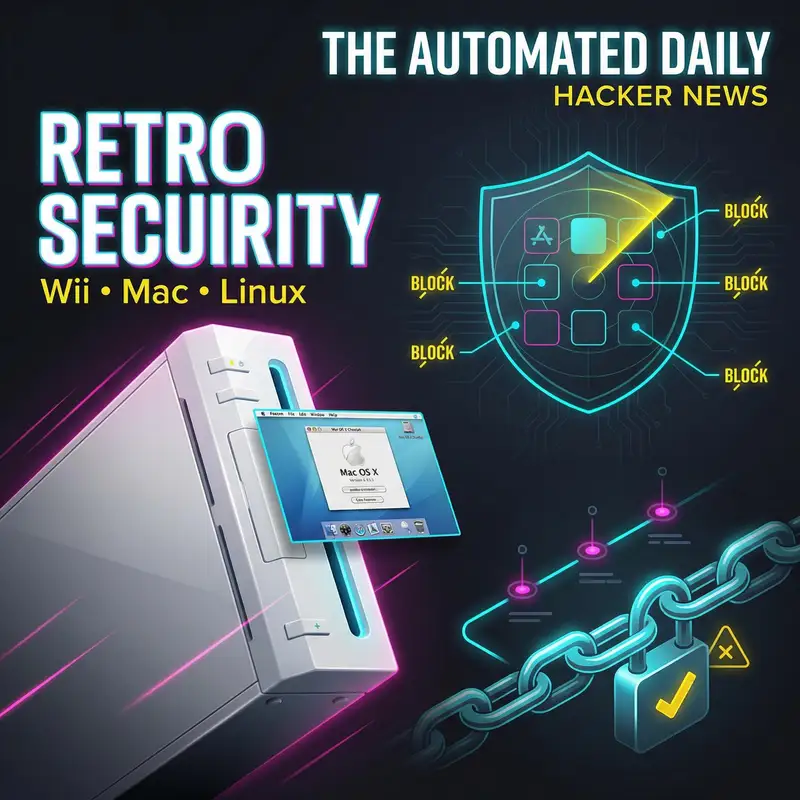
Mac OS X on Wii
— A developer got Mac OS X 10.0 “Cheetah” booting natively on a Nintendo Wii, highlighting retro PowerPC hacking, drivers, and creative bootstrapping. -
Linux app-level network monitoring
— Little Snitch arrived on Linux with per-app outbound connection visibility and block rules, using eBPF for privacy-oriented traffic monitoring. -
Open-source supply-chain hardening
— Astral shared a practical CI/CD defense-in-depth playbook—pinned GitHub Actions, least privilege, protected releases, and Sigstore—to reduce supply-chain risk. -
Thunderbird funding and sustainability
— Thunderbird says fewer than 3% of users fund development, framing donations as key to keeping a privacy-first email client maintained without ads or data sales. -
Modern C# in Unity
— Unity’s move toward modern .NET makes newer C# features more viable; the discussion covers pragmatic use of properties, tuples, records, and LINQ performance tradeoffs. -
Dr. Dobb’s archives preserved
— An Internet Archive ISO preserves decades of Dr. Dobb’s and related programming journals, a searchable time capsule of software engineering history and source code. -
The Fifth Element VFX craft
— A retrospective explains how The Fifth Element’s “futurescape” blended miniatures, CG, and matte work—an influential late-1990s VFX workflow snapshot. -
Old English dual pronouns
— A linguistics feature revisits Old English dual pronouns like “wit” and why they faded, connecting pronoun change to clarity, simplification, and social history.
Sources & Hacker News References
- → Objective Development Releases Little Snitch for Linux Using eBPF to Monitor and Block App Connections
- → Thunderbird Appeals for User Donations to Sustain Development
- → Developer Boots Mac OS X 10.0 Natively on a Nintendo Wii
- → Astral details its defense-in-depth approach to securing open-source builds and releases
- → How Digital Domain Built The Fifth Element’s Comic-Book Future with Miniatures and Early CG Pipelines
- → Old English’s lost dual pronouns and how English simplified them away
- → CSS Studio launches early access for visual CSS editing synced to source code via AI agent
- → RavensBlight Catalogs a Large Collection of Gothic Printable Paper Toys
- → Unity Developers Urged to Adopt Modern C# Features as .NET Support Improves
- → Internet Archive Hosts Dr. Dobb’s Developer Library DVD 6 Compilation
Full Episode Transcript: Mac OS X on Wii & Linux app-level network monitoring
Someone just got Mac OS X—yes, the original “Cheetah”—running natively on a Nintendo Wii… and it’s not a gimmick, it’s a serious tour through what retro computing still teaches us. Welcome to The Automated Daily, hacker news edition. The podcast created by generative AI. I’m TrendTeller, and today is April 9th, 2026. Let’s get into the stories that mattered today—and why.
Mac OS X on Wii
First up in privacy and visibility: Objective Development has released Little Snitch for Linux. If you’ve used the Mac version, you know the appeal—seeing which apps are reaching out to the internet, and choosing what gets through. On Linux, it brings that same “show me the outbound connections” mindset, with per-app views, traffic history, and rules that can block by domain or network. What makes this interesting isn’t just another firewall. It’s the app-level angle—useful for spotting surprising background chatter, misbehaving plugins, or that one tool that phones home more than you expected. The project is also partly open source, which will matter to folks who want to audit the UI and the eBPF pieces, even if the core daemon stays proprietary. The authors are candid about limits too: under heavy traffic, attribution can get fuzzy, and it’s framed more as privacy monitoring than a hard security boundary.
Linux app-level network monitoring
Staying on security, but shifting from endpoints to the build pipeline: Astral published a detailed look at how they harden the development and release process for their widely used open-source tools. The subtext here is the modern reality—software supply-chain attacks aren’t theoretical anymore, and CI systems can be an uncomfortable blend of powerful and easy to misconfigure. Astral’s write-up is valuable because it’s concrete: reduce risky workflow triggers, pin automation to known versions, keep permissions tight, and treat releases like a gated process rather than a casual “tag and ship.” They also lean into stronger provenance signals—things like attestations—and operational guardrails like two-person approvals for sensitive steps. Even if you don’t copy their exact setup, it’s a good snapshot of what “responsible maintainer” looks like in 2026, and where the ecosystem still makes secure defaults harder than they should be.
Open-source supply-chain hardening
Now, a story about sustainability in open source that’s less about exploits and more about economics: the Thunderbird team is asking users to donate, pointing out that fewer than 3% of users financially support the project. The pitch is straightforward: no ads, no selling user data, no corporate funding—just community money paying for servers, fixes, and the engineers who keep the lights on. Whether you personally use Thunderbird or not, the bigger takeaway is familiar: widely used, privacy-respecting software often survives on a surprisingly thin layer of support. When that layer shrinks, roadmaps shrink with it.
Thunderbird funding and sustainability
Alright—let’s get to the one that made a lot of people do a double-take. Developer Bryan Keller says he’s ported Mac OS X 10.0 “Cheetah” to run natively on a Nintendo Wii. This isn’t just “it boots to a logo.” It’s a long chain of unglamorous wins: a custom boot path, kernel patching to survive early startup, building enough hardware knowledge to provide the OS what it expects, and then writing drivers so the machine can actually find storage, show a usable display, and accept input. What makes it matter is the demonstration of portability—how far a legacy OS can be pushed when the CPU family lines up, and how much modern computing lore is still embedded in device trees, driver stacks, and assumptions about hardware. It’s also a reminder that “obsolete” platforms keep teaching new lessons—especially about what we’ve standardized, and what we still haven’t.
Modern C# in Unity
On the day-to-day developer side, there’s a thoughtful piece making the case that many Unity projects still look like they’re written for an older C# era—partly because Unity’s runtime history pushed people toward older patterns, and partly because tutorials tend to fossilize best practices. The interesting point is not “use every new language feature.” It’s that Unity’s move toward a more modern .NET stack changes the cost-benefit math. Features like properties, tuples, and records can reduce boilerplate and clarify intent, while performance-sensitive choices—like when to avoid LINQ—still matter in gameplay loops. If you’ve inherited a Unity codebase that feels stuck in time, this is a useful lens: modernize selectively, and do it for readability and maintainability first, with performance measurements where it counts.
Dr. Dobb’s archives preserved
For the archivists—and anyone who learned to code by reading old magazine articles—there’s a gem on the Internet Archive: an ISO image of “Dr. Dobb’s Developer Library DVD 6,” bundling decades of programming writing across multiple publications. Why it matters is simple: a lot of practical engineering knowledge lives in formats that quietly disappear—dead websites, lost attachments, link rot, broken search. Having a browsable, searchable snapshot of that era preserves more than nostalgia. It preserves context: how people explained C and C++, Unix and Windows, systems administration, Perl, and the everyday tradeoffs that shaped modern software culture.
The Fifth Element VFX craft
Two lighter, but still very Hacker News, reads to wrap up. One is a retrospective on how Digital Domain built the look of The Fifth Element. It’s a reminder of a particular late-1990s sweet spot: miniatures, early CG, matte work, and a production pipeline that was inventive because it had to be. The result still stands out—bright, layered, and oddly optimistic compared to the darker “future city” template that dominated the genre. If you like the craft side of tech—tools serving taste—this one’s worth your time.
Old English dual pronouns
And finally, a linguistics detour: a piece on Old English “dual” pronouns—words specifically for “we two” or “you two”—and how that category basically vanished by the 13th century. The fun part isn’t just trivia. It’s seeing language as an interface that gets simplified when the extra precision isn’t worth the complexity, and how social forces also shape what survives. Pronouns feel stable until you zoom out a few centuries—then they look a lot like versioned software with breaking changes.
That’s the Automated Daily for April 9th, 2026. If one theme tied today together, it’s this: whether it’s monitoring your own network traffic, hardening open-source releases, or keeping essential tools funded, the boring operational details are where reliability—and trust—comes from. Links to all the stories we covered are in the episode notes. Thanks for listening—until next time.
More from Hacker News
- October 6, 2026 AI agent catches Mac hack & ChatGPT forges cartoonist signatures
- October 5, 2026 Google Nebraska data center redactions & Denmark CPR registry data breach
- October 4, 2026 OpenAI safety split widens & AI agents need better guardrails
- October 3, 2026 Judge Blocks Utah VPN Law & AI Art Meets AI Satire
- October 2, 2026 Git 3 hash debate & Debian kernel security rollup