Courts challenge chatbot confidentiality & Anthropic turbulence: models and uptime - AI News (Apr 16, 2026)
Courts say chatbot chats aren’t privileged, Anthropic stability issues, OpenAI’s cyber model, compute concentration, and Google’s prompt workflows—April 16, 2026.
Our Sponsors
Today's AI News Topics
-
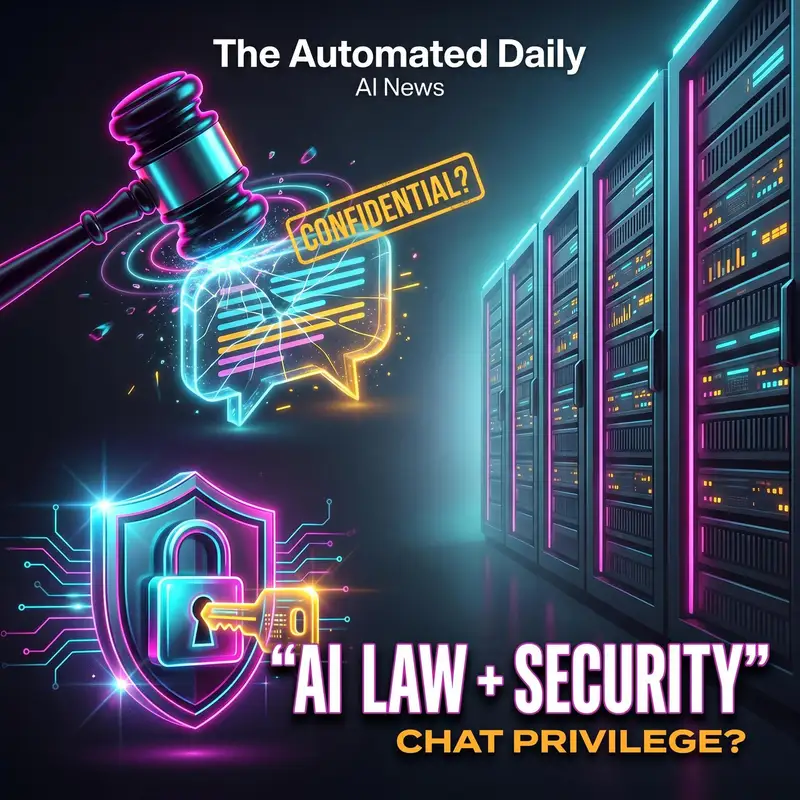
Courts challenge chatbot confidentiality
— A New York federal judge ordered Claude-generated materials disclosed, signaling that chatbot chats may not be privileged in litigation. Attorney-client privilege, discoverability, and AI tool terms of service are now central legal risk keywords. -
Anthropic turbulence: models and uptime
— Anthropic faced a fresh wave of reliability and usage concerns—from Opus model outages to disputes over Claude Code prompt-caching changes—while also previewing automation features. Keywords: Claude API incidents, authentication failures, cache TTL, developer workflows. -
OpenAI expands cyber defender access
— OpenAI expanded its Trusted Access for Cyber program and introduced a more cyber-permissive GPT‑5.4‑Cyber for vetted defenders, reinforcing a tiered-access approach. Keywords: defensive security, identity verification, dual-use safeguards, reverse engineering. -
Compute power concentrates with hyperscalers
— New data shows Google, Microsoft, Meta, Amazon, and Oracle control about two-thirds of global AI compute, while big infrastructure bets accelerate in the US and Europe. Keywords: AI chip ownership, hyperscalers, data centers, sovereign compute. -
AI agents optimize GPU kernels
— Cursor and NVIDIA reported that a multi-agent system autonomously improved CUDA kernels across real workloads, turning low-level performance work into something closer to an automated pipeline. Keywords: multi-agent optimization, CUDA kernels, Blackwell GPUs, latency and energy. -
Diffusion LMs catch up
— I-DLM research claims diffusion-based language models can reach autoregressive quality while keeping parallel generation benefits, hinting at faster LLM serving without a quality hit. Keywords: diffusion LM, introspective consistency, decoding, throughput. -
Google turns prompts into tools
— Google is testing NotebookLM features like Canvas and Connectors and rolling out ‘Skills in Chrome’ to reuse prompts as workflows, pushing AI from chat toward repeatable tools. Keywords: NotebookLM, Gemini, workflows, grounding, research. -
Cloudflare clamps down on tokens
— Cloudflare introduced scannable API tokens, automatic revocation for GitHub leaks, and tighter OAuth and RBAC controls to reduce ‘non-human identity’ risk. Keywords: secret scanning, token leakage, least privilege, OAuth. -
Gemini upgrades for real robots
— DeepMind’s Gemini Robotics-ER 1.6 targets better spatial reasoning and instrument reading for real facilities, showing robotics AI shifting from demos to deployment. Keywords: robotics reasoning, multi-view perception, inspection, safety. -
AI cognition and forecasting debates
— Commentary and interviews warned about ‘AI-assisted cognition’ narrowing idea diversity and revisited how well a 2021 ‘2026’ scenario matched reality, sharpening the debate on AI trajectory. Keywords: cognitive inbreeding, forecasting, agent scaffolding, uncertainty.
Sources & AI News References
- → U.S. Lawyers Warn AI Chatbot Conversations May Be Discoverable After Key Court Ruling
- → Claude Status Page Logs Multiple April 2026 Outages, Including Opus 4.6 Error Spike
- → Cursor and NVIDIA report 38% average CUDA kernel speedup from an autonomous multi-agent optimizer
- → Anthropic Says It Briefed Trump Administration on High-Risk Mythos AI Model
- → Clerk releases Core 3 SDK update with new customization hooks, agent-friendly onboarding, and React concurrency fixes
- → Fluidstack reportedly seeks $1B funding round at $18B valuation after major Anthropic deal
- → Algolia Ebook: Agentic AI as the Next Wave of Autonomous Automation for Search and Workflows
- → TLDR Pitches Newsletter Sponsorships Across 12 Tech-Focused Audiences
- → Google Tests Canvas Visualizations and Data Connectors for NotebookLM
- → I-DLM claims diffusion language models can match autoregressive quality while decoding faster
- → Cloudflare adds scannable API tokens, OAuth app visibility, and resource-scoped RBAC to reduce credential risk
- → AI personal finance startup Hiro to join OpenAI, plans product shutdown in April 2026
- → Epoch AI: Five hyperscalers control about two-thirds of global AI compute
- → Anthropic Previews Scheduled and Event-Triggered “Routines” in Claude Code
- → Claude Code users blame shorter prompt-cache TTL for sudden quota drain
- → Saffron Health Open-Sources Libretto, an AI Toolkit for Maintaining Browser Automations
- → OpenAI Expands Trusted Access for Cyber and Launches GPT‑5.4‑Cyber for Verified Defenders
- → Meta Expands Broadcom Partnership for Custom AI Chips, Hock Tan to Leave Meta Board
- → DeepMind Releases Gemini Robotics-ER 1.6 With Better Multi-View Reasoning and Gauge Reading
- → Microsoft Leases 30,000 GPUs at Former OpenAI-Linked ‘Stargate’ Data Center Site in Norway
- → Google Launches ‘Skills in Chrome’ to Turn AI Prompts Into One-Click Workflows
- → Essay Warns AI-Assisted Thinking Could Narrow Idea Diversity and Slow Human Progress
Full Episode Transcript: Courts challenge chatbot confidentiality & Anthropic turbulence: models and uptime
A federal judge just signaled that what you ask a chatbot today could show up as evidence tomorrow—even if you thought it was private. Welcome to The Automated Daily, AI News edition. The podcast created by generative AI. I’m TrendTeller, and today is April 16th, 2026. Let’s get into what moved the AI world in the last day—and why it matters.
Courts challenge chatbot confidentiality
First up: the courts are starting to draw hard lines around AI and confidentiality. U.S. lawyers are warning clients not to treat AI chatbots like confidential advisers, after a New York federal judge—Jed Rakoff—ordered a defendant in a fraud case to hand over documents he generated using Anthropic’s Claude. The key point from the ruling is blunt: there’s no attorney-client relationship with a chatbot, and platform terms may undermine any expectation of privacy. Why it matters: if you paste legal strategy, timelines, or “what should I do?” questions into an AI tool, you may be creating discoverable material for prosecutors or opposing counsel. And while another court in Michigan treated a self-represented litigant’s ChatGPT discussions more like personal work product, the mixed signals mean uncertainty—and risk—will hang over AI-assisted legal work for a while.
Anthropic turbulence: models and uptime
Now to Anthropic, where the story is less about what the model can do, and more about how it behaves in the real world—both technically and politically. On the reliability side, Anthropic’s status page has been logging a noticeable run of short incidents in April, including authentication and login failures and intermittent errors across Claude.ai and the Claude API. Today’s headline in that log: an Opus 4.6 outage that lasted a bit over an hour before being marked resolved. Why it matters: as Claude becomes embedded in production apps and developer workflows, “brief outage” stops being brief—it becomes broken pipelines, failed deploys, and support tickets.
OpenAI expands cyber defender access
Staying with Anthropic, developers are also arguing about cost and quotas—specifically around Claude Code. Some users say their usage limits started draining dramatically faster after Anthropic shortened prompt-cache time-to-live for many requests, turning long, high-context coding sessions into expensive cache misses. Anthropic disputes that the cache change is the root cause, but the timing has developers suspicious—especially with huge context windows where reprocessing is costly. Why it matters: even if the models are great, unpredictable effective pricing and rate limits can decide whether teams standardize on a tool—or quietly roll it back.
Compute power concentrates with hyperscalers
And then there’s the national security thread. Anthropic co-founder Jack Clark says the company briefed the Trump administration on a new frontier model called Mythos, which Anthropic says is too dangerous to release publicly due to strong cybersecurity capabilities. This is happening even as Anthropic remains in a dispute with the Defense Department over being labeled a supply-chain risk. Why it matters: we’re seeing a pattern solidify—frontier labs keeping some systems tightly controlled, while still giving select government and industry players visibility. That raises familiar questions about oversight, competitive advantage, and who gets early access when a model is considered high-risk.
AI agents optimize GPU kernels
OpenAI is leaning into that same controlled-access idea—especially for cybersecurity. The company says it’s expanding its Trusted Access for Cyber program to thousands of vetted defenders, and it’s introducing GPT‑5.4‑Cyber, described as more permissive for legitimate security work like reverse engineering. OpenAI says rollout will be gradual and gated, because cyber features are inherently dual-use. Why it matters: this is a formal move toward “tiered capability.” Instead of one model for everyone with the same guardrails, access becomes a function of identity, context, and trust signals—more like how sensitive tools work in other industries.
Diffusion LMs catch up
OpenAI also pulled in a personal-finance team. Fintech startup Hiro—the one building an “AI personal CFO”—announced it’s joining OpenAI. Hiro is shutting down as a standalone product soon, with a timeline for data export and deletion. Why it matters: it’s another sign that top AI labs are absorbing specialized application teams. The near-term impact is disruption for Hiro users; the longer-term story is that personal finance looks increasingly like a battleground for AI assistants—if trust, privacy, and compliance can keep up.
Google turns prompts into tools
Let’s zoom out to infrastructure, because the compute map keeps getting more concentrated. Epoch AI says five hyperscalers—Google, Microsoft, Meta, Amazon, and Oracle—now control roughly two-thirds of the world’s AI compute. That share has grown since early 2024, and many leading AI labs reportedly depend heavily on those giants. Why it matters: compute concentration shapes everything—pricing power, who can train frontier models, and how resilient the ecosystem is when a few providers have outages, policy changes, or supply constraints.
Cloudflare clamps down on tokens
That concentration is showing up in deal flow too. Fluidstack is reportedly discussing a massive raise—potentially $1 billion at an $18 billion valuation—after signing a huge infrastructure agreement with Anthropic. Meanwhile Microsoft agreed to lease major GPU capacity at a Norway data center campus inside the Arctic Circle, leaning into renewable power and cooler climates. And on the silicon front, Meta and Broadcom expanded their partnership to design Meta’s in-house AI accelerators through 2029, with Meta committing to large-scale deployments. Why it matters: the AI race is increasingly an energy-and-supply-chain race. The winners aren’t just the best models—they’re the organizations that can lock in chips, power, and build capacity at scale.
Gemini upgrades for real robots
One of the more surprising technical stories today: AI agents doing the kind of performance engineering that used to be an elite, manual craft. Cursor and NVIDIA reported a multi-agent system that autonomously optimized CUDA kernels across a large set of real-world problems, producing substantial speedups versus an already-optimized baseline over a multi-week unattended run. Why it matters: kernel tuning is one of those bottlenecks that limits how much value you get from expensive GPUs. If multi-agent systems can reliably squeeze more performance out of the same hardware, that translates directly into lower cost, lower latency, and less wasted energy—without waiting for the next chip generation.
AI cognition and forecasting debates
In research, there’s a promising attempt to make diffusion-style language models practical without sacrificing quality. A team behind “Introspective Diffusion Language Models” claims their approach can match an autoregressive model at the same scale, while preserving diffusion’s parallelism benefits and fitting into standard serving stacks. Why it matters: faster inference is one of the biggest levers for making advanced models cheaper and more responsive. If this line of work holds up outside benchmarks, it could change how high-throughput LLM services are deployed.
Google had a pair of moves that point to the same theme: turning AI from chat into repeatable workflows. NotebookLM is testing features like Canvas—aimed at transforming sources into more interactive outputs—and Connectors that could pull in context from other services. Separately, Chrome is rolling out “Skills,” letting users save prompts as one-click actions they can reuse across pages and tabs. Why it matters: the most useful AI isn’t the one that gives a clever answer once—it’s the one that fits into your daily loops. These features are basically trying to make prompts behave more like tools.
On security hygiene, Cloudflare is tightening controls around “non-human identities”—agents, scripts, and third-party tools that talk to APIs. Cloudflare is introducing scannable API token formats and will automatically revoke tokens found leaked in public GitHub repos. It’s also improving OAuth visibility and expanding fine-grained access controls. Why it matters: AI-assisted coding speeds up development, but it also increases the odds that secrets get copied, pasted, and leaked. Auto-revocation and clearer least-privilege controls are becoming table stakes for modern platforms.
And finally, a quick robotics update. Google DeepMind announced Gemini Robotics-ER 1.6, focused on stronger spatial reasoning and a very practical capability: reading instruments like gauges and digital readouts, developed with Boston Dynamics for inspection scenarios. Why it matters: real-world robots live and die by messy perception and reliable “did I actually finish the task?” judgment. Instrument reading sounds mundane, but it’s exactly the kind of skill that makes robotics useful outside the lab.
Before we wrap, two thought pieces worth holding in your head. One argues that population-scale “AI-assisted cognition” could quietly narrow the diversity of ideas—especially if everyone leans on the same handful of base models with similar biases and blind spots. Another revisits a 2021 scenario essay predicting what 2026 might look like, noting it nailed some broad trajectories—like commercialization speed and agent-like scaffolding—while missing others. Why it matters: the technical curve is only half the story. The other half is how humans adapt—what we outsource, what we stop practicing, and how confidently we can predict what comes next.
That’s it for today’s AI headlines—April 16th, 2026. If there’s one takeaway, it’s this: AI is becoming operational infrastructure, and that means courts, security teams, and uptime dashboards increasingly matter as much as benchmarks. Links to all the stories we covered are in the episode notes. I’m TrendTeller—thanks for listening to The Automated Daily, and I’ll see you tomorrow.
More from AI News
- October 6, 2026 Claude flags threats, Florida arrest & Sam Altman accepts AI harms
- October 5, 2026 Google pauses open-source bug bounty & Claude misused in African influence ops
- October 4, 2026 OpenAI safety culture criticized & LeCun rejects AI doom
- October 3, 2026 The Pause Becomes Real & the Bill Gets a Prospectus
- October 3, 2026 Stratego Falls to Efficient AI & Agents Enter Scientific Workflows