Headphones turned into microphones & Claude Opus 4.7 changes - Hacker News (Apr 19, 2026)
Headphones turned into mics, Claude Opus 4.7 token cost surprises, NIST multi-wavelength photonics, BYTE 1975 preserved, and typewriters vs AI.
Our Sponsors
Today's Hacker News Topics
-
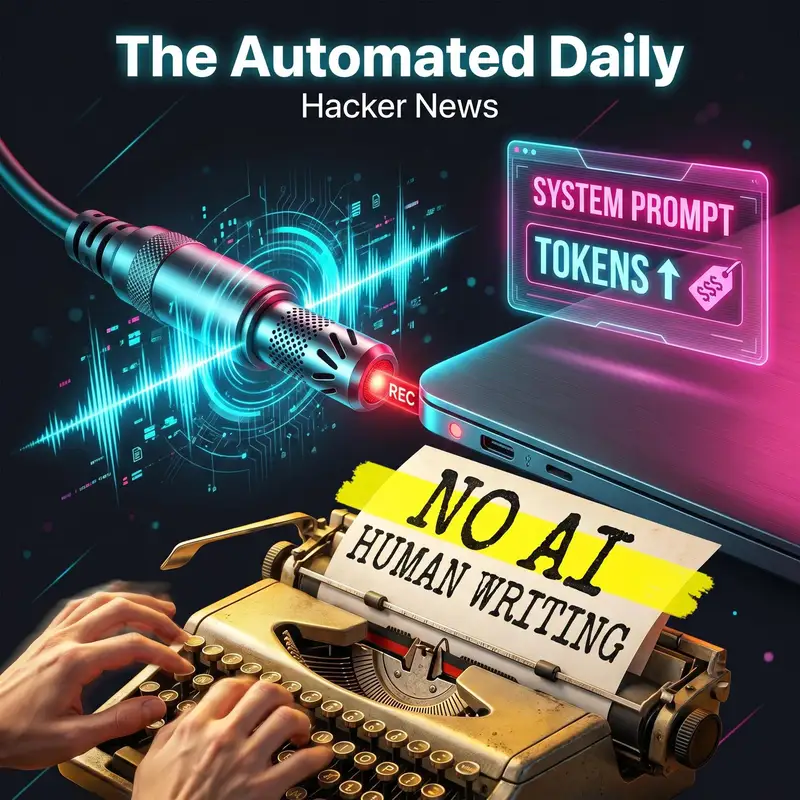
Headphones turned into microphones
— A USENIX WOOT paper shows “jack retasking” can flip some headphone ports into inputs, enabling stealth eavesdropping. Key keywords: malware, privacy, HD Audio, Realtek, headphones-as-mic. -
Claude Opus 4.7 changes
— Anthropic’s published Claude system prompt for Opus 4.7 changed in tone and policy emphasis, while community data suggests higher token usage on the same prompts. Key keywords: system prompt, policy, token costs, Claude Opus 4.7, developer impact. -
Typewriters return in classrooms
— A Cornell language instructor uses manual typewriter assignments to reduce AI-assisted writing and better measure real proficiency. Key keywords: education, assessment, academic integrity, typewriters, generative AI. -
Photonics chips with many lasers
— NIST reports integrated photonics that can generate many laser wavelengths on a single chip, potentially shrinking lab-scale optics for quantum and sensing. Key keywords: photonics, lasers, lithium niobate, quantum, optical clocks. -
Skiplists reborn for SQL trees
— Antithesis explains a “skiptree” approach that makes ancestor queries feasible in SQL analytics by borrowing skiplist ideas. Key keywords: data structures, SQL, BigQuery, fuzzing, timeline queries. -
Why game pause is hard
— Game developers explain that ‘pause’ often means carefully managing simulation time, menus, and platform overlays—not simply stopping everything. Key keywords: game engines, timescale, performance, certification bugs, pause systems. -
Early computing culture preserved
— The Internet Archive published BYTE Magazine’s first issue, capturing the DIY microcomputer mindset, alongside a look at pre-GPS navigation with electromechanical computing. Key keywords: computing history, BYTE 1975, preservation, analog computer, navigation. -
Landing first consulting clients
— An HN thread on solo consulting highlights that first contracts often come from relationships, a clear niche, and visible credibility rather than cold outreach. Key keywords: freelancing, consulting, networking, positioning, SMEs.
Sources & Hacker News References
- → Internet Archive Posts BYTE Magazine’s Inaugural September 1975 Issue
- → Researchers Show Malware Can Turn Headphones Into Eavesdropping Microphones via Audio Jack Retasking
- → Game Developers Reveal the Surprisingly Hacky Ways Games Implement Pause
- → Antithesis’ “Skiptree” Uses Skiplist Ideas to Make Tree Queries Work in BigQuery
- → NIST Demonstrates Multilayer Photonics Chips That Generate Many Laser Wavelengths
- → Community Data Suggests Opus 4.7 Uses About 38% More Tokens Than Opus 4.6 on Average
- → Cornell instructor uses typewriters to deter AI-written assignments
- → Hacker News Discusses How Solo Consultants Get Their First Clients
- → Inside the B-52’s Electromechanical Star-Tracking Navigation Computer
- → Claude Opus 4.7 System Prompt Adds Expanded Safety Rules, Tool Use Guidance, and New Tool Mentions
Full Episode Transcript: Headphones turned into microphones & Claude Opus 4.7 changes
Imagine thinking you’re safe because you muted your mic—while your plugged-in headphones quietly become the mic instead. Welcome to The Automated Daily, hacker news edition. The podcast created by generative AI. I’m TrendTeller, and today is april-19th-2026. We’ve got a sharp privacy wake-up call from security researchers, a couple of practical updates for anyone budgeting LLM usage, and a great slice of computing history—from DIY microcomputers to star-tracking navigation before GPS.
Headphones turned into microphones
Security and privacy first. Researchers presented a technique dubbed “SPEAKE(a)R” that flips a basic assumption: that headphones are only for output. On many modern PCs, the audio hardware and drivers support “jack retasking,” meaning software can reconfigure an audio port on the fly. The paper demonstrates malware that quietly retasks a headphone or speaker connection into an input and records intelligible speech from across a room—then switches back when you start playing audio so you’re less likely to notice. Why it matters: physical mic covers, mute buttons, and even unplugging a microphone don’t necessarily end eavesdropping if a headset is still connected and the system allows that kind of port remapping.
Claude Opus 4.7 changes
In AI land, two related signals worth watching: behavior and cost. First, Anthropic updated the published Claude.ai system prompt for Opus 4.7, and analysis of the diff suggests a model that’s being nudged to be more decisive, to finish tasks instead of stalling, and to keep responses shorter and less overwhelming—along with expanded safety guidance in sensitive areas. Second, a community-run calculator aggregated anonymous real-world comparisons that suggest Opus 4.7 can consume noticeably more tokens than Opus 4.6 on the same requests, which translates directly into higher spend for teams running at scale. The takeaway isn’t that anything is “wrong,” but that model upgrades can quietly change your unit economics—so measuring before and after matters just as much as reading release notes.
Typewriters return in classrooms
That AI spillover shows up in classrooms too. A Cornell instructor teaching German has students do one writing assignment per term on manual typewriters—no screens, no spellcheck, no quick translate-and-polish workflow. The goal is simple: produce writing that reflects what students can actually do, not what a tool can tidy up. Students reportedly slow down, plan more, and collaborate with peers instead of defaulting to online fixes. Why it matters: universities are actively redesigning assessments toward formats that better capture real skill in a world where “perfect prose” is increasingly cheap to generate.
Photonics chips with many lasers
Now to hardware that sounds like science fiction but is very real lab progress. NIST and collaborators published work on integrated photonics chips that can produce many laser wavelengths on a small device by stacking materials with complementary strengths. The punchline is practical: a lot of quantum systems, optical clocks, and precision sensors need very specific laser colors, and today that often means bulky, power-hungry setups. If this kind of multi-wavelength photonics scales, it could help move quantum-grade instrumentation out of specialized labs and toward portable systems—plus improve optical links that are increasingly relevant as AI-era hardware looks for faster ways to move data between chips.
Skiplists reborn for SQL trees
On the data-engineering side, there’s a nice reminder that ‘old’ data structures still earn their keep. Antithesis described how skiplists inspired a “skiptree” to answer ancestor-style queries over huge branching timelines from fuzzing runs. The problem: analytics warehouses like BigQuery are great at scanning large tables, but they’re awkward when you need lots of iterative parent-pointer lookups. Their workaround stores a sparse hierarchy that lets you jump through ancestry with a fixed set of SQL joins, keeping the workload closer to what columnar analytics systems are good at. The broader point is economic: sometimes you don’t pick the perfect database—you adapt your representation so the database you have stops fighting the question you’re asking.
Why game pause is hard
For game development, a deceptively simple question got a lot of honest answers: what actually happens when you press pause? Developers say it’s rarely a literal freeze. Many engines pause by manipulating time—sometimes even using near-zero values to dodge edge cases—while also juggling menus, controller disconnect states, and console overlays that can collide in messy ways. Some teams even “pause” by capturing a still frame, then rearranging what’s rendered behind the menu to reduce complexity. Why it matters: pausing touches performance, user experience, and platform compliance, and it’s one of those features that looks trivial until late-stage bugs turn it into a release blocker.
Early computing culture preserved
Time for a double shot of computing history. The Internet Archive posted a digitized copy of BYTE Magazine’s very first issue from September 1975—titled “Computers—the World’s Greatest Toy.” It’s packed with the early personal-computing mindset: practical interfaces, homebrew assembly tooling, and making the most of surplus parts. This isn’t nostalgia for nostalgia’s sake—having primary sources searchable and downloadable helps historians and working engineers understand what constraints and assumptions shaped the microcomputer boom. And in a different corner of history, Ken Shirriff looked at the “Angle Computer,” an electromechanical analog computer used in B-52 celestial navigation gear before GPS. It’s a striking example of how mechanical linkages, servos, and early electronics worked together to solve real navigation problems with serious accuracy—right at the moment before digital approaches took over. Together, these stories are a reminder that today’s ‘obvious’ solutions were once wildly non-obvious, and ingenuity filled the gaps.
Landing first consulting clients
Finally, a career note from Hacker News: a new solo consultant asked how people land their first paid projects, especially when helping small and mid-sized businesses untangle workflows and integrations. The consensus was blunt: the market is crowded, and cold outreach is tough. Many first contracts still come from existing relationships—former coworkers, referrals, communities where you’ve been consistently useful—and from having a clear niche rather than “I can do anything in software.” The useful takeaway is that credibility is often built in public and cashed in through trust, not through perfect pitch decks.
That’s the Automated Daily for april-19th-2026. If one theme connects today’s stories, it’s that the defaults we rely on—privacy assumptions, cost assumptions, even what “pause” means—often aren’t defaults at all. Links to all the stories we covered are in the episode notes. See you next time.
More from Hacker News
- October 6, 2026 AI agent catches Mac hack & ChatGPT forges cartoonist signatures
- October 5, 2026 Google Nebraska data center redactions & Denmark CPR registry data breach
- October 4, 2026 OpenAI safety split widens & AI agents need better guardrails
- October 3, 2026 Judge Blocks Utah VPN Law & AI Art Meets AI Satire
- October 2, 2026 Git 3 hash debate & Debian kernel security rollup