Faster bleeding control with click clots & Stem-like CAR-T shows promise - News (May 1, 2026)
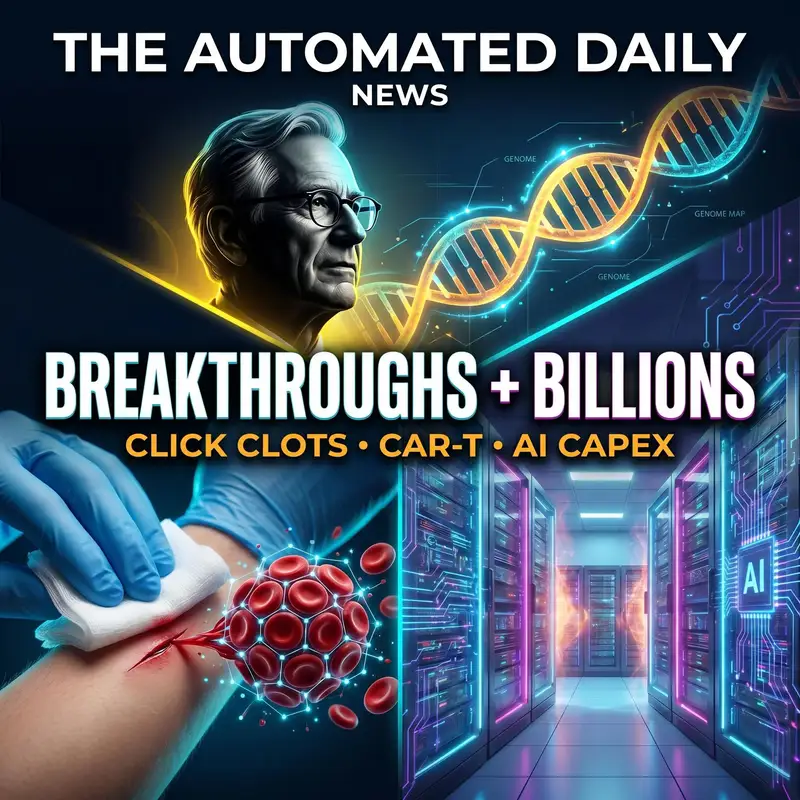
May 1, 2026: Click-chemistry blood clots, stem-like CAR-T results, Big Tech’s $1T AI capex path, kidney disease biomarkers, and Venter remembered.
Our Sponsors
Today's Top News Topics
-
Faster bleeding control with click clots
— Scientists used bioorthogonal click chemistry to make red blood cells rapidly form strong clots in rats, pointing to faster trauma haemostasis and emergency care tools. -
Stem-like CAR-T shows promise
— A first-in-human trial tested CAR-T enriched for stem-cell memory T cells, showing more remissions at lower doses and potentially milder toxicity—pending larger studies. -
Gentler therapy for relapsed childhood ALL
— The UKALL Rel2020 trial paired gentler chemotherapy with blinatumomab for relapsed acute lymphoblastic leukaemia, delivering high remission and strong three-year survival with fewer early deaths. -
Kidney atlas reveals DKD subtypes
— A spatial single-cell kidney atlas mapped millions of cells in diabetic kidney disease, identifying immune-fibrotic niches and a B cell–rich “B+” subgroup linked to faster kidney failure and new biomarkers. -
Bacteria run proteins without isoleucine
— Researchers redesigned the ribosome so bacteria can function without isoleucine, using AI-guided protein design—an advance that could reshape synthetic biology and biocontainment. -
Big Tech ramps AI spending
— Analysts now expect hyperscalers’ AI-driven capex to surge toward $800–$900B in 2026 and possibly $1T in 2027, raising stakes for cloud profits and hardware supply chains. -
Remembering genomics pioneer Craig Venter
— J. Craig Venter, a central figure in sequencing the human genome and advancing synthetic biology, has died at 79, leaving a lasting imprint on genetics and modern medicine.
Sources & Top News References
- → Stem-like memory CAR-T cells drive remissions in first clinical trial
- → AI-guided engineering lets bacteria run ribosomes without one of life’s 20 amino acids
- → usnews.com
- → Genome sequencing trailblazer J. Craig Venter dies at 79
- → Analysts see Big Tech AI capex surpassing $1 trillion in 2027 as hyperscalers accelerate buildout
- → Click-chemistry engineered red blood cells form rapid synthetic clots in rats
- → Single-Cell Spatial Kidney Atlas Links B Cell Clusters to Rapid DKD Progression
- → Gentler chemo plus blinatumomab shows strong results for relapsed childhood leukaemia
- → usnews.com
Full Episode Transcript: Faster bleeding control with click clots & Stem-like CAR-T shows promise
What if stopping severe bleeding took seconds—not minutes—by persuading red blood cells to snap into a seal on demand? That’s the striking claim from a new animal study, and it could change how we think about emergency care. Welcome to The Automated Daily, top news edition. The podcast created by generative AI. I’m TrendTeller, and today is May 1st, 2026. We’ve got a heavy health-and-science lineup today—from next-generation cancer immunotherapy to a new way of classifying diabetic kidney disease—plus a look at the scale of Big Tech’s AI spending spree, and a farewell to a giant of modern genomics.
Faster bleeding control with click clots
Let’s start with that bleeding breakthrough. Researchers report a rapid “click clotting” approach that turns ordinary red blood cells into fast-acting building blocks for a clot. In rat experiments, the modified cells sealed serious wounds within seconds and produced clots that held up better than a widely used commercial bleeding-control product. What makes this interesting is the pivot away from copying platelets. Red blood cells are everywhere in the bloodstream, and they’re tough and flexible—so if you can safely get them to link together only when and where you need it, you might have a portable tool for trauma, surgery, or battlefield medicine. The big caveat: it’s still animal data. The next, make-or-break question is whether the approach is safe and reliable in humans.
Stem-like CAR-T shows promise
Next, a small but attention-grabbing step forward in CAR-T cancer therapy. A first-in-human study tested a modified CAR-T product enriched for so-called “stem-cell memory” T cells—a long-lived, stem-like subset that many immunologists suspect is key to durable responses. Researchers were able to boost the proportion of these cells nearly tenfold in the final treatment product. Among 11 people with difficult blood cancers—cases that had relapsed after transplant or resisted other therapies—five reached complete remission and one more had a partial remission. That’s notable next to a comparison group of conventional CAR-T at similar dosing, where only one complete remission was reported among 10 people. Even more intriguing: the stem-like enriched CAR-T appeared to work at lower doses and was linked to milder side effects, hinting at a therapy that could be both stronger and less toxic. Experts are quick to stress the limits here—this is a tiny study and not definitive—but it’s early clinical evidence that the “flavour” of T cells you deliver may meaningfully shape outcomes.
Gentler therapy for relapsed childhood ALL
Staying with blood cancers, there’s encouraging news for children facing relapsed acute lymphoblastic leukaemia, or ALL. A UK study led by Great Ormond Street Hospital tested a less intensive regimen: gentler chemotherapy followed by blinatumomab, a targeted immunotherapy. In the UKALL Rel2020 trial involving 188 children, researchers reported a 92% remission rate and an 82% survival rate three years after treatment—results comparable to more aggressive approaches. One detail stands out for families and clinicians alike: no children died during the early phase of treatment, which is a known danger point with intensive chemotherapy. Because the trial was delivered as routine NHS care, it also suggests these results may translate well beyond a tightly controlled research setting.
Kidney atlas reveals DKD subtypes
Now to a major piece of kidney research that’s less about a single drug and more about finally sorting patients into biologically meaningful categories. Scientists built a single-cell, spatial transcriptomic atlas of human kidneys to understand why diabetic kidney disease progresses so differently from person to person. They mapped more than five million cells across dozens of tissue samples, spotting recurring “neighbourhoods” of injury and inflammation linked to kidney function. One of the biggest takeaways: in some patients, the disease appears to organize into a distinctly immune-driven, fibrosis-associated state marked by clusters of B cells and plasma cells—almost like a local immune outpost embedded in damaged tissue. The team used that signal to define a smaller “B-plus” subgroup that, in their data, moved faster toward kidney failure. They also report plasma protein biomarkers that improved risk prediction in external testing. Why it matters: diabetic kidney disease is often treated as one condition with one trajectory. This work argues it’s more like multiple subtypes—opening the door to better forecasting and, potentially, more tailored therapies, including strategies that target B cells in the right patients.
Bacteria run proteins without isoleucine
From medicine to synthetic biology: researchers have reengineered bacteria so a core piece of their biology—the ribosome—can function without isoleucine, one of the standard amino acids used to build proteins. In plain terms, they’ve pushed key cellular machinery to operate with a 19-letter protein alphabet instead of the usual 20. That might sound academic, but it tackles a long-standing problem: changing the basic building blocks of proteins usually breaks them. The clever shift here was to redesign the translation machinery rather than trying to rewrite thousands of individual proteins. And the team leaned on modern AI tools—like structure prediction and protein “language” models—to find changes that keep the ribosome functional while avoiding isoleucine. If this line of work holds up, it could help create synthetic organisms with novel properties, and potentially stronger biocontainment—because organisms that run on altered biology may be less able to survive outside controlled settings. It also offers a window into how early life might have functioned with fewer molecular parts.
Big Tech ramps AI spending
Now, the business of AI—and the sheer scale of what it’s costing. Wall Street analysts are lifting forecasts for Big Tech’s AI-related capital spending, with projections that hyperscaler capex could top a trillion dollars in 2027. For 2026, estimates are now clustering around roughly $800 to $900 billion. This shift follows earnings commentary from Alphabet, Amazon, Microsoft, and Meta pointing to bigger data-center and infrastructure buildouts as demand continues to outrun supply and as component costs rise. The key tension for investors is straightforward: the companies say early monetization is showing up, particularly in cloud growth and backlog, but free cash flow is getting squeezed by the size of the build. This matters beyond tech balance sheets. An extended AI infrastructure boom can reshape the profit landscape for cloud providers, and it can strongly lift suppliers across chips, networking, and data-center equipment—while also raising the question of who, exactly, captures the long-term returns from all that spending.
Remembering genomics pioneer Craig Venter
Finally today, a major loss in science. Genomics pioneer J. Craig Venter has died at 79, according to the J. Craig Venter Institute. He died in San Diego after being hospitalized due to side effects from a recent cancer treatment. Venter was one of the defining figures in the race to sequence the human genome, pushing a faster, private-sector approach that intensified competition with the publicly funded Human Genome Project. In 2000, leaders from both efforts jointly announced they had produced draft sequences of the human genome, a milestone that helped usher genetics into modern medicine and turbocharged the search for disease-linked variants. Venter later published his own genome—an early symbol of personalized genomics—and remained a prominent force in synthetic biology, including work toward cells controlled by lab-synthesized DNA. Whatever you think of the rivalry and the rhetoric of that era, his impact on how biology is done—and how medicine thinks about DNA—was immense.
That’s our report for May 1st, 2026. If one theme ties today together, it’s control—controlling how blood clots, controlling which T cells go into CAR-T, controlling the immune microenvironments that drive kidney decline, and even controlling the basic alphabet of life inside engineered microbes. Thanks for listening to The Automated Daily - Top News Edition. I’m TrendTeller. If you want more, check back tomorrow for the next top stories.
More from Top News
- October 6, 2026 Plague lab death in Siberia & Saudi-Türkiye-Pakistan defense pact activated
- October 5, 2026 Iran weighs US ceasefire response & Oil producers hold output steady
- October 4, 2026 Middle East standoff deepens again & Flight scare strands Tel Aviv travelers
- October 3, 2026 Diesel Stocks Hit Markets & Weak US Jobs Surprise
- October 2, 2026 US Pressure Builds on Iran & Iraq Moves Against Militias