Malicious PyPI package hits AI stacks & GitHub bug shows AI-boosted exploits - AI News (May 1, 2026)
PyPI “lightning” malware, GitHub RCE, OpenAI’s Stargate pivot, ER triage AI results, Gen Z backlash, and the rising cost of AI evaluation.
Our Sponsors
Today's AI News Topics
-
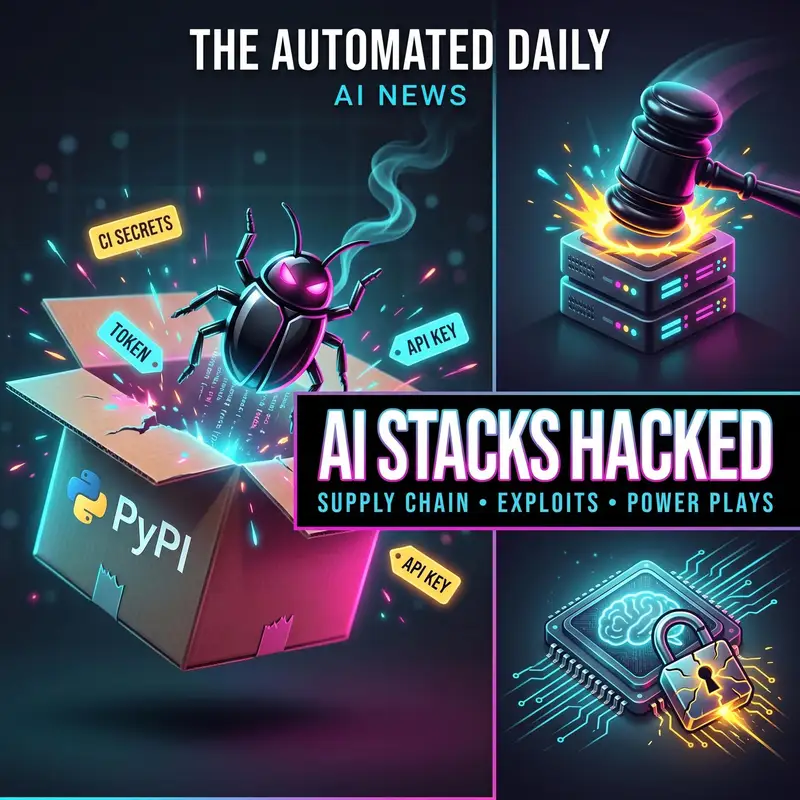
Malicious PyPI package hits AI stacks
— A supply-chain compromise of the popular PyPI package lightning shows how malware can steal CI secrets and spread across ecosystems, risking AI training pipelines. -
GitHub bug shows AI-boosted exploits
— A high-impact GitHub flaw underscores how AI-assisted reverse engineering can accelerate exploit development, changing the speed of both offense and defense. -
OpenAI shifts away from Stargate
— OpenAI is reportedly de-emphasizing its massive Stargate data center co-investment plan, favoring long-term compute leases to reduce capital strain and partner friction. -
OpenAI governance fight heats up
— Elon Musk’s court testimony revives questions about nonprofit-to-for-profit transitions, governance promises, and who controls major AI labs. -
Weird system prompts shape models
— A published Codex system prompt includes a strange ban on “goblins,” illustrating how prompt-level patches can rein in unexpected model behaviors. -
Rewarding agent processes, not answers
— New research suggests classic process reward models miss silent errors in data-analysis agents, while environment-aware rewards can improve reliability and scientific workflows. -
Benchmarks and evaluation get expensive
— Hugging Face and DeepMind highlight that agent evaluation is becoming a compute bottleneck, driving interest in cheaper, more informative benchmarking methods. -
Agents in coding and workplace tools
— From Mistral’s remote coding agents to best practices for MCP servers and CrewAI’s ‘entangled’ agent experiments, tool-using agents are moving from demos to operations. -
TPUs go on-prem, infra shifts
— Alphabet selling TPUs for customer data centers and new long-context training techniques signal accelerating competition across AI infrastructure and deployment models. -
AI in ER triage outcomes
— A Harvard-led trial found an LLM could beat ER doctors on limited-info triage-style diagnosis, raising stakes around clinical support, safety, and accountability. -
Gen Z backlash despite heavy use
— Polling suggests Gen Z uses chatbots heavily but is growing more skeptical about AI’s job impact, trustworthiness, and environmental costs—reshaping adoption pressures. -
Rethinking orgs for AI gains
— An essay argues AI’s real productivity boost will require organizational redesign—more like electrification than the dot-com era—so change may take a decade or more.
Sources & AI News References
- → OpenAI Shifts Away From Owning Stargate Data Centers, Turns to Leased Compute
- → DataPRM Targets Silent Errors by Rewarding the Process in Agentic Data Analysis
- → Contra Labs Proposes Human Creativity Benchmark to Measure Both Craft Agreement and Taste Disagreement in AI Outputs
- → AI-Assisted Reverse Engineering Finds GitHub Enterprise Server RCE Flaw
- → AI’s Real Parallel Is Electrification, Not the Dot-Com Bubble, Joe Reis Argues
- → Codex System Prompt Reveals OpenAI Rule to Stop GPT-5.5 From Mentioning “Goblins”
- → AWS Marketplace Releases Book on Data Foundations for Agentic AI
- → AI Evaluation Costs Are Emerging as a Major Compute Bottleneck
- → Harvard Study Finds AI Beats Doctors in Emergency Triage Diagnoses
- → Gen Z Uses Chatbots Widely but Becomes More Hostile to AI, Polls Show
- → Mistral brings Vibe coding agents to the cloud and launches Medium 3.5-powered Work mode
- → Developer Shares Practical Patterns for Reliable MCP Server Toolchains
- → PyTorch Lightning PyPI Package Compromised, Malware Steals Secrets and Spreads via npm
- → DeepMind open-sources ProEval to cut GenAI evaluation cost and surface failure cases
- → AWS Marketplace Releases ‘Data and AI Leader Insights’ Book on Foundations for Agentic AI
- → PyTorch Introduces AutoSP to Automate Sequence Parallelism for Long-Context LLM Training
- → Musk Says He Was a ‘Fool’ to Fund OpenAI, Accuses Altman of Misleading on Mission
- → CrewAI Says Its Self-Improving Slack Agent ‘Iris’ Is Producing a Quarter of Company PRs
- → Microsoft Research Unveils World-R1 to Reinforce 3D Consistency in Text-to-Video
- → Alphabet to Sell TPUs to Select Customers, Escalating Rivalry With Nvidia
- → AWS Marketplace Releases Data and AI Leaders Book on Foundations for Agentic AI
- → LaDiR Uses Latent Diffusion to Iteratively Refine LLM Reasoning
- → IBM Details Training Pipeline Behind Granite 4.1 Open-Source LLMs
- → AI Inference Market Splits Into Specialized Stacks by Latency, Modality, and Edge Needs
Full Episode Transcript: Malicious PyPI package hits AI stacks & GitHub bug shows AI-boosted exploits
A widely used AI training package was reportedly booby-trapped—and the attack didn’t stop at Python. It may try to jump into npm and even plant persistence in developer workflows. Stay with me. Welcome to The Automated Daily, AI News edition. The podcast created by generative AI. I’m TrendTeller, and today is May 1st, 2026. Let’s get into what happened—and why it matters.
Malicious PyPI package hits AI stacks
First up, a serious supply-chain incident: security researchers report that the PyPI package “lightning,” commonly pulled into PyTorch training workflows, was compromised in recent versions. The alarming part isn’t just credential theft—though that’s bad enough—it’s the attempt to propagate. The malware reportedly hunts for secrets on developer machines and in CI, then tries to use any tokens it finds to spread into other ecosystems, including npm. If confirmed broadly, this is a reminder that AI teams aren’t just protecting models anymore—they’re protecting the entire build-and-release machinery around them.
GitHub bug shows AI-boosted exploits
Staying in security, GitHub disclosed a high-severity vulnerability affecting GitHub Enterprise Server, and said cloud variants were patched quickly with no evidence of exploitation. The key takeaway is how the bug was discovered and weaponized: Wiz says it used AI-assisted reverse engineering to reconstruct internal behavior far faster than traditional manual work. That’s a double-edged trend. AI can help defenders find issues earlier, but it also lowers the time and expertise barrier for attackers to do deep analysis of closed systems.
OpenAI shifts away from Stargate
Now to OpenAI and infrastructure. The Financial Times reports OpenAI is dialing back the big, splashy “Stargate” idea—co-investing in up to half a trillion dollars’ worth of US data centers with partners like Oracle and SoftBank—and leaning more toward leasing compute from third parties through long-term capacity deals. It’s a pragmatic shift: owning data centers is brutally expensive, slow, and politically complicated. But it also comes with reputational risk, because partners and developers reportedly feel the story changed midstream, and some would rather sign Microsoft as a tenant because it’s perceived as the steadier payer.
OpenAI governance fight heats up
That infrastructure pivot lands in a moment where OpenAI’s governance story is already in the spotlight. Elon Musk testified that he was a “fool” for funding OpenAI when it began as a nonprofit, arguing that his support helped create what became a massive commercial enterprise—and that leadership wasn’t honest about the original mission. Whatever you think of Musk, the broader point matters: as AI labs scale, the mismatch between early mission statements and later capital needs can turn into legal battles that shape expectations for transparency and control across the industry.
Weird system prompts shape models
And in a lighter-but-still-revealing OpenAI note: the newly published system prompt for Codex CLI includes an unusual repeated instruction to never talk about goblins—plus a grab bag of similar creatures—unless it’s clearly relevant. Reports suggest the model had started injecting “goblin” references into unrelated chats, and this looks like a prompt-level patch to suppress a quirky behavior. It’s funny on the surface, but the lesson is serious: system prompts aren’t just tone guidelines—they’re operational levers that can paper over emergent oddities, sometimes in ways users will immediately try to bypass.
Rewarding agent processes, not answers
Let’s talk about making AI agents more reliable, especially when they’re doing data analysis. A new arXiv paper argues that process-level reward models—tech that helped with structured reasoning like math—don’t translate cleanly to agentic data work. The problem is “silent errors”: code can run fine and still be wrong, and generic reward models may not notice. The proposed fix, called DataPRM, is environment-aware: it can check intermediate states rather than judging purely from text. The bigger theme here is that as agents move from answers to actions, supervision has to see what the agent actually did—not just what it claimed.
Benchmarks and evaluation get expensive
That connects to a growing worry across the field: evaluation is getting expensive enough to distort who gets to be believed. A Hugging Face team argues that agent benchmarks, in particular, can cost tens of thousands of dollars for meaningful runs, and reruns for reliability multiply the bill. In other words, a leaderboard score can start reflecting budget and scaffolding choices as much as model quality. That’s pushing the community to demand better sharing of logs and more reusable results—so accountability doesn’t concentrate only in the best-funded labs.
Agents in coding and workplace tools
On that front, Google DeepMind released ProEval, an open-source toolkit aimed at cutting evaluation cost while still surfacing useful failure patterns. The pitch is simple: if you can estimate performance with far fewer samples and deliberately hunt diverse mistakes, you can iterate faster—and audit more often—without spending a fortune. Whether ProEval’s claims hold broadly, it signals something important: evaluation is now a first-class engineering problem, not an afterthought.
TPUs go on-prem, infra shifts
Creativity evaluation is getting a rethink too. Contra Labs introduced the Human Creativity Benchmark, which treats expert disagreement as meaningful signal, not noise. They separate areas where pros should converge—basic craft and usability—from areas where taste legitimately diverges. Their results suggest no current model is consistently great at both “getting the requirements right” and being steerable across aesthetic preferences. That matters because the creative industries don’t want generic, averaged outputs; they want reliable defaults plus controllable variation, depending on the phase of work.
AI in ER triage outcomes
Now, the agent wave in day-to-day tools. Mistral launched cloud-based “remote agents” for its Vibe coding product, designed to run longer tasks asynchronously and report back with concrete changes like diffs and draft pull requests. The trend here is shifting developers from constant babysitting to review-and-approve. It’s the same direction we’re seeing across the ecosystem: agents that keep working while you’re offline, with permissions and approvals acting as the safety rail.
Gen Z backlash despite heavy use
If you’re building tool integrations for agents, there’s also a practical field report worth noting: a developer shared lessons from hardening MCP servers against real model behavior. The core message is that models don’t plan like humans; they often pick the next tool opportunistically. So the interface has to nudge them toward the right next action, with clear, consistent tool naming and responses that guide recovery when things go sideways. It’s a reminder that “agent reliability” is frequently a product design problem as much as a model problem.
Rethinking orgs for AI gains
In a related workplace experiment, CrewAI’s founder described an internal Slack-based agent called Iris that can write code, open pull requests, and even propose improvements to its own behavior using persistent memory—subject to human approval. The interesting part isn’t the hype; it’s the operating lesson: trust, provenance, and knowing when not to orchestrate are what determine whether these systems become durable co-workers or just noisy automation.
Zooming out to infrastructure, Alphabet says it will begin selling its TPUs to select customers to install in their own data centers, instead of only renting TPU capacity through Google Cloud. This is a meaningful shift in the AI hardware market: hyperscalers aren’t just cloud providers anymore—they’re pushing their chips into on-prem environments, directly challenging Nvidia’s dominance and trying to reduce dependence on a single supplier ecosystem.
On the training side, PyTorch introduced AutoSP, aimed at making long-context transformer training more feasible across multiple GPUs without teams rewriting large chunks of code. You don’t need the implementation details to see why it matters: long-context models are becoming a competitive requirement, and any tool that lowers the engineering barrier to train them changes who can realistically attempt it.
There’s also a strategic read making the rounds: AI inference is turning into a huge market—and it’s fragmenting. Different workloads, like long-context chat versus image and video generation versus on-device inference, pull infrastructure in different directions. The implication is that we may not end up with one universal serving stack. Instead, we’ll likely see specialized platforms optimized for different latency and modality needs, similar to how databases split into distinct categories over time.
In research, Microsoft released World-R1, a text-to-video approach aimed at better 3D consistency—keeping scenes spatially coherent as objects move and cameras shift. They’re also putting code and data out in the open, which is important because video generation has suffered from flashy demos that are hard to verify. More reproducible baselines help the field measure real progress, not just impressive clips.
Apple researchers also proposed LaDiR, a “latent diffusion” approach to reasoning that tries to let models revise and refine their thinking more holistically than standard token-by-token generation. The big picture here is that the industry is still searching for better ways to do multi-step reasoning without getting trapped by early mistakes—and we’re seeing experimentation beyond classic chain-of-thought.
IBM, meanwhile, detailed how it built the open-source Granite 4.1 models, emphasizing data quality and training discipline over sheer scale, plus very long-context capabilities and an enterprise-friendly license. The significance is less about any single benchmark and more about strategy: well-trained, predictable open models remain a real option for organizations that want control and clearer governance than pure closed APIs.
Now to healthcare, with a result that’s hard to ignore. A Harvard-led study in Science reports that an AI system outperformed emergency doctors in triage-style diagnosis when given limited information from electronic health records, and stayed competitive when more detail was available. The researchers were careful about framing: no bedside cues, no physical exam, no human interaction—so this isn’t “AI replaces clinicians.” But it does suggest LLMs can function as a strong second opinion in high-uncertainty settings, which raises immediate questions about liability, over-reliance, and how to monitor performance across different patient populations.
Finally, a social signal that institutions should take seriously: The Verge reports Gen Z is becoming more negative about AI even while using chatbots heavily for school and work. Polling suggests a growing share feel the risks outweigh the benefits, citing job anxiety, environmental concerns, disinformation, and academic integrity—plus frustration at universities rolling out AI policies and vendor deals without clear guardrails. If the generation that’s supposed to normalize AI is also developing a strong skepticism reflex, that will shape how fast workplaces and schools can push adoption.
To close, one thoughtful analogy: Joe Reis argues this AI era may look more like early electrification than the dot-com bubble. The tech can be transformative, but the productivity payoff comes late because organizations initially bolt new tools onto old workflows. The claim is that real gains require redesigning processes and decision-making—embedding intelligence into operations, not just adding chatbots on top. If that’s right, the winners won’t only be the companies with the best models, but the ones willing to rebuild how work actually gets done.
That’s it for today’s Automated Daily, AI News edition. If you’re tracking the trend line, it’s this: the industry is racing ahead on capability, but the real battles are infrastructure economics, trustworthy evaluation, and operational safety—especially as agents touch real systems. Links to all stories we covered can be found in the episode notes. Thanks for listening—I’m TrendTeller, and I’ll see you tomorrow.
More from AI News
- October 6, 2026 Claude flags threats, Florida arrest & Sam Altman accepts AI harms
- October 5, 2026 Google pauses open-source bug bounty & Claude misused in African influence ops
- October 4, 2026 OpenAI safety culture criticized & LeCun rejects AI doom
- October 3, 2026 The Pause Becomes Real & the Bill Gets a Prospectus
- October 3, 2026 Stratego Falls to Efficient AI & Agents Enter Scientific Workflows