Molecular networks that can learn & GrapheneOS on Pixel phones - Hacker News (Feb 17, 2026)
Please support this podcast by checking out our sponsors: - Invest Like the Pros with StockMVP - https://www.stock-mvp.com/?via=ron - KrispCall: Agentic Cloud Telephony - https://try.krispcall.com/tad - Effortless AI design for presentations, websites, and more with Gamma - https://try.gamma.app/tad Support The Automated Daily directly: Buy me a coffee: https://buymeacoffee.com/theautomateddaily Today's topics: Molecular networks that can learn - Simulations of gene regulatory networks (GRNs) show Pavlov-style conditioning, rising causal emergence (phi), and hints of agency below organism level—keywords: Michael Levin, associative learning, causal emergence, integrated information. GrapheneOS on Pixel phones - A hands-on switch from Apple/Android to GrapheneOS: Pixel-only support, web installer steps, sandboxed Play Services, profiles for compartmentalization—keywords: privacy, security, Verified Boot, Titan M, Obtainium, Aurora Store. ASCII control keys explained clearly - A four-colu
Today's Hacker News Topics
- 01
Molecular networks that can learn
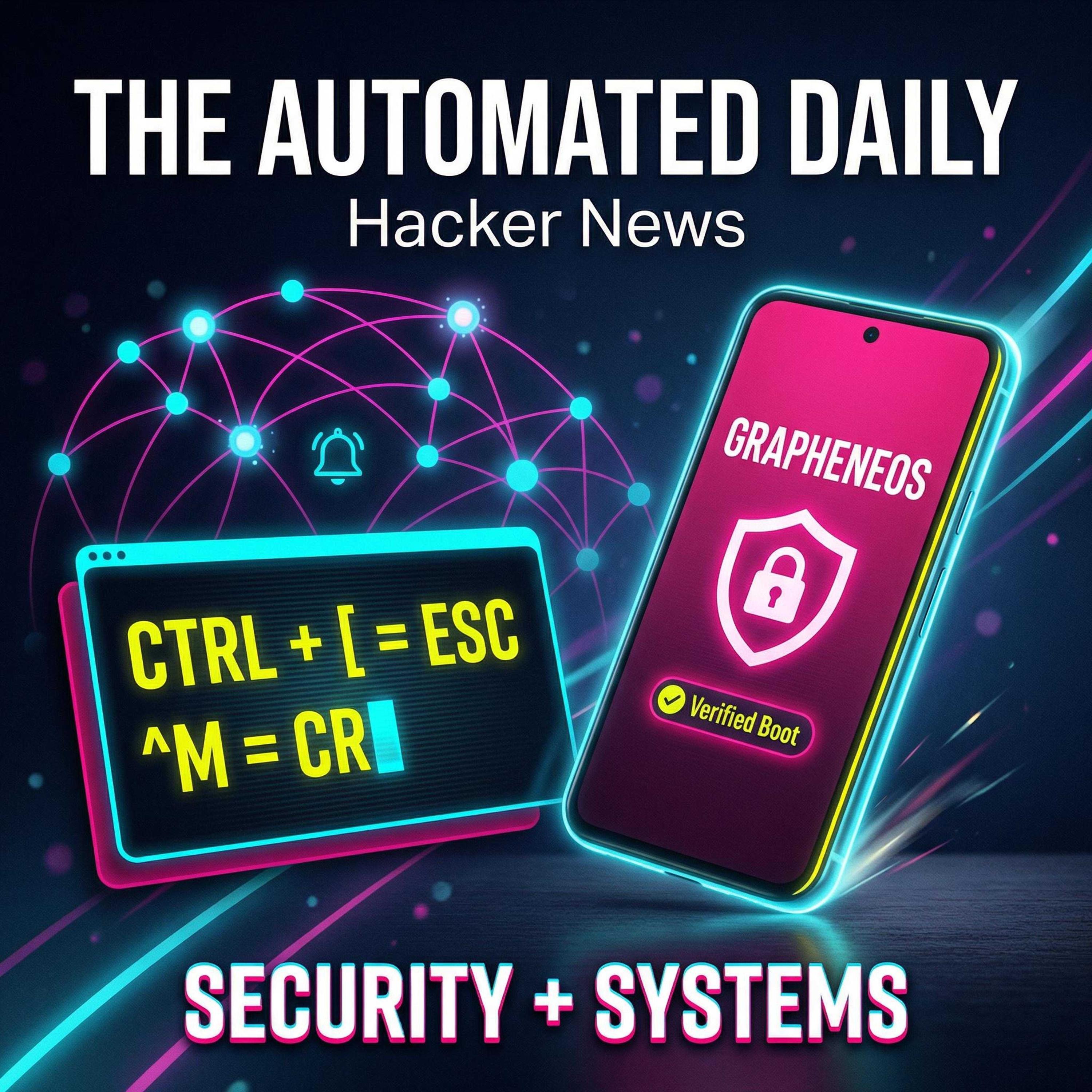
— Simulations of gene regulatory networks (GRNs) show Pavlov-style conditioning, rising causal emergence (phi), and hints of agency below organism level—keywords: Michael Levin, associative learning, causal emergence, integrated information. - 02
GrapheneOS on Pixel phones
— A hands-on switch from Apple/Android to GrapheneOS: Pixel-only support, web installer steps, sandboxed Play Services, profiles for compartmentalization—keywords: privacy, security, Verified Boot, Titan M, Obtainium, Aurora Store. - 03
ASCII control keys explained clearly
— A four-column 7-bit ASCII table makes CTRL-key mappings intuitive by zeroing high bits; it clarifies ESC as CTRL+[ and explains ^M with CRLF—keywords: control characters, caret notation, terminals, bitwise AND. - 04
Undo behavior across vi variants
— A tour of undo/redo semantics from POSIX vi’s single-level toggle to Vim’s multi-level model and nvi’s dot extension—keywords: u, Ctrl-r, POSIX, compatibility, editor ergonomics. - 05
Dolphin adds Triforce arcade support
— Dolphin Emulator’s mainline builds now run the GameCube-based Triforce arcade platform, covering hardware boards, security keys, Segaboot, and multiplayer/network quirks—keywords: Triforce, JVS, DIMM, Mario Kart Arcade GP, F-Zero AX. - 06
Rendering a realistic visible spectrum
— An essay argues most “visible spectrum” images are wrong and proposes a physics-driven spectrum renderer with gamut mapping and Abney-effect corrections—keywords: CIE XYZ, sRGB, chromaticity, gamut, spectrumrenderer. - 07
Origami folds for disaster shelters
— A 14-year-old used Miura-ori parametric design to create fold patterns that hold up to 200 pounds, pointing toward rapid-deploy emergency shelters—keywords: Miura-ori, strength-to-weight, deployable structures, testing rig. - 08
Fixing the incentives in science fairs
— A critique of modern science fairs says they reward lab-affiliated ‘glorified internships’ over student inquiry, proposing categories like null results and replication—keywords: inquiry learning, reproducibility, incentives, Regeneron/ISEF. - 09
Why OKRs beat Deming in US
— An argument that OKRs thrive because they reduce managerial complexity, while Deming’s statistical-process approach demands deeper system understanding—keywords: Drucker, Deming, management by objectives, variability, SPC.
Sources & Hacker News References
More from Hacker News
- October 6, 2026 AI agent catches Mac hack & ChatGPT forges cartoonist signatures
- October 5, 2026 Google Nebraska data center redactions & Denmark CPR registry data breach
- October 4, 2026 OpenAI safety split widens & AI agents need better guardrails
- October 3, 2026 Judge Blocks Utah VPN Law & AI Art Meets AI Satire
- October 2, 2026 Git 3 hash debate & Debian kernel security rollup