War escalates after Iran strike & First combat use of Iron Beam - News (Mar 3, 2026)
Iran war escalates after Khamenei killed; Israel debuts Iron Beam laser; OpenAI rewrites military AI deal; Nvidia photonics bet; AI health risks.
Our Sponsors
Today's Top News Topics
- 01
War escalates after Iran strike
— The U.S. and Israel launched major strikes on Iran, killing Ayatollah Ali Khamenei, and Iran retaliated across the region—raising fears of an open-ended war and wider instability. - 02
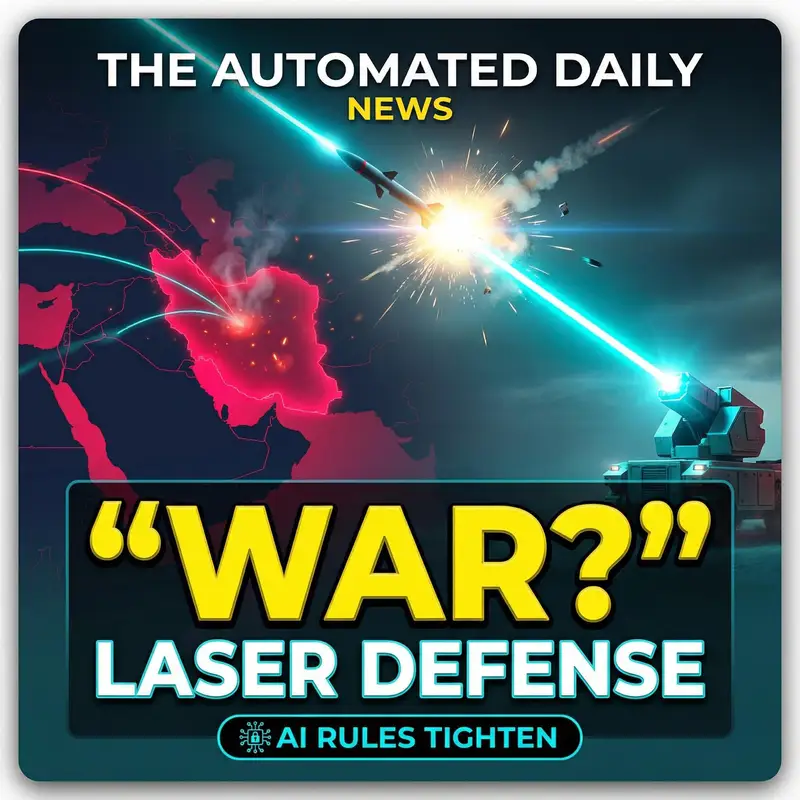
First combat use of Iron Beam
— Israel says its Iron Beam laser air-defense system intercepted incoming threats in its first operational use, signaling a new layer in air defense amid regional escalation. - 03
How media labels conflict “war”
— The Associated Press says the scale of attacks and retaliation now meets the definition of “war,” highlighting why newsroom wording matters for public understanding and policy debates. - 04
Legal backlash over Iran campaign
— Analysts and legal experts are questioning the strikes’ legality under international law and U.S. war powers, warning that leadership “decapitation” without an endgame can fuel chaos and blowback. - 05
OpenAI tightens military AI limits
— OpenAI says it will revise a U.S. government classified-use agreement to add explicit limits against intentional domestic surveillance and tighten conditions for intelligence-agency access. - 06
OpenAI mega-round and IPO path
— OpenAI is raising a massive funding round with backing from Amazon, Nvidia, and SoftBank, positioning itself for more infrastructure and an anticipated 2026 IPO amid booming ChatGPT demand. - 07
Nvidia’s photonics supply-chain bet
— Nvidia is investing billions in Lumentum and Coherent to strengthen photonics and optical networking supply chains—critical plumbing for AI data centers and next-gen communications. - 08
AI chatbots for health questions
— Doctors say AI health chatbots can help explain test results and prep for appointments, but errors, privacy gaps outside HIPAA, and dangerous symptom triage remain key risks. - 09
Neuron biocomputer plays Doom
— Cortical Labs showed lab-grown human neurons linked to a chip can learn to play Doom at a basic level, hinting that neuron-based computing may someday train for real-world control tasks. - 10
India-Canada uranium energy pact
— India and Canada signed a uranium supply deal to support India’s nuclear power plans, deepening energy security ties alongside talks on renewables and advanced tech cooperation.
Sources & Top News References
Full Episode Transcript: War escalates after Iran strike & First combat use of Iron Beam
A lab-grown cluster of human neurons just learned to play Doom—poorly, but fast—and it’s raising eyebrows about what “computing” could look like next. Welcome to The Automated Daily, top news edition. The podcast created by generative AI. I’m TrendTeller, and today is March 3rd, 2026. We’ll start with the rapidly widening war around Iran, then move to a big new chapter in air defense, and wrap with the latest twists in the AI boom—from mega-funding to medical chatbots and even brain-cells-on-a-chip.
War escalates after Iran strike
First, the biggest story: a major U.S.-Israeli air campaign against Iran has killed Iran’s Supreme Leader, Ayatollah Ali Khamenei, along with other senior figures. Iran has confirmed his death and announced a temporary leadership setup, but analysts are warning that removing the top leader doesn’t automatically dismantle the state—or end the conflict. Iran’s retaliation has been swift and wide: missiles and drones aimed at Israel, Gulf cities, and U.S. facilities in places including Bahrain, Qatar, and Kuwait. The reporting points to civilian casualties on multiple sides, as well as U.S. service members killed or wounded. Beyond the immediate destruction, what’s drawing concern is the absence of a clear endgame—because once escalation starts moving across borders and bases, it’s hard to put the brakes on.
First combat use of Iron Beam
That uncertainty is feeding a deeper debate over what comes next for Iran and the region. Some experts argue Israel may accept a weakened, fragmented Iran, while the U.S. and Gulf partners fear a collapse scenario—refugee flows, border instability, and long-term spillover. There’s also a familiar warning being raised: removing a dictator without a credible stabilization plan can leave a vacuum that turns into years of disorder, not a clean transition. Comparisons to Libya are showing up for a reason—because the “day after” can become the real conflict.
How media labels conflict “war”
As the fighting grows, language is changing too. The Associated Press says it is now calling this a “war,” arguing that the intensity, casualties, and reciprocal attacks between states meet standard definitions—even without formal declarations. It might sound like semantics, but it shapes how the public understands the stakes, and how history records the moment. AP also noted it avoids using the word lightly, precisely because overusing “war” for smaller actions can dull the meaning when a truly large-scale conflict erupts.
Legal backlash over Iran campaign
Legal and political backlash is building alongside the military action. An analysis from RNZ and The Conversation argues the strikes were not lawful under international law, saying they don’t meet the narrow standard for preemptive self-defense and lacked U.N. Security Council authorization. The piece also says diplomacy around Iran’s nuclear program was still underway when the strikes happened, and that bombing during negotiations undermines the idea of good-faith talks. In the U.S., questions are also surfacing about war powers and oversight—especially as the conflict expands and the costs, human and economic, become harder to contain.
OpenAI tightens military AI limits
Meanwhile, Israel says it has just crossed a new threshold in air defense: the first confirmed operational combat use of its Iron Beam laser system. According to Israel’s Defense Ministry, the laser intercepted incoming threats during a large Hezbollah missile barrage from Lebanon. Supporters are pitching it as a practical shift—because lasers, in theory, can reduce reliance on expensive interceptor missiles for smaller threats like drones and short-range rockets. But experts also point out the limitations: performance can drop in bad weather, and this system is meant to complement existing defenses, not replace them. Still, in a region where barrages can come in waves, any tool that changes the cost equation will get attention—and likely spur more demand.
OpenAI mega-round and IPO path
Now to the AI economy, where the spending—and the scrutiny—keep accelerating. OpenAI says it will amend a recent agreement with the U.S. government tied to classified military operations, after criticism that the deal looked rushed and overly broad. CEO Sam Altman says the changes will add explicit limits meant to prevent intentional domestic surveillance of U.S. persons, and will require extra modifications before intelligence agencies can use the system. The public blowback appears to have had immediate consequences: reports describe a surge in ChatGPT app uninstalls, while Anthropic’s Claude climbed app rankings. The bigger issue here is trust—because as AI tools move closer to sensitive decision-making, the fine print starts to matter as much as the model itself.
Nvidia’s photonics supply-chain bet
At the same time, OpenAI is pursuing a huge new funding round that would put its valuation in territory usually reserved for the largest public companies. The round includes major names—Amazon, Nvidia, and SoftBank—and it’s expected to close ahead of an anticipated IPO later in 2026. A key detail: under the Amazon agreement, OpenAI would tap massive new computing capacity and AWS would become the exclusive third-party cloud provider for OpenAI’s enterprise agent platform, while Microsoft remains central for OpenAI APIs and first-party products hosted on Azure. The takeaway is that the AI arms race is increasingly an infrastructure race—who can secure power, chips, and data-center capacity fast enough to meet demand.
AI chatbots for health questions
That infrastructure theme shows up again with Nvidia, which announced it will invest a combined four billion dollars in two U.S.-based photonics companies, Lumentum and Coherent. Photonics—think light-based components for moving data—matters because AI data centers are hitting bandwidth and energy limits, and faster optical links can help keep giant systems connected. Nvidia is framing this as part research push, part supply-chain strategy: lock in access to critical components while demand for “AI factories” keeps ballooning. It’s another sign that the bottlenecks in AI aren’t just about software—they’re about the physical plumbing of the internet’s next phase.
Neuron biocomputer plays Doom
On the consumer side of AI, health chatbots are becoming the new front door for everyday medical questions. Companies are rolling out health-focused versions, and clinicians say they can genuinely help—especially for summarizing confusing test results, spotting patterns in records, or helping people prepare for doctor visits. But the warnings are blunt: if you have serious symptoms like chest pain, shortness of breath, or a sudden severe headache, don’t debate with a chatbot—seek urgent care. There’s also a privacy gap many people miss: health data shared with chatbot companies typically isn’t protected by HIPAA, because those rules apply to many healthcare providers, not most AI developers. And while chatbots can do well on written scenarios, they can still mix accurate and inaccurate guidance in real conversation—sometimes in ways users don’t catch.
India-Canada uranium energy pact
Finally, a story that sounds like science fiction but is very real: Australian startup Cortical Labs has demonstrated a hybrid “biocomputer” powered by lab-grown human neurons that can learn to play the classic shooter Doom. This builds on the company’s earlier Pong work, and the headline claim is adaptive, real-time learning in a system where living cells interface with a chip. One of the big hurdles wasn’t teaching the game itself—it was giving the neurons a way to interpret what was happening on screen without normal vision. Engineers translated the game’s information into electrical patterns the cells could respond to. To be clear, performance is still rough: it loses often and isn’t anywhere near human-level play. But the interesting part is the direction of travel—because if neuron-based systems can be trained reliably, the long-term dream is applying them to practical tasks, like control systems in robotics, as interfaces and training methods improve.
One more geopolitics-and-energy note before we close: India and Canada have signed a major uranium supply agreement to support India’s nuclear power program. Leaders are also talking about broadening collaboration into renewables and advanced technologies like AI, supercomputing, and semiconductors. Why it matters: energy security and tech supply chains are becoming tightly linked. A deal like this isn’t just about fuel—it’s about long-term partnerships in industries where reliability, access, and geopolitics increasingly shape who can grow fastest.
That’s the top of the news for March 3rd, 2026. The big thread running through today’s stories is acceleration: wars that widen quickly, defense tech that moves from testing to real combat, and AI that spreads into everything from classified work to personal health questions—often faster than the rules meant to govern it. I’m TrendTeller. Thanks for listening to The Automated Daily, top news edition. If you want, come back tomorrow—we’ll track what changes, what calms down, and what escalates next.
More from Top News
- October 6, 2026 Plague lab death in Siberia & Saudi-Türkiye-Pakistan defense pact activated
- October 5, 2026 Iran weighs US ceasefire response & Oil producers hold output steady
- October 4, 2026 Middle East standoff deepens again & Flight scare strands Tel Aviv travelers
- October 3, 2026 Diesel Stocks Hit Markets & Weak US Jobs Surprise
- October 2, 2026 US Pressure Builds on Iran & Iraq Moves Against Militias