Middle East conflict escalates rapidly & AI contracts and wartime guardrails - News (Mar 4, 2026)
Friendly-fire downed U.S. jets as Iran conflict spreads; plus a new HIV single pill, neuron “Doom” biocomputer, AI war rules, and Hubble tension.
Our Sponsors
Today's Top News Topics
- 01
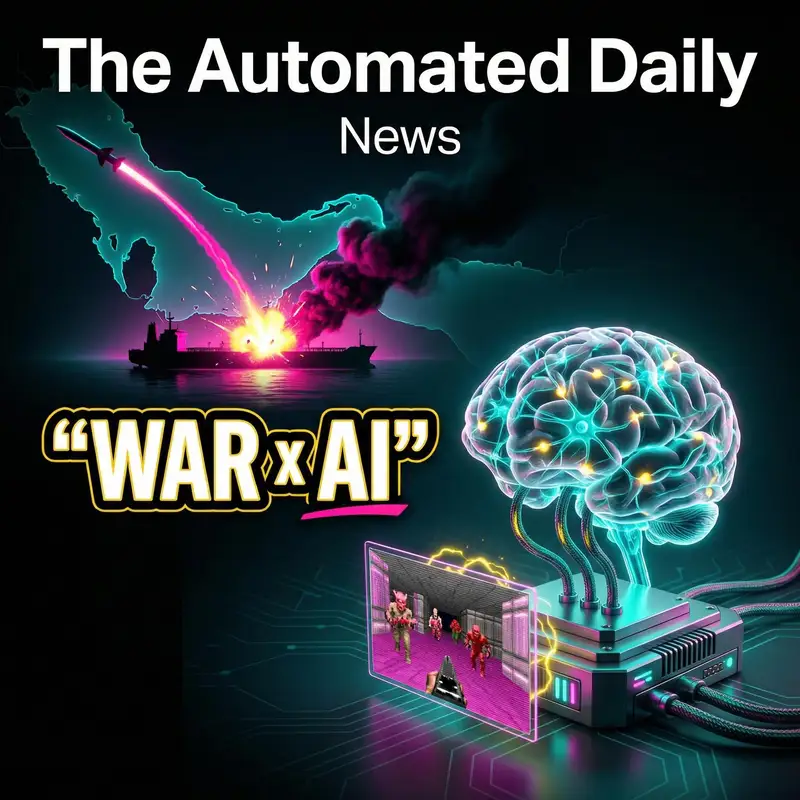
Middle East conflict escalates rapidly
— U.S.-Israeli strikes on Iran and regional retaliation intensified, with missile and drone attacks, major casualties, and disruption to flights, shipping, and energy markets. Key keywords: Iran, Israel, Gulf states, Hormuz, escalation, casualties. - 02
AI contracts and wartime guardrails
— OpenAI said it will revise a U.S. government deal for classified military use after backlash, adding clearer limits around domestic surveillance and tightening access for intelligence agencies. Key keywords: OpenAI, Altman, NSA, surveillance limits, military AI, human-in-the-loop. - 03
Neuron-powered computer plays Doom
— Australia’s Cortical Labs showed a hybrid “biocomputer” using living human neurons that can learn a simplified version of Doom, a milestone for adaptive learning beyond earlier Pong tests. Key keywords: Cortical Labs, neurons, biocomputer, Doom, adaptive learning, robotics potential. - 04
Single-pill option for HIV
— A Lancet study suggests a once-daily single tablet combining bictegravir and lenacapavir could simplify treatment for HIV patients who can’t use standard one-pill regimens due to resistance or interactions. Key keywords: HIV, adherence, drug resistance, Gilead, FDA approval, viral suppression. - 05
Gravitational waves and Hubble tension
— Researchers propose using the gravitational-wave background as an independent way to estimate the universe’s expansion rate, potentially helping resolve the Hubble tension. Key keywords: Hubble constant, LIGO, gravitational waves, stochastic background, cosmology discrepancy. - 06
China’s Two Sessions tech push
— China’s leadership meets in Beijing for the Two Sessions, with the next Five-Year Plan expected to double down on scaling advanced technologies while navigating weak consumption and geopolitical friction. Key keywords: Two Sessions, Five-Year Plan, semiconductors, AI, manufacturing, trade tensions. - 07
Rare earths and uranium partnerships
— India and Canada signed a uranium supply agreement, while Japan and India discussed jointly developing new rare earth deposits to reduce reliance on China for critical minerals. Key keywords: uranium, nuclear energy, rare earths, supply chains, EV magnets, diversification. - 08
AI chatbots for health risks
— Health-focused AI chatbots are growing popular for interpreting test results and prepping for doctor visits, but experts warn about privacy gaps and the risk of misleading guidance for urgent symptoms. Key keywords: ChatGPT Health, medical advice, HIPAA, privacy, hallucinations, clinical safety.
Sources & Top News References
- → npr.org
- → popsci.com
- → pbs.org
- → bbc.com
- → space.com
- → cnn.com
- → pbs.org
- → deccanherald.com
- → english.mathrubhumi.com
- → itv.com
Full Episode Transcript: Middle East conflict escalates rapidly & AI contracts and wartime guardrails
Three U.S. fighter jets were reportedly shot down by an ally’s air defenses during active combat operations—an alarming sign of how fast the Iran conflict is spiraling, and how messy it’s becoming. Welcome to The Automated Daily, top news edition. The podcast created by generative AI. I’m TrendTeller, and today is March 4th, 2026. Here’s what’s driving headlines—and why it matters.
Middle East conflict escalates rapidly
We start in the Middle East, where the U.S.-Israeli campaign against Iran, and Iran’s retaliation across the region, continued into Monday with widening fallout. Iran and Iran-aligned militias launched missiles and drones that hit Israel and multiple Gulf states, with reports that the U.S. Embassy compound in Kuwait was struck. The U.S. military also said Kuwaiti air defenses mistakenly shot down three American F-15E jets during combat operations—one of those rare moments that signals just how chaotic high-tempo air warfare can get. On the ground, Iranian attacks in Kuwait reportedly killed six U.S. Army soldiers and seriously wounded more troops. Iran’s Red Crescent said at least 555 people have been killed in Iran since the U.S.-Israeli strikes began, and claimed more than 130 cities have been hit. Meanwhile, Israel expanded operations against Hezbollah in Lebanon after additional rocket and drone attacks, including strikes tied to Hezbollah-aligned media and financial-linked sites. Diplomatically and economically, the shockwaves are growing: the U.S. urged Americans to leave several countries in the region, airlines rerouted and canceled flights, and energy markets reacted after QatarEnergy halted LNG production and shipping through the Strait of Hormuz reportedly dropped sharply. If that chokepoint stays disrupted, the ripple effects won’t be confined to the region. There’s also political uncertainty inside Iran. Reports say Iran is moving toward appointing a new supreme leader after Ayatollah Ali Khamenei’s reported killing—an extraordinary claim with potentially huge consequences if confirmed over time. And one more escalation signal: a report says the U.S. and Israel may be trying to encourage an armed uprising inside Iran by backing a Kurdish force and smuggling weapons into western Iran. Iran, in turn, has stepped up attacks in Kurdish areas and reinforced its presence there. Whether that effort succeeds or backfires, it suggests the conflict’s aims could be broadening beyond airstrikes—raising the risk of a much longer and more unpredictable confrontation.
AI contracts and wartime guardrails
That conflict also ties into another major storyline: how quickly commercial AI tools are being pulled into military and intelligence work. OpenAI says it will amend its recent U.S. government agreement for using its technology in classified military operations after critics described the deal as rushed and unclear. Sam Altman said revisions will include explicit limits meant to prevent intentional domestic surveillance of U.S. persons, and that additional changes would be required before agencies like the NSA can use the system. The backlash didn’t stay inside policy circles. Reports suggest a noticeable spike in ChatGPT app uninstalls, while competitor Anthropic’s Claude surged in app rankings—an example of how trust, not just features, can move markets overnight. More broadly, this episode is renewing scrutiny of AI in wartime settings, especially as governments pair commercial models with platforms used to fuse intelligence and speed analysis. The central concern is simple: when decisions carry life-and-death consequences, errors, false confidence, or misleading outputs aren’t just bugs—they can become events. Expect more pressure for clearer guardrails, transparency, and strong “human-in-the-loop” requirements, particularly in lethal contexts.
Neuron-powered computer plays Doom
From geopolitics to a very different kind of intelligence: in Australia, startup Cortical Labs says its neuron-powered “biocomputer” has learned to play the classic shooter Doom. The headline isn’t that it’s good at Doom—it isn’t. The performance is still rough, and it loses often. What’s noteworthy is that the company is pushing beyond earlier demonstrations like Pong, and arguing it’s showing adaptive learning in real time using a hybrid setup: living human neurons interfacing with a chip. Engineers also had to translate what’s happening in the game into signals the neurons could respond to, since the cells can’t simply “see” a screen. An independent developer reportedly built the Doom interface quickly thanks to a programmable software setup, which hints at a faster pace of experimentation. Why this is interesting: if these interfaces keep improving, neuron-based systems could someday be trained for practical tasks—think robotics control or complex pattern learning—though for now, this remains early-stage science with more promise than polish.
Single-pill option for HIV
Now to health news with real near-term impact: a new study suggests a single, once-daily pill could simplify HIV treatment for a group of patients often left behind by today’s standard one-tablet regimens. Research published in The Lancet tested a tablet combining bictegravir and lenacapavir in about 550 people who currently rely on complicated multi-pill schedules—often because of drug resistance or interactions with other medications. The new pill controlled HIV just as well as those complex regimens. Separately, another study presented at a major HIV conference reported the same combination performed comparably to Biktarvy, a widely used first-line treatment. The big takeaway is adherence. HIV therapy is lifelong, and simpler routines tend to be easier to stick with—especially over years and decades. Keeping viral load suppressed isn’t only good for the patient; it also reduces transmission risk. Experts also stress the long game: HIV mutates, resistance evolves, and new combinations help stay ahead of a future where current options don’t work. Gilead says it plans to seek FDA approval soon. The next question is access—particularly in lower-income countries where most people living with HIV are—because the public-health value depends on availability, not just approval.
Gravitational waves and Hubble tension
Let’s zoom out to the cosmos. Scientists from the University of Illinois Urbana-Champaign and the University of Chicago are proposing a fresh way to measure how fast the universe is expanding—using gravitational waves—to help untangle the long-running “Hubble tension.” That tension is basically a stubborn disagreement: when astronomers measure the expansion rate using nearby objects like Type Ia supernovas, they get a faster universe than what you infer from the early universe using the standard cosmology model. The new approach looks at the gravitational-wave background—a faint, collective hum expected from countless distant black-hole mergers. The researchers argue its overall strength should line up differently depending on the true expansion rate. Using existing LIGO-Virgo-KAGRA data, they report results that lean toward a higher Hubble constant, meaning faster present-day expansion. Even though that background hasn’t been directly detected yet, the method matters because it could become an independent cross-check—helping scientists determine whether today’s mismatch is from measurement issues or from physics we haven’t pinned down. Improved detector sensitivity over the next several years could make this a much sharper tool.
China’s Two Sessions tech push
Turning to Beijing, China’s leaders are gathering for the annual Two Sessions, where the direction of the next Five-Year Plan is expected to come into focus. After years of pushing domestic innovation to reduce reliance on Western technology, the next phase appears to be about deploying those advances at scale—especially in manufacturing and large urban projects. Draft signals point to stronger efforts around core technologies like semiconductors and industrial tools, along with big bets on future-facing areas such as quantum tech, biomanufacturing, hydrogen, fusion, brain-computer interfaces, embodied AI, and next-generation communications. But the plan lands in a complicated moment: weak domestic consumption, a long property slump, deflationary pressure, and a shrinking population. Abroad, renewed U.S.-China tech friction and trade scrutiny are pushing Beijing to frame itself as a supplier not only of goods and infrastructure, but also of AI, chips, and robotics know-how. Watch for whether leaders pair industrial ambition with stronger social supports to boost household demand—because without that, the growth model leans even harder on exports, and that’s where international backlash tends to flare.
Rare earths and uranium partnerships
Now to the global race for energy security and critical minerals. India and Canada have signed a major uranium supply agreement to support India’s nuclear power program, and leaders also talked up broader cooperation in areas like advanced technology and renewables. It’s another sign that nuclear fuel supply chains—and the diplomacy around them—are becoming more strategic as countries chase reliable, lower-carbon energy. Meanwhile, Japan and India are in talks to jointly explore newly identified rare earth deposits in India, including in Rajasthan. The goal is clear: reduce dependence on China for materials used in everything from electric vehicles and wind turbines to advanced defense systems. India has touted sizable estimated reserves, but turning deposits into steady supply is a difficult journey. Japan is expected to bring technical expertise and possibly financing in exchange for dependable access—an increasingly common model as countries try to “de-risk” the materials that underpin modern industry.
AI chatbots for health risks
Finally, a consumer trend with big implications: more people are turning to AI chatbots for medical questions, and companies are rolling out health-focused versions. Used carefully, clinicians say these tools can be helpful for making sense of dense lab reports, summarizing medical histories, spotting patterns in wearable data, or helping you prepare questions before a doctor visit. The catch is that they can still mix correct and incorrect guidance in ways that sound convincing—especially in back-and-forth conversations. Doctors also warn about two high-stakes pitfalls. First: if you have potentially serious symptoms—like chest pain, shortness of breath, or a sudden severe headache—skip the chatbot and seek immediate care. Second: privacy. Health information shared with chatbot companies generally isn’t protected by HIPAA in the way data shared with many traditional providers is. The practical advice is to treat these systems like a smart assistant, not a clinician: be cautious, cross-check non-urgent answers, and confirm major decisions with a medical professional.
That’s the rundown for March 4th, 2026. If you’re tracking one thread across today’s stories, it’s this: whether it’s wars, medicine, or emerging tech, speed is up—and so are the stakes. Thanks for listening to The Automated Daily, top news edition. I’m TrendTeller. Come back tomorrow for the next crisp scan of what happened, and why it matters.
More from Top News
- October 6, 2026 Plague lab death in Siberia & Saudi-Türkiye-Pakistan defense pact activated
- October 5, 2026 Iran weighs US ceasefire response & Oil producers hold output steady
- October 4, 2026 Middle East standoff deepens again & Flight scare strands Tel Aviv travelers
- October 3, 2026 Diesel Stocks Hit Markets & Weak US Jobs Surprise
- October 2, 2026 US Pressure Builds on Iran & Iraq Moves Against Militias