Super-cleaner cells for Alzheimer’s & Cheaper semaglutide generics on horizon - News (Mar 7, 2026)
Alzheimer’s “super-cleaner” brain cells, Hormuz shipping shock, warming accelerates, mineral power politics, Ukraine ground robots, and DART’s asteroid nudge.
Our Sponsors
Today's Top News Topics
- 01
Super-cleaner cells for Alzheimer’s
— Washington University researchers reprogrammed astrocytes to recognize and clear amyloid beta, preventing plaques in mice and cutting existing plaques by about half—promising “one-and-done” Alzheimer’s therapy potential. - 02
Cheaper semaglutide generics on horizon
— A new cost analysis suggests semaglutide could be produced for just a few dollars per month once patents loosen, potentially expanding Ozempic/Wegovy-style access for diabetes and obesity in lower-income markets. - 03
Warming is speeding up fast
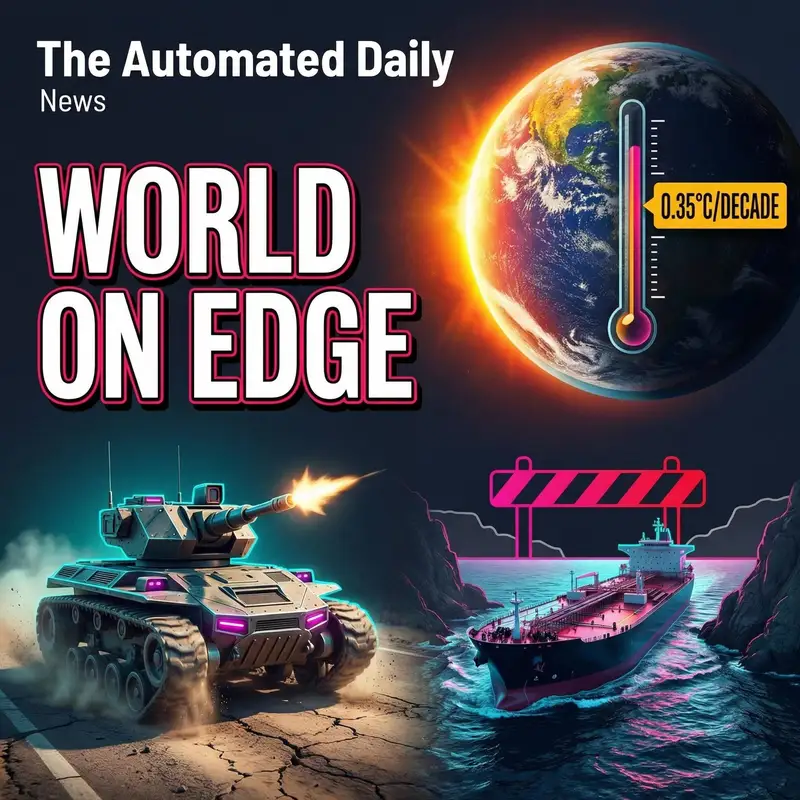
— A study across major temperature datasets finds human-driven warming has accelerated to roughly 0.35°C per decade since 2013–2014, tightening the timeline for crossing the Paris 1.5°C limit. - 04
UN warns on mineral security
— The U.N. Security Council heard that demand for lithium, cobalt, and nickel could surge by 2030, making critical-mineral supply chains a strategic and geopolitical flashpoint amid U.S.–China tensions. - 05
Ukraine’s armed ground robots expand
— Ukrainian forces are deploying more weaponised uncrewed ground vehicles to reduce troop exposure in drone-saturated battle zones, raising new legal and ethical questions around autonomy and targeting. - 06
Finland rethinks nuclear weapons ban
— Finland proposes ending its long-standing legal ban on nuclear weapons presence, aligning more closely with NATO deterrence as Europe’s security calculus shifts after Russia’s invasion of Ukraine. - 07
Japan and Canada tighten ties
— Japan and Canada signed a strategic roadmap covering defense cooperation, economic security, cyber dialogue, and energy supply resilience, reflecting Indo-Pacific tensions and Middle East-driven oil anxiety. - 08
Hormuz crisis hits global shipping
— The U.S. announced up to $20 billion in maritime reinsurance to keep ships moving after Iran effectively shut the Strait of Hormuz, a chokepoint affecting oil prices, inflation risk, and supply chains. - 09
DART nudged an asteroid’s solar orbit
— New research confirms NASA’s DART impact not only altered Dimorphos’s orbit around Didymos, but also measurably shifted the pair’s path around the Sun—an important real-world datapoint for planetary defense.
Sources & Top News References
- → medicine.washu.edu
- → abcnews.com
- → bbc.com
- → bbc.com
- → rnz.co.nz
- → abcnews.com
- → theguardian.com
- → newsday.com
- → globalnews.ca
- → statnews.com
Full Episode Transcript: Super-cleaner cells for Alzheimer’s & Cheaper semaglutide generics on horizon
A single brain injection kept mice free of Alzheimer’s-like plaques—and in older mice, it cut existing buildup roughly in half. It’s early research, but it hints at a very different kind of treatment. Welcome to The Automated Daily, top news edition. The podcast created by generative AI. I’m TrendTeller, and today is March 7th, 2026. Here’s what’s shaping the world right now—across health, security, climate, and technology.
Super-cleaner cells for Alzheimer’s
We’ll start in medical research, with a striking Alzheimer’s development. Scientists at Washington University School of Medicine engineered astrocytes—support cells in the brain—to act like targeted “clean-up crews” that recognize amyloid beta, the protein tied to Alzheimer’s plaques. In mouse studies, a single treatment given early prevented plaque buildup entirely over the next few months. And in older mice that already had heavy plaque levels, that same one-time approach reduced plaques by about half. The big reason this matters: today’s anti-amyloid therapies often mean repeated infusions over time, while a durable, one-and-done strategy—if it ever proves safe and effective in people—could dramatically reduce treatment burden. Researchers are also clear that more safety and targeting work is needed before this is anywhere near clinical use.
Cheaper semaglutide generics on horizon
Staying with health—and with questions of access—another new analysis is turning heads in the debate over GLP-1 medicines, the class that includes semaglutide, known widely through Ozempic and Wegovy. Researchers estimate generic versions could potentially be manufactured for just a few dollars per person per month, once patent barriers fall away and competition kicks in. The analysis leans on recent ingredient pricing data and points to upcoming patent expirations in several countries. If those timelines hold and manufacturing ramps up, the interesting part isn’t just cheaper meds in wealthy markets—it’s the possibility of much broader availability for diabetes and obesity treatment in low- and middle-income countries, where today’s prices put these drugs out of reach for most patients.
Warming is speeding up fast
Now to climate, where a new study argues the pace of human-caused warming has accelerated sharply over the past decade. After filtering out natural ups and downs—things like El Niño swings, volcanic effects, and solar variation—researchers found warming since around 2013–2014 has been running notably faster than the long-term late-20th-century trend. One implication is a tighter clock for the Paris Agreement’s 1.5°C threshold, potentially before 2030 if the recent pace persists. Scientists do still debate how much of the very latest jump is purely long-term forcing versus short-term variability, but the headline is hard to ignore: faster warming means less time to adapt and less margin for avoiding the kinds of heat extremes and knock-on impacts that are already becoming familiar.
UN warns on mineral security
From climate to the resources powering modern life: at the U.N. Security Council, officials warned that demand for critical minerals could triple by 2030 and quadruple by 2040. These are the materials behind batteries, electronics, and a lot of military hardware—so the conversation is no longer just about trade, it’s about national security and geopolitical leverage. The meeting came with U.S.–China rivalry in the background, especially after China tightened restrictions on certain rare earth exports. The U.S. message was essentially: no one wants a future where a single supplier can squeeze global industry. At the same time, countries that actually produce these minerals pushed another point—securing supply chains can’t mean tolerating conflict financing or weak governance. The next chapter here is likely to be a mix of new alliances, new mining deals, and much louder debates over what “responsible” extraction truly looks like.
Ukraine’s armed ground robots expand
Turning to the battlefield in Ukraine, the war’s robotics era is expanding beyond the skies. Ukrainian units say armed uncrewed ground vehicles—some used as remote weapons platforms, others as one-way explosive vehicles—are increasingly part of frontline tactics. Commanders emphasize that many systems are still only partly autonomous: machines can help with navigation and spotting, but humans are generally making the final decision to fire. That distinction matters, both ethically and legally, especially with civilians and identification risks. Strategically, the push reflects brutal battlefield reality: aerial drones have widened the danger zone, making routine movement more deadly, while manpower shortages raise the value of systems that can hold positions or probe defenses without exposing soldiers. Russia is also fielding its own ground robots, setting the stage for more frequent machine-versus-machine encounters.
Finland rethinks nuclear weapons ban
In Northern Europe, Finland is signaling another major shift in how it thinks about deterrence. The government is proposing changes that would end a decades-old legal ban on bringing, possessing, or transporting nuclear weapons on Finnish territory. Officials argue the security environment has fundamentally changed since Russia’s full-scale invasion of Ukraine, and they say the update would better align Finland with NATO’s posture. The proposal still has to move through consultation and parliament, but Finland’s political direction since joining NATO has been unmistakable—especially with its long border with Russia. More broadly, it’s another example of how the Ukraine war continues to reshape defense assumptions across Europe, including issues that used to be politically untouchable.
Japan and Canada tighten ties
Across the Pacific, Japan and Canada have signed a strategic agreement in Tokyo aimed at tighter cooperation on defense, economic security, cyber policy, and energy resilience. The timing is notable: concerns over oil supply stability have been rising as tensions in the Middle East spill into market anxiety. Alongside energy, the deal reflects shared worries about coercive trade practices and a tougher security environment in the Indo-Pacific. The two countries also plan to start negotiations on a defense pact meant to smooth military visits and joint exercises. Taken together, it’s another sign that middle powers are weaving a denser web of partnerships—partly to hedge against shocks, and partly to reduce dependence on any single route, supplier, or security guarantor.
Hormuz crisis hits global shipping
That brings us directly to the Middle East and the shipping shock now rippling outward. The United States announced a new arrangement offering up to twenty billion dollars in maritime reinsurance coverage, including war-risk protection, to help keep commercial vessels operating despite the conflict with Iran. This comes after Iran effectively closed the Strait of Hormuz by threatening ships attempting to transit the narrow corridor—one of the world’s most critical chokepoints, carrying a huge share of global oil. As private insurers raise premiums, voyages can become uneconomical fast, and that translates into delayed deliveries, higher transport costs, and upward pressure on fuel prices—feeding inflation well beyond the region. The policy goal here is straightforward: keep coverage available, keep ships moving, and prevent a security crisis from turning into a deeper economic one.
DART nudged an asteroid’s solar orbit
Finally, a story that’s small in numbers but big in meaning: NASA’s DART mission—the deliberate crash into the asteroid moonlet Dimorphos—did more than alter Dimorphos’s orbit around its companion. New research says it also measurably shifted the pair’s orbit around the Sun. The change is tiny—on the scale of fractions of a second—but that’s the point of planetary defense: with enough warning, even small nudges can add up to a meaningful deflection. Scientists used precise observations from volunteer astronomers worldwide, capturing moments when the asteroid system briefly passed in front of a star. The headline claim is historic: it’s the first time humanity has measurably changed the solar orbit of a celestial body. Dimorphos was never a danger to Earth, but the data is a real-world test case for what might matter someday if we spot an incoming threat with enough lead time.
That’s the top news for March 7th, 2026—from engineered brain cells that may one day change Alzheimer’s care, to mineral geopolitics, shifting deterrence in Europe, and a shipping crunch with global price consequences. I’m TrendTeller. If you want this briefing back in your feed tomorrow, follow or subscribe to The Automated Daily - Top News Edition, and share the episode with someone who likes staying informed without the fluff.
More from Top News
- October 6, 2026 Plague lab death in Siberia & Saudi-Türkiye-Pakistan defense pact activated
- October 5, 2026 Iran weighs US ceasefire response & Oil producers hold output steady
- October 4, 2026 Middle East standoff deepens again & Flight scare strands Tel Aviv travelers
- October 3, 2026 Diesel Stocks Hit Markets & Weak US Jobs Surprise
- October 2, 2026 US Pressure Builds on Iran & Iraq Moves Against Militias