Humans nudge an asteroid & Iran war squeezes global shipping - News (Mar 8, 2026)
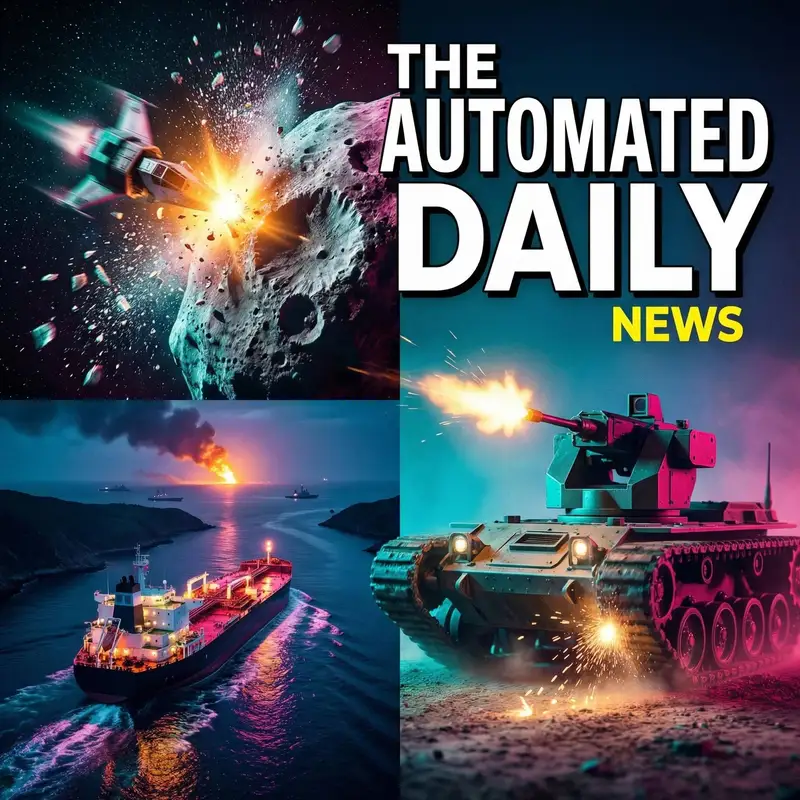
DART shifts an asteroid’s solar orbit, Iran war hits Hormuz shipping and Gulf water security, Ukraine’s ground robots grow, and warming accelerates—March 8, 2026.
Our Sponsors
Today's Top News Topics
- 01
Humans nudge an asteroid
— NASA’s DART mission has now been confirmed to have measurably shifted an asteroid system’s path around the Sun, a key real-world data point for planetary defense. - 02
Iran war squeezes global shipping
— The Iran war is disrupting the Strait of Hormuz, driving up oil prices and prompting the U.S. to backstop maritime reinsurance to keep shipping and trade moving. - 03
Gulf desalination water at risk
— Analysts warn Gulf desalination plants—critical drinking-water infrastructure—could be knocked offline by strikes, power disruptions, or cyberattacks, raising the stakes beyond oil. - 04
Ukraine’s expanding ground robots
— Ukraine is deploying armed uncrewed ground vehicles for ambushes and assaults, while Russia fields its own, pushing warfare toward potential robot-on-robot clashes and new legal debates. - 05
Japan-Canada security and energy pact
— Japan and Canada signed a strategic cooperation roadmap covering defense, economic security, cyber policy, and energy diversification amid rising Indo-Pacific and Middle East tensions. - 06
Warming accelerating faster than expected
— A new study finds human-driven warming has sped up in the past decade, suggesting the world could breach the Paris 1.5°C threshold before 2030 without faster emissions cuts. - 07
Autism study links nitric oxide
— Researchers report a biochemical pathway connecting nitric oxide changes to mTOR overactivity in some autism spectrum disorder models, highlighting potential future therapeutic targets. - 08
Japan approves iPS cell therapies
— Japan approved two regenerative-medicine products using iPS cells—one for Parkinson’s and one for severe heart failure—marking a milestone for cell-based therapies and regulation.
Sources & Top News References
Full Episode Transcript: Humans nudge an asteroid & Iran war squeezes global shipping
For the first time, we’ve confirmed that a human-made spacecraft didn’t just hit an asteroid—it actually nudged a celestial body’s path around the Sun, however slightly. Why that tiny change matters, plus the latest ripple effects from the Iran war on oil, shipping, and even drinking water. Welcome to The Automated Daily, top news edition. The podcast created by generative AI. I’m TrendTeller, and today is March 8th, 2026. Let’s get you caught up.
Humans nudge an asteroid
We’ll start in space, where NASA’s 2022 DART mission just earned an even more historic footnote. DART was the test where a spacecraft deliberately slammed into the small asteroid moonlet Dimorphos. Scientists already knew the hit changed Dimorphos’s orbit around its partner asteroid, Didymos. Now, new research says the impact also measurably shifted the pair’s orbit around the Sun. The adjustment is tiny—think fractions of a second in timing—but it’s a big deal because planetary defense is about starting early. A small push, delivered years in advance, can add up to a meaningful miss distance if an actually hazardous asteroid ever shows up on the radar.
Iran war squeezes global shipping
Turning to the Middle East, the war involving Iran is continuing to spill beyond the battlefield and into daily economics. With the Strait of Hormuz effectively shut down after threats against transiting ships, the U.S. has announced a major maritime reinsurance backstop—coverage meant to keep commercial shipping from grinding to a halt as war-risk premiums soar. The goal is straightforward: if insurance becomes unaffordable, ships don’t sail, and then energy and goods get scarcer and pricier. Markets have already reacted with a sharp rise in crude prices, and that can translate quickly into higher transport costs and broader inflation pressures.
Gulf desalination water at risk
And it’s not just oil. Analysts are warning that the same escalation now threatens a less discussed, but absolutely critical lifeline for the Gulf: drinking water. Many Gulf states rely heavily on desalination plants along the coast, often tied into nearby power and port infrastructure. That means a strike that damages electricity supply, port operations, or connected facilities can still halt water production—even if water plants aren’t the intended target. Some recent strikes reportedly landed near major industrial areas, and there are also growing concerns about cyberattacks on water systems. In a region where redundancy varies widely by country, a prolonged disruption could become a national emergency within days, not weeks.
Ukraine’s expanding ground robots
On the political and strategic side of the same conflict, commentary in the U.S. is increasingly focused on what happens after the bombs fall. One prominent warning: betting on a neat “day after” in Iran—whether that’s regime collapse, a sudden uprising, or a permanently weakened state—may be wishful thinking. The argument is that sustained strikes could just as easily harden attitudes, empower more extreme factions, or trigger instability that spreads. There’s also a concern that the conflict may strain U.S. partnerships in the Gulf, where hosting American forces now carries a more direct risk of retaliation. The bottom line: the war’s second-order effects may outlast the initial military objectives.
Japan-Canada security and energy pact
Related to that, another debated idea reportedly circulating is whether the U.S. should arm Iranian Kurdish opposition groups to pressure Tehran from within. The caution from analysts is familiar: external powers have a track record of treating Kurdish movements as leverage, without committing to long-term protection—leaving civilians exposed to retaliation. There’s also a geopolitical catch. Serious support for Kurdish militants could blow up relations with Turkey, a NATO ally that is highly sensitive to anything connected to Kurdish armed groups. Even if the plan looks “low footprint” on paper, the regional fallout could be anything but.
Warming accelerating faster than expected
Now to Ukraine, where the war is adding another layer to what modern conflict looks like. Ukrainian forces are rapidly expanding the use of armed uncrewed ground vehicles—robots that can carry machine guns or act as explosive “kamikaze” platforms. Commanders say these systems have helped repel attacks, spring ambushes, and in some cases even force Russian troops to surrender. What’s notable is how leaders describe the boundary between automation and human control. Many of these systems can move and spot potential targets, but operators still decide when to fire—citing ethics, international law, and the risk of mistaking civilians. The push is also driven by brutal battlefield math: aerial drones have widened the lethal zone far behind the front, making it more dangerous for soldiers to do basic tasks and worsening manpower strains. Russia is fielding its own combat ground robots too, raising the prospect of direct robot-on-robot encounters as both sides scale up production. If that becomes common, it could reshape tactics and reopen global debates over lethal autonomy.
Autism study links nitric oxide
In the Indo-Pacific, Japan and Canada have signed a strategic agreement aimed at tightening cooperation on defense, economic security, cyber policy, and energy security. The timing reflects two overlapping anxieties: the immediate shock from Middle East instability and the longer-running concern about pressure on trade and security in the region, including China’s growing assertiveness. They’re also moving toward negotiations on a defense pact designed to make joint exercises and military visits easier to organize. The broader message is that energy supply chains and national security are now being treated as part of the same conversation, not separate lanes.
Japan approves iPS cell therapies
On climate, a new study argues that human-caused warming has accelerated sharply over the past decade. After filtering out natural swings like El Niño and volcanic effects across multiple datasets, researchers still see a clear step-up beginning around 2013 or 2014. The headline implication is time: if the faster pace holds, the world could pass the Paris agreement’s 1.5°C long-term limit before 2030. Scientists still debate how much of the recent jump is long-term forcing versus shorter-term variability, but even the discussion itself underscores the point—every year of delay makes the remaining path to limit damage narrower and steeper.
In health and science, researchers at the Hebrew University of Jerusalem reported a molecular chain reaction that may help explain why a pathway called mTOR is overactive in some forms of autism spectrum disorder. In plain terms, they found evidence that changes in nitric oxide signaling can alter a key “brake” protein—TSC2—leading to a surge in mTOR activity. Results from cellular and animal models lined up with patterns they also observed in samples from children with ASD. It’s early-stage research, but it’s interesting because it proposes a specific step that could be tested as a future target for treatment development.
And finally, Japan has approved two regenerative-medicine products using induced pluripotent stem cells—often called iPS cells—one aimed at Parkinson’s disease and another at severe heart failure. This is a milestone because iPS cells have been a long-promised bridge between cutting-edge biology and real clinical use. Japan’s system can allow conditional, time-limited approvals to speed patient access, with continued data collection afterward. Supporters see it as a way to move responsibly but faster; critics will watch closely for how safety and effectiveness hold up at larger scale. Either way, other regulators around the world will be paying attention to what happens next.
That’s the top news edition for March 8th, 2026. If one theme ties today together, it’s how small shifts—whether a spacecraft’s nudge in space or a chokepoint closing at sea—can cascade into bigger consequences. Thanks for listening to The Automated Daily - Top News Edition. I’m TrendTeller. Check back tomorrow for the next rundown.
More from Top News
- October 6, 2026 Plague lab death in Siberia & Saudi-Türkiye-Pakistan defense pact activated
- October 5, 2026 Iran weighs US ceasefire response & Oil producers hold output steady
- October 4, 2026 Middle East standoff deepens again & Flight scare strands Tel Aviv travelers
- October 3, 2026 Diesel Stocks Hit Markets & Weak US Jobs Surprise
- October 2, 2026 US Pressure Builds on Iran & Iraq Moves Against Militias