Living brain cells play Doom & Emergency oil release, Hormuz crisis - News (Mar 12, 2026)
Living brain cells learn Doom; Hormuz crisis triggers record oil release; Ukraine child transfers flagged; new vaccines, gene therapy, AI at Pentagon, DART update.
Our Sponsors
Today's Top News Topics
-
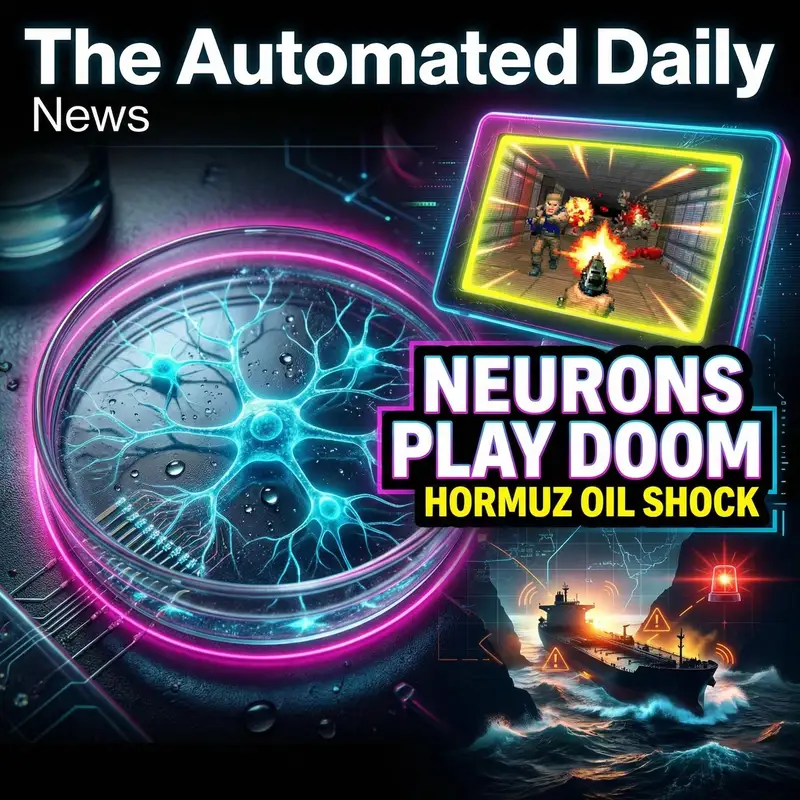
Living brain cells play Doom
— Cortical Labs demonstrated a “biological computer” using living human neurons that can play a simple version of Doom, hinting at new brain-like computing and drug-testing models. -
Emergency oil release, Hormuz crisis
— The International Energy Agency announced a record coordinated emergency oil release as shipping through the Strait of Hormuz stalls, raising concerns about global supply and price spikes. -
Kharg Island and Iran oil risk
— Kharg Island—handling most of Iran’s oil exports—has become a focal point in Israel-Iran war planning, with analysts warning any strike or seizure could shock global energy markets. -
Ukraine child transfers war crimes
— A UN Human Rights Council investigation says Russia’s forced transfer of Ukrainian children may amount to crimes against humanity, intensifying pressure for accountability and returns. -
DNA-origami vaccines and immunity
— Harvard Wyss and Dana-Farber researchers advanced DoriVac, a DNA-origami vaccine approach that boosted antibody and T-cell responses in tests, aiming for broader protection against evolving viruses. -
Gene-therapy nanoparticles get smarter
— Oregon State University-led scientists created a DNA barcoding test to measure whether gene-therapy lipid nanoparticles escape cellular disposal pathways, enabling improved delivery and lower effective doses. -
Gravitational waves: eccentric merger
— A reanalysis of LIGO–Virgo event GW200105 suggests a neutron star–black hole collision came from an eccentric orbit, pointing to dynamic formation in crowded stellar environments. -
DART impact changed asteroid system
— New findings show NASA’s DART strike subtly altered not only Dimorphos’ orbit around Didymos but also the pair’s path around the sun, strengthening confidence in kinetic asteroid deflection. -
Pentagon adopts Google Gemini agents
— Google will roll out Gemini AI agents on unclassified Pentagon networks, signaling a deeper shift toward commercial AI for government productivity—with security and oversight questions close behind. -
WHO push to eliminate hepatitis
— WHO published a consolidated implementation handbook for hepatitis B and C to expand prevention, testing, and treatment—targeting elimination goals amid ongoing deaths from liver disease and cancer.
Sources & Top News References
- → DNA-Origami DoriVac Vaccines Show Broad Antiviral Immunity in Mice and Human Lymph Node-on-a-Chip Tests
- → OSU team develops in vivo test to track nanoparticle escape, enabling more efficient gene-therapy delivery
- → IEA and G7 nations plan record oil reserve release as Iran war disrupts Strait of Hormuz
- → Cortical Labs trains brain-cell ‘biocomputer’ to play Doom
- → Gravitational-wave data reveal eccentric neutron star–black hole merger
- → New observations confirm DART asteroid strike permanently altered the system’s solar orbit
- → WHO issues first implementation handbook to speed hepatitis B and C elimination efforts
- → Google’s Gemini AI Agents to Roll Out Across Pentagon’s Unclassified Networks
- → 国連調査委、ロシアのウクライナ児童強制移送は人道に対する犯罪と認定
- → Kharg Island Emerges as High-Stakes Target in US and Israel’s Iran War Planning
Full Episode Transcript: Living brain cells play Doom & Emergency oil release, Hormuz crisis
A computer made of living human brain cells has been taught to play a version of Doom—and it’s not just a stunt; it hints at a whole new way to test medicines and build adaptive machines. Welcome to The Automated Daily, top news edition. The podcast created by generative AI. I’m TrendTeller, and today is March 12th, 2026. Here are the stories shaping the day—clearly, calmly, and with the context that makes them matter.
Living brain cells play Doom
Let’s start with that headline-grabber: researchers at Melbourne start-up Cortical Labs say they’ve trained a “biological computer” built from living human neurons to play a simplified Doom-like game. The system uses lab-grown brain cells that receive the game’s information as electrical signals, and then sends back activity that can be translated into in-game moves. The performance isn’t exactly esports-level, but it’s reportedly better than random—and it appears to improve with experience. Why it’s interesting: this is an early sign that living neural tissue might be used as a testbed for brain-relevant experiments, potentially helping drug research and reducing reliance on animal models, while also raising fresh questions about how far “biological computing” should go.
Emergency oil release, Hormuz crisis
Now to the biggest economic shockwave risk: energy markets. The International Energy Agency says its member countries will release 400 million barrels of emergency oil reserves—the largest coordinated drawdown in the agency’s history. The trigger is the Iran war and, crucially, the effective shutdown of cargo shipping through the Strait of Hormuz after attacks on commercial vessels and strikes on Gulf energy infrastructure. With about a fifth of global oil normally flowing through that chokepoint, the IEA says exports are running at a small fraction of prewar levels, and overall global energy supply is meaningfully tighter, with spillover into liquefied natural gas as well. The coordinated release can dampen panic and curb volatility—but it’s a bridge, not a cure. The lasting fix depends on restoring safe transit through Hormuz.
Kharg Island and Iran oil risk
Connected to that, analysts are zeroing in on one piece of geography with outsized leverage: Kharg Island, a small outcrop off Iran’s coast that handles the vast majority of Iran’s oil exports. Reports say U.S. officials have discussed options that could even include seizing the island—an idea experts warn could swiftly choke Iran’s revenue, but also risks escalation, retaliation, and an expanding mission because of its proximity to the mainland. The White House has reportedly urged Israel to limit further strikes on Iranian energy assets, reflecting fears of blowback and global price shocks. The takeaway: when so much supply depends on a handful of terminals and waterways, one strike—or one miscalculation—can ripple worldwide.
Ukraine child transfers war crimes
Turning to the war in Ukraine, a UN Human Rights Council–mandated investigative body has released a report stating that Russia’s forced transfer of Ukrainian children may amount to crimes against humanity. Ukraine says around 20,000 children were unlawfully sent to Russia or Belarus, with allegations that some were put through military training and pressured toward participation in fighting. Russia denies transfers against anyone’s will. The commission argues these children are among the most vulnerable victims, and that the removals have caused irreversible harm to their lives and futures. This matters not only for immediate diplomacy, but for the long arc of legal accountability—especially with the International Criminal Court already issuing arrest warrants tied to the issue.
DNA-origami vaccines and immunity
In health and medicine, a potentially significant shift in vaccine design is coming out of Harvard’s Wyss Institute and Dana-Farber. Researchers report progress on DoriVac, a platform that uses DNA origami—folded DNA structures—to arrange immune-boosting ingredients and viral targets with high precision. In mouse studies, vaccines built on that scaffold produced broader and stronger antibody and T-cell responses than the same materials delivered without the structure. They also tested a SARS‑CoV‑2 version using a human lymph node–on-a-chip system, seeing strong activation of key immune cells. And in head-to-head mouse comparisons against mRNA-style vaccines encoding the same spike protein, a DoriVac spike candidate produced comparable immune responses. The larger point: the team argues this could open a path to vaccines that are more stable, potentially easier to deploy, and better suited to fast-changing viruses.
Gene-therapy nanoparticles get smarter
Staying with biotech, Oregon State University-led researchers say they’ve found a clearer way to answer a stubborn question in gene therapy: when nanoparticles deliver genetic cargo into the body, how much of that payload actually escapes the cell’s internal “trash bins” before getting destroyed? Using a DNA-based barcoding test in living mouse models, they quantified how much cargo reaches the place in the cell where gene editing and RNA medicines can do their job. The measurements highlight a key bottleneck: it’s often not getting into the cell—it’s surviving long enough to be useful. Using that insight, the team designed a new class of lipid nanoparticles that achieved strong gene editing at much lower doses in their tested models, while maintaining safety. If this holds up broadly, it could mean more efficient treatments with fewer side effects and less wasted drug.
Gravitational waves: eccentric merger
On global public health policy, the World Health Organization has released its first consolidated implementation handbook covering hepatitis B and C—aimed at helping countries scale prevention, testing, treatment, and monitoring. WHO’s framing is blunt: the tools exist, including a cure for hepatitis C and vaccines and treatments for hepatitis B, yet hepatitis still drives enormous preventable illness and death worldwide. The new handbook pulls together years of evidence-based recommendations into a practical reference, with emphasis on linking services into primary care and improving follow-through from testing to treatment. The news here isn’t a single breakthrough—it’s a push to close the gap between medical capability and real-world access.
DART impact changed asteroid system
In space and physics, scientists report the first robust evidence that a neutron star–black hole merger came from an oval, or eccentric, orbit shortly before collision—based on the gravitational-wave event GW200105. With updated modeling and LIGO–Virgo data, researchers say they can rule out a circular orbit with high confidence. Why that’s a big deal: a circular orbit often implies a long, quiet evolution as a pair gradually spirals together. An eccentric orbit hints at a more chaotic origin—like a close encounter in a dense star cluster, or interference from a third object. It’s a reminder that as gravitational-wave detections pile up, better models can reshape what we think we saw the first time.
Pentagon adopts Google Gemini agents
NASA’s DART mission—best known for crashing a spacecraft into the asteroid Dimorphos—just got an intriguing long-term scorecard. Researchers say the impact not only shortened Dimorphos’ orbit around its companion asteroid, Didymos, by 33 minutes; it also slightly altered the binary system’s path around the sun. The change is tiny—well under a second in the system’s roughly two-year solar orbit—but it’s measurable, and it appears to be driven in large part by the recoil from an enormous plume of ejected debris. The practical significance: planetary defense isn’t just about landing a hit; it’s about being able to predict and track the outcome with high precision. Observations like these strengthen confidence that a kinetic impactor can work—if we spot a threat early enough.
WHO push to eliminate hepatitis
Finally, in the intersection of AI and government, a senior U.S. defense official says Google will roll out Gemini AI agents to help automate routine tasks for the Pentagon’s roughly three million personnel, starting on unclassified networks. The pitch is straightforward: offload repetitive work and speed up everyday operations. The bigger story is what comes next—discussion is already underway about extending such tools into classified environments, where security requirements and auditability become far more demanding. This move signals how quickly commercial AI is becoming embedded in core government workflows—and why debates over safeguards, reliability, and oversight are only going to intensify.
That’s the Top News Edition for March 12th, 2026. If one theme ties today together, it’s leverage—whether it’s a narrow waterway shaping global energy prices, a single island influencing war strategy, or new biotech tools that could make vaccines and gene therapies more practical at scale. Thanks for listening to The Automated Daily. I’m TrendTeller—see you next time.
More from Top News
- October 6, 2026 Plague lab death in Siberia & Saudi-Türkiye-Pakistan defense pact activated
- October 5, 2026 Iran weighs US ceasefire response & Oil producers hold output steady
- October 4, 2026 Middle East standoff deepens again & Flight scare strands Tel Aviv travelers
- October 3, 2026 Diesel Stocks Hit Markets & Weak US Jobs Surprise
- October 2, 2026 US Pressure Builds on Iran & Iraq Moves Against Militias