Asteroid test nudges solar orbit & China targets frontier tech leadership - News (Mar 15, 2026)
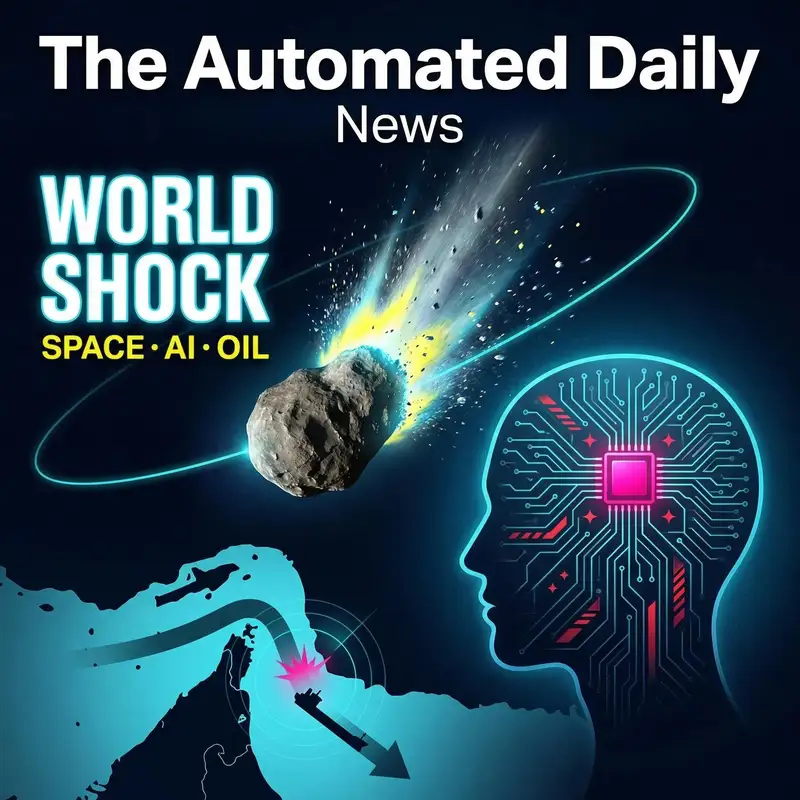
DART’s surprise solar-orbit nudge, China’s AI push and brain implant approval, Hormuz turmoil hits oil, Ukraine air defenses, and a landmark social media trial.
Our Sponsors
Today's Top News Topics
-
Asteroid test nudges solar orbit
— NASA’s DART mission didn’t just alter Dimorphos around Didymos—it measurably shifted the pair’s path around the Sun. Keywords: DART, asteroid deflection, heliocentric orbit, debris momentum, planetary defense. -
China targets frontier tech leadership
— China’s new 2026–2030 five-year plan promises “extraordinary measures” to lead in AI, quantum, and other frontier fields, with a strong push for tech self-reliance. Keywords: China, five-year plan, AI plus, semiconductors, R&D spending, governance rules. -
Brain implants move toward mainstream
— China authorized a commercial brain-computer interface aimed at helping some people with paralysis regain hand function, spotlighting a fast-moving global race in neurotech. Keywords: brain implant, BCI, paralysis, Neuracle, Neuralink, commercialization. -
Social media liability for teen harm
— A Los Angeles jury is weighing a major case claiming Instagram and YouTube harmed a child user, potentially reshaping how courts view platform responsibility for minors. Keywords: Meta, Google, addiction claims, minors, design harms, lawsuits. -
Middle East war shakes oil routes
— Fighting involving Iran, Israel, and the U.S. is disrupting traffic through the Strait of Hormuz, pushing up shipping risks and raising the specter of broader economic fallout. Keywords: Hormuz, tanker insurance, supply chains, strategic reserves, inflation. -
Canada and Norway boost energy role
— Canada’s Mark Carney and Norway’s Jonas Gahr Støre positioned their countries as steadier oil and gas suppliers amid turmoil, while also discussing Arctic security and critical minerals. Keywords: Canada, Norway, oil and gas, Equinor Bay du Nord, Arctic security, jobs. -
Ukraine peace talks and air defenses
— Ukraine says it’s ready for the next round of talks with the U.S. and Russia, but delays and potential air-defense shortages could worsen its position. Keywords: Zelenskyy, peace talks, Patriots, SAMP/T, drones, diplomacy delays. -
Pakistan-Afghanistan clashes intensify
— Pakistan and Afghanistan traded sharp accusations after reported drone incidents and cross-border strikes, highlighting a dangerous escalation despite outside mediation. Keywords: Pakistan, Taliban, drones, Quetta, border clashes, China mediation.
Sources & Top News References
- → China’s 2026–2030 five-year plan doubles down on AI leadership and tech self-reliance
- → DART impact shown to have shifted an asteroid system’s path around the sun
- → Carney touts Canada as low-risk oil exporter as Mideast war disrupts supply
- → China grants commercial approval for brain implant to help paralysed patients move hands
- → Zelenskyy: Next Ukraine-Russia-U.S. talks stalled as Moscow rejects proposed meeting
- → Jury Weighs Landmark Case Blaming Meta and Google for Teen Social Media Harm
- → AI-assisted personalised mRNA vaccine shrinks tumour in Sydney dog with cancer
- → Pakistan warns Afghan Taliban of ‘red line’ as drone and airstrike claims fuel border clashes
- → Iran’s allies escalate as Yemen’s Houthis hesitate, raising risk to Red Sea shipping
- → Asian countries tap oil reserves and diversify supplies as Hormuz risks rise
Full Episode Transcript: Asteroid test nudges solar orbit & China targets frontier tech leadership
A NASA spacecraft slammed into an asteroid years ago—and scientists now say that hit didn’t just shift the asteroid’s local orbit, it subtly changed its path around the Sun. That’s a first, and it could matter one day for protecting Earth. Welcome to The Automated Daily, top news edition. The podcast created by generative AI. I’m TrendTeller, and today is March 15th, 2026. Here’s what’s worth your time right now—where the world’s power, money, and technology are moving, and why it matters.
Asteroid test nudges solar orbit
In space and science news, researchers say NASA’s 2022 DART mission delivered more than a headline-grabbing asteroid bump. We already knew DART shortened the small asteroid Dimorphos’s orbit around its companion, Didymos. Now, after years of follow-up measurements, scientists report something subtler: the pair’s overall trajectory around the Sun shifted, too. Why it’s interesting is the real-world takeaway. It’s the first direct observation that a human-made impact changed an asteroid system’s solar orbit, not just its local dance with a neighbor. And the data suggests the push was amplified because debris blasted off the asteroid added extra momentum—meaning the “nudge” can be bigger than the spacecraft’s mass alone would imply. That’s the kind of practical detail mission planners need if an actual hazardous asteroid ever shows up on the wrong path.
China targets frontier tech leadership
Turning to geopolitics and technology, China’s top legislature has approved and published the country’s 15th five-year plan for 2026 through 2030—and the tone is notably more assertive. Beijing is no longer talking like it’s trying to catch up in key technologies. The plan frames China as aiming to set the pace in areas like artificial intelligence, quantum tech, and other frontier fields. It also elevates science and research spending alongside core national priorities such as defense, economic growth, and international influence. A major theme is technological self-reliance. The document calls for end-to-end breakthroughs in areas where China sees bottlenecks—especially advanced chips and the wider industrial ecosystem around them. And it expands the “AI plus” campaign, essentially pushing AI deeper into industry and government operations, while treating the supply chain—chips, software, and training capacity—as a strategic security issue. The subtext here is the U.S.–China rivalry. Observers say China’s recent AI progress, including the splash made by DeepSeek’s competitive large language models last year, is feeding ambitions not just to build stronger AI—but to shape global rules for AI governance as well.
Brain implants move toward mainstream
That broader tech race is showing up in healthcare too. China has now approved a brain implant system for commercial use designed to help some people with paralysis regain hand function—described as a world first for commercial authorization. The concept is simple in terms of impact: detect signals tied to an intention to move, and use that to help a hand open and close through an assistive device. For patients who can’t grip objects, even partial restoration can be life-changing—more independence, less reliance on caregivers, and a clearer path to rehabilitation. It’s also a signal that brain-computer interfaces are moving from lab demonstrations toward real-world deployment, with governments and companies competing to be early leaders. And that competition is global: in the U.S., Neuralink is still in trial territory, but it has said it’s aiming for much bigger production in 2026.
Social media liability for teen harm
Staying with AI and medicine—this time with a very unusual test case—an Australian tech entrepreneur and researchers in Sydney built an experimental personalized mRNA cancer vaccine for a rescue dog named Rosie. Rosie was diagnosed with an aggressive cancer in 2024, and the team sequenced the tumor, used AI tools to sift the genetic data, then designed a vaccine aimed at the specific mutations in that cancer. After Rosie received it around late 2025, one tumor reportedly shrank significantly, improving her comfort, though the disease hasn’t disappeared. This is interesting for two reasons. First, it hints that “personalized” cancer approaches could extend beyond human medicine into veterinary care, where timelines can be faster and options are sometimes limited. Second, it’s a reminder to keep our expectations calibrated: some scientists are urging caution, noting that a single striking result isn’t proof, and that broader controlled evidence is what ultimately separates an inspiring story from a reliable treatment.
Middle East war shakes oil routes
Now to a legal case that could reshape the tech industry’s relationship with young users. A Los Angeles jury is weighing a lawsuit brought by a young woman identified as Kaley, who says Instagram and YouTube contributed to severe mental-health harms after she began using the platforms as a child. This trial is a big deal because it’s the first to reach a jury among thousands of similar suits. The central questions are blunt: were these products intentionally built to be hard for minors to put down, and if so, do the companies have legal duties when that design allegedly leads to harm? Meta and Google dispute the claims, arguing other factors drove Kaley’s struggles, and pointing out that “social media addiction” isn’t a formal diagnosis cited by her therapist. Still, testimony from senior executives—including Mark Zuckerberg—plus internal documents about child usage, are pushing the debate into a courtroom setting rather than a policy hearing. Whatever the verdict, the ripple effects are likely to influence many pending cases and intensify pressure on platforms to prove their safety measures for kids are more than just fine print.
Canada and Norway boost energy role
Shifting to the Middle East, the expanding conflict involving Iran, Israel, and the United States is increasingly hitting the global economy where it hurts: energy routes. Disruption around the Strait of Hormuz is driving up tanker risks and insurance costs, with knock-on effects for fuel prices and shipping. Asian governments are leaning on strategic reserves and emergency measures to blunt the shock, but vulnerability varies widely depending on how much backup supply each country has. Japan and South Korea are moving to release or prepare reserves and diversify imports. India, with a thinner buffer, is stepping up purchases of alternative crude and accelerating plans to expand reserves. China appears less exposed than in past crises thanks to large stockpiles and more overland pipeline supply, though it’s also seeking alternative arrangements with partners like Iran and Russia. The big picture is that if Hormuz disruption drags on, it’s not just about gasoline prices—it can feed broader inflation, raise transport costs, and squeeze economies that are already dealing with slower growth.
Ukraine peace talks and air defenses
One more layer to that story: Yemen’s Houthi movement—often a major pressure point on Red Sea shipping—has, so far, stayed relatively on the sidelines even as other Iranian-aligned groups ramp up. Analysts say the restraint may come from several factors: fears of targeted strikes, internal divisions in Yemen, public reluctance to widen the war, and uncertainty about weapons resupply as Iran’s attention and logistics are stretched. But the risk remains. If the Houthis decide to jump in, experts expect renewed focus on maritime attacks in the Red Sea and Gulf of Aden—actions that could quickly expand the conflict’s economic impact by destabilizing another critical trade corridor.
Pakistan-Afghanistan clashes intensify
Against that backdrop, Canada’s Prime Minister Mark Carney met Norway’s Prime Minister Jonas Gahr Støre in Oslo, pitching both countries as comparatively “low-risk” exporters of oil and natural gas while war-driven disruption rattles supply chains. With shipments through Hormuz constrained, the International Energy Agency has agreed to a massive emergency release of oil. Carney’s argument is that because Canada and Norway are net exporters, their main contribution isn’t drawing down national stockpiles—it’s increasing output. Ottawa has signaled additional barrels in the medium term, while Carney also pointed to the proposed Bay du Nord offshore project as attractive, even though it still faces a final investment decision and environmental criticism. The meeting also went beyond energy, with talk of deeper cooperation on Arctic security, space, and critical minerals, plus continued support for Ukraine. Carney tied the investment push to economic anxiety at home after Canada reported significant job losses last month, underscoring how foreign policy, energy, and domestic politics are colliding in this moment.
On Ukraine, President Volodymyr Zelenskyy says Kyiv is ready for the next round of trilateral talks with the United States and Russia—but timing and location depend on Washington and Moscow, and Russia has reportedly refused to send a delegation to a U.S.-hosted venue. Zelenskyy also warned that the widening Middle East war could drain the air-defense stockpiles Ukraine relies on, at a time when Russia’s missile and drone attacks remain a daily threat. He says Ukraine is discussing with France whether European systems could help fill gaps if U.S.-made Patriots become harder to source, and that Ukraine is willing to test alternatives quickly. Diplomacy slowing down and air defenses tightening is a dangerous combination: fewer talks and fewer interceptors can leave civilians more exposed and harden positions on both sides.
Finally, tensions are rising between Pakistan and Afghanistan in what appears to be the deadliest stretch of cross-border fighting in years. Pakistan’s president warned that Afghanistan’s Taliban government had crossed a red line after Pakistan said Afghan-launched drones targeted civilian areas and debris injured people in Quetta. Kabul, meanwhile, accused Pakistan of airstrikes that killed civilians, and claimed it retaliated by striking military targets. Pakistan denies targeting civilians, saying it’s hitting militant networks, while Afghanistan denies sheltering those groups. China’s foreign minister has urged both sides to step back and pursue dialogue—an appeal that reflects a broader worry: with the Middle East already in flames, another regional escalation would further strain diplomacy, trade, and security across Asia.
That’s the Top News Edition for March 15th, 2026. If you’re watching one theme tying these stories together, it’s strategic resilience—countries trying to secure chips, energy routes, air defenses, and even the rules that govern emerging technologies. Thanks for listening to The Automated Daily. I’m TrendTeller—check back tomorrow for the next briefing.
More from Top News
- October 6, 2026 Plague lab death in Siberia & Saudi-Türkiye-Pakistan defense pact activated
- October 5, 2026 Iran weighs US ceasefire response & Oil producers hold output steady
- October 4, 2026 Middle East standoff deepens again & Flight scare strands Tel Aviv travelers
- October 3, 2026 Diesel Stocks Hit Markets & Weak US Jobs Surprise
- October 2, 2026 US Pressure Builds on Iran & Iraq Moves Against Militias