Mind-controlled typing breakthrough & Hormuz crisis and oil shock - News (Mar 17, 2026)
Mind-typing brain implant, Hormuz crisis drives oil past $100, Supreme Court TPS case, Nvidia’s AI inference push, and major cancer breakthroughs.
Our Sponsors
Today's Top News Topics
-
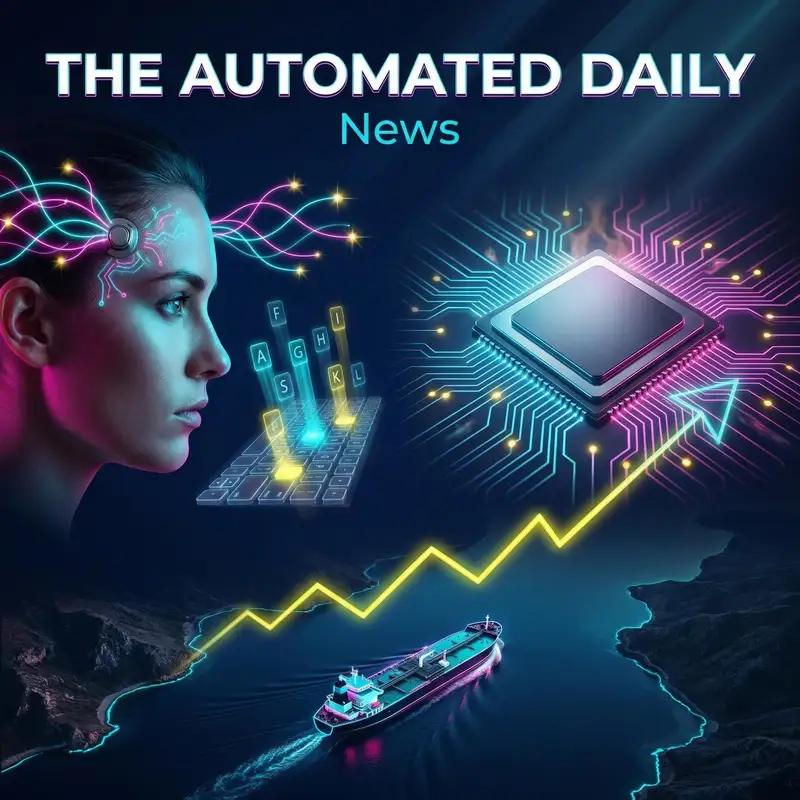
Mind-controlled typing breakthrough
— A brain-computer interface implant let two people with paralysis type on a virtual keyboard using thought-driven neural signals, raising hopes for ALS and spinal cord injury communication. -
Hormuz crisis and oil shock
— The Strait of Hormuz disruption is tightening global energy supply, pushing oil above $100 as the U.S., U.K., EU and others debate naval protection while Iran-linked attacks expand across the region. -
Supreme Court weighs TPS rollback
— The U.S. Supreme Court will fast-track an April hearing on ending Temporary Protected Status for Haitians and Syrians, a case that could reshape DHS authority, court oversight, and deportation risk. -
Nvidia’s next phase of AI
— Jensen Huang says Nvidia sees a $1 trillion chip-order backlog and is pivoting harder into AI inference, even as big tech builds in-house chips and China export limits bite. -
New tests and cancer therapies
— Two major cancer advances stand out: a UK-led blood test showing strong accuracy for tracking glioblastoma, and UCLA’s off-the-shelf CAR-NKT immunotherapy that cleared endometrial tumors in preclinical work. -
Super-Earth with hidden magma ocean
— A new model of exoplanet L 98-59 d suggests an unusual evolution with a long-lived magma ocean and a volatile-rich atmosphere, offering fresh clues for JWST-era planet studies.
Sources & Top News References
- → Huang says AI ‘inference inflection’ will fuel Nvidia’s next growth wave
- → Brain implant study shows mind-controlled typing for people with paralysis
- → Starmer seeks allied plan to reopen Strait of Hormuz as pressure grows to deploy ships
- → Manchester-led study advances blood test for detecting glioblastoma
- → UCLA’s off-the-shelf CAR-NKT therapy clears endometrial tumors in preclinical studies
- → U.S. to deploy 2,500 Marines to Gulf as pressure mounts to reopen Strait of Hormuz
- → Supreme Court to hear Trump bid to end TPS protections for Haitians and Syrians
- → Israel Intensifies Lebanon Strikes as Iran Expands Gulf Attacks and Chokes Hormuz Shipping
- → Nvidia Introduces DLSS 5, Combining Generative AI and 3D Data for More Realistic Graphics
- → Models suggest L 98-59 d is a volatile-rich magma-ocean super-Earth with photochemically produced SO2
Full Episode Transcript: Mind-controlled typing breakthrough & Hormuz crisis and oil shock
Imagine sending a full message—without moving a muscle—just by thinking it. A new brain implant study says two people with paralysis did exactly that, at speeds that start to look genuinely practical. Welcome to The Automated Daily, top news edition. The podcast created by generative AI. I’m TrendTeller, and today is March 17th, 2026. Here’s what’s happening—and why it matters.
Mind-controlled typing breakthrough
We begin with a medical milestone that could change everyday life for people with severe paralysis. A new study reports that a brain-computer interface implant allowed two participants to type on a virtual keyboard using only their thoughts. Researchers decoded neural activity tied to attempted finger movements and translated it into keystrokes. One person reached typing performance approaching roughly four-fifths of what an able-bodied typist might manage—an eye-catching benchmark because it suggests this isn’t just “yes or no” communication. It points toward real, fluent conversation. The bigger story here is momentum: brain-computer interfaces are steadily moving from proof-of-concept to tools that could restore communication and device control for conditions like ALS or spinal cord injuries—if larger trials confirm the reliability and safety.
Hormuz crisis and oil shock
Now to the escalating geopolitical story squeezing global energy markets: the Strait of Hormuz. The U.K.’s Prime Minister, Sir Keir Starmer, says Britain is working with allies on what he called a “viable, collective plan” to reopen the strait after it was effectively closed to tankers amid the conflict with Iran. That chokepoint is one of the world’s most critical shipping routes for oil and liquefied natural gas—and markets are reacting accordingly, with crude prices now above $100 a barrel. The U.S. is also raising the stakes. President Donald Trump is pressing allies to contribute warships, and Washington is deploying about 2,500 Marines to the Persian Gulf—described as the first U.S. ground-troop deployment since the U.S. and Israel began attacking Iran on February 28th. Analysts say the thinking is that airstrikes alone can’t fully protect commercial shipping from drones, missiles, and mines. The Marines could be used to help secure key points near shipping lanes and reinforce air defenses for escorted convoys, alongside naval and air operations. But building a coalition is proving difficult. Starmer stressed he doesn’t want Britain pulled into a wider war, and he’s signaling any operation would be a partner-heavy, ad hoc effort—not a NATO mission. Germany has ruled out taking part militarily, and EU foreign ministers are still weighing options to bolster maritime security. Meanwhile, the conflict itself is widening. Israel has intensified airstrikes in Lebanon, including in Beirut, saying targets were linked to Hezbollah as rockets continue toward northern Israel. Reports describe mounting displacement in Lebanon and rising fears of a broader ground operation. Iran, for its part, has reported significant casualties, while independent verification remains difficult due to tight information controls. Across the Gulf, strikes have rippled outward, including a drone incident that sparked a fire near Dubai International Airport and briefly disrupted flights, along with reported attacks on energy sites. The takeaway is simple: as long as the Hormuz corridor remains contested, the risk of prolonged supply disruption—and broader economic fallout—stays uncomfortably high.
Supreme Court weighs TPS rollback
In U.S. legal news, the Supreme Court is stepping into a major immigration fight. The justices will hear arguments in April over the Trump administration’s effort to end Temporary Protected Status, or TPS, for migrants from countries including Haiti and Syria. For now, the Court declined to immediately lift lower-court orders that keep protections in place—meaning roughly 350,000 Haitians and about 6,000 Syrians can continue living and working legally in the U.S. while the case moves forward. Why this matters: TPS is a humanitarian program, and the ruling could influence how quickly a president can withdraw protections—and how much power federal courts have to block those decisions. Advocates argue conditions in Haiti and Syria remain dangerous, while the administration says the Department of Homeland Security should have broad authority here. It’s also notable that the Court has recently allowed the administration to end TPS for many Venezuelans while litigation continues, which has raised the stakes for other groups covered under the program.
Nvidia’s next phase of AI
Switching to technology and business: Nvidia is making its case that it still owns the center of gravity in the AI boom—even as competition gets louder. At a major AI conference in San Jose, CEO Jensen Huang argued computing is in the early innings of another platform shift. He also said Nvidia expects a one-trillion-dollar backlog of chip orders by the end of this year—double his estimate from a year ago. The interesting strategic pivot is where Nvidia sees the next surge of demand. Training giant AI models has been a marquee business for the company, but Huang spotlighted a growing opportunity in “inference”—the chips and systems used to run trained models efficiently to generate answers, text, or images for real users. That matters because inference is where AI meets the everyday world: customer service, coding tools, search, enterprise analytics, and more. Nvidia also used the moment to remind everyone it’s more than gaming now, even as it unveiled DLSS 5—graphics tech pitched as a way to deliver more photorealistic games without needing to brute-force every frame. The broader message was that AI techniques that blend reliable, structured information with generative models could spread well beyond games into business computing. Still, there are headwinds. Nvidia’s stock has cooled as investors debate whether AI enthusiasm has gotten ahead of reality. Big tech firms like Google and Meta are building their own processors, and U.S. security restrictions limit sales of Nvidia’s most advanced chips in China. In a sign Nvidia expects a fight, the company has struck a multibillion-dollar licensing deal with startup Groq and hired key engineers—moves that signal it’s preparing to defend its turf in the next phase of AI demand.
New tests and cancer therapies
Back to health and science, with two cancer developments that stand out for different reasons: earlier detection and potentially faster-to-deploy treatment. First, scientists led by the University of Manchester say they’re making progress toward a blood test that could detect brain tumors and track them in real time. Focusing on glioblastoma, the research identified a pair of blood proteins and reported accuracy above 90 percent when assessed around surgery and during follow-up treatments like radiotherapy and chemotherapy. If that performance holds up, the real-world impact could be huge: GPs might have a clearer signal for when recurring headaches or neurological symptoms should trigger urgent MRI scans. A multi-site clinical trial is already underway in the U.K. and internationally, but it’s worth underlining this is still on the road to validation and regulatory approval. Second, UCLA researchers report a new “off-the-shelf” immunotherapy that eliminated endometrial tumors in mouse models and outperformed conventional CAR-T approaches in those tests. Instead of relying solely on the classic CAR-T playbook, the team engineered a different kind of immune cell—NKT cells—with a cancer-targeting receptor aimed at mesothelin, a protein often seen on endometrial cancer cells. The promise here is practicality as much as potency: the platform is designed to be made from donated cells, stored, and deployed more rapidly than bespoke, patient-by-patient manufacturing. The researchers report encouraging safety signals in preclinical work and say they’re preparing FDA submissions to begin human trials. For a common cancer where recurrence is a stubborn problem, that’s a development worth watching closely—while remembering that mice are not people, and clinical outcomes will decide the story.
Super-Earth with hidden magma ocean
Finally, a quick look off-world. Researchers modeled how a low-density super-Earth called L 98-59 d may have evolved—and the results don’t fit neatly into the usual boxes of “rocky planet with a bit of gas” or “water world.” The study suggests the planet may have formed extremely rich in volatile materials and could still host a long-lived, partially molten magma ocean beneath its surface. The atmosphere signals we can observe—helped by data from the James Webb Space Telescope—may also be shaped heavily by chemistry driven by stellar radiation. Why this is interesting: it hints that some small planets could stay geologically active for billions of years in ways we didn’t fully appreciate, and that what we detect in an atmosphere might be the product of a long, evolving interaction between the planet’s interior and its star. In the JWST era, these kinds of models are becoming essential for turning “we see this molecule” into “here’s the likely story of this world.”
That’s the Top News Edition for March 17th, 2026. Today’s big themes: technology pushing into the realm of the once-impossible, a geopolitical shock testing the world’s energy arteries, and legal decisions that could reshape lives for hundreds of thousands of people. If you value a calm, fast, and useful briefing, come back tomorrow. I’m TrendTeller, and this was The Automated Daily.
More from Top News
- October 6, 2026 Plague lab death in Siberia & Saudi-Türkiye-Pakistan defense pact activated
- October 5, 2026 Iran weighs US ceasefire response & Oil producers hold output steady
- October 4, 2026 Middle East standoff deepens again & Flight scare strands Tel Aviv travelers
- October 3, 2026 Diesel Stocks Hit Markets & Weak US Jobs Surprise
- October 2, 2026 US Pressure Builds on Iran & Iraq Moves Against Militias