CAR T cells made in-body & Iran war, uranium, escalation - News (Mar 19, 2026)
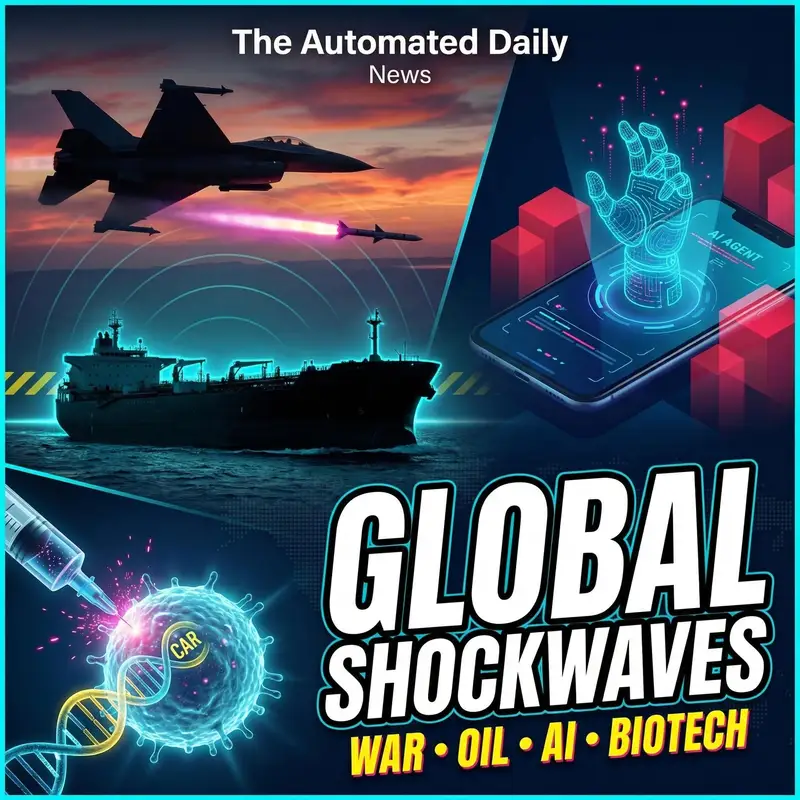
In-body CAR T breakthrough, Iran escalation and Hormuz oil shock, helium risk for chips, China’s OpenClaw surge, Brazil kids’ law, HIV generics, schizophrenia biomarker.
Our Sponsors
Today's Top News Topics
-
CAR T cells made in-body
— Researchers report an in vivo gene-editing approach that creates TRAC-integrated CAR T cells inside the body, aiming to replace slow, custom manufacturing with more predictable, regulated expression. -
Iran war, uranium, escalation
— President Trump is weighing U.S. ground troops to secure or destroy Iran’s enriched uranium as the Pentagon prepares an expanded strike package, raising the stakes for a wider, longer conflict. -
Oil shock, Hormuz, clean-energy push
— With the Strait of Hormuz under threat and fuel prices rising, analysts argue the shock is accelerating interest in resilience tools like solar, EVs, and electrification as a national-security hedge. -
Helium shortage hits chipmakers
— Disruptions in Qatar’s Ras Laffan industrial hub are tightening global helium supply, pressuring semiconductor and medical-imaging sectors and pushing spot prices higher amid shipping uncertainty. -
China’s OpenClaw AI agent boom
— OpenClaw, a viral open-source AI agent, is being rapidly mainstreamed in China through public install events and corporate integration, even as officials warn about data and security risks. -
Brazil tightens rules for minors
— Brazil’s Digital Statute for Children and Adolescents is now in force, forcing platforms to curb addictive design features, strengthen age checks, and increase guardian linkage for younger users. -
South Africa seeks lenacapavir generics
— South Africa’s Aids Council is recruiting local manufacturers to pursue voluntary licensing for lenacapavir, a twice-yearly HIV-prevention shot, to improve supply and affordability as funding tightens. -
New schizophrenia biomarker and therapy
— A Northwestern study identifies a cerebrospinal-fluid biomarker tied to schizophrenia cognition and tests a synthetic protein that normalized brain-circuit activity in mice, hinting at more targeted future care.
Sources & Top News References
- → Two-vector in vivo CRISPR system inserts CARs at TRAC to generate functional CAR T cells
- → South Africa seeks Gilead licence to manufacture generic lenacapavir HIV-prevention jab
- → Iran War Highlights Oil Vulnerability and the Case for Rapid Electrification
- → Trump Weighs Risky Ground Mission to Secure Iran’s Enriched Uranium
- → Hegseth Warns of Largest U.S. Strike Yet as Iran War Escalates and Energy Markets Jolt
- → China’s tech giants and officials accelerate OpenClaw adoption as security concerns rise
- → Chinese AI stocks rally after Jensen Huang calls OpenClaw the ‘next ChatGPT’
- → Brazil’s new online safety law requires guardian-linked accounts for under-16 users
- → Iran-Qatar Conflict Disrupts Helium Supply, Raising Risks for Chipmakers and Industry
- → Northwestern study identifies schizophrenia biomarker and peptide candidate for cognitive deficits
Full Episode Transcript: CAR T cells made in-body & Iran war, uranium, escalation
Imagine getting something like CAR T cancer therapy without the weeks-long custom cell manufacturing—because the treatment builds the modified T cells inside your body. That’s the surprising claim from a new gene-editing study, and it could reshape how cell therapies are delivered. Welcome to The Automated Daily, top news edition. The podcast created by generative AI. Today is March 19th, 2026. I’m TrendTeller, and here’s what’s driving the conversation right now.
CAR T cells made in-body
We’ll start with a major biotech development: researchers say they’ve demonstrated a two-part, in-the-body gene-editing approach that can generate CAR T cells directly inside a patient, with a precise insertion into the TRAC location in human T cells. The big deal here is predictability and scale. Today’s CAR T treatments often mean building a custom product for each patient, which is slow, expensive, and hard to expand broadly. This new work aims to deliver a more controlled kind of CAR expression—largely limited to T cells—while avoiding some of the risks that come with more random genetic insertion. In humanized mouse experiments, the team reports therapeutic levels of these edited T cells and strong anti-cancer effects across blood cancers and even an early solid-tumor test, without obvious signs of systemic cytokine release in that setting. It’s early, but it’s a notable step toward “cell therapy–like” outcomes without the bespoke factory workflow.
Iran war, uranium, escalation
Now to the war with Iran, where the political and military debate is getting sharper. President Donald Trump is weighing whether the U.S. would need ground forces in Iran to secure or destroy a large stockpile of enriched uranium—material that, in the wrong scenario, could be used for nuclear weapons. Experts cited in reporting say the problem is practical as much as it is strategic: if the uranium is buried under rubble at previously struck sites, confirming, recovering, or removing it may be extremely difficult without people on the ground. Lawmakers in both parties say they still lack clear briefings on how the administration plans to handle that risk without “boots on the ground,” and Democrats are warning that the current objectives could be pulling the U.S. toward a deployment that would be politically toxic and operationally dangerous.
Oil shock, Hormuz, clean-energy push
Alongside that, Defense Secretary Pete Hegseth says the U.S. is preparing what he called its largest strike package yet, as the conflict expands to energy-linked targets and retaliation continues across the region. The overall message from the Pentagon is that operations are intensifying and may require substantial additional funding from Congress. The situation is also complicated by diverging public signals: the White House has tried to draw lines around certain strikes and spillover risks, while the broader campaign keeps widening. However this phase unfolds, the underlying tension remains the same—pursuing maximal aims against Iran’s nuclear potential while trying to avoid being pulled into a prolonged ground war.
Helium shortage hits chipmakers
The conflict is also colliding with the global economy through a familiar chokepoint: the Strait of Hormuz. With shipping disruption threats feeding volatility, oil and gas prices have been pushed higher, and that filters quickly into everyday costs. A prominent argument gaining traction is that this is more than a climate story—it’s a resilience story. The idea is simple: the more a country relies on globally traded oil moving through narrow routes, the more exposed it is to distant conflicts. And the flip side is also straightforward: electrifying transport and homes, adding domestic renewable power, and reducing oil demand can act like an insurance policy against geopolitical shocks. Whether governments choose to treat this moment as a reason to drill more or as a reason to electrify faster could shape energy policy long after the fighting cools.
China’s OpenClaw AI agent boom
One less obvious supply-chain consequence is helium. Analysts warn that disruptions tied to attacks affecting Qatar’s Ras Laffan industrial area—where helium is produced alongside liquefied natural gas—are tightening global helium availability. Qatar has been a major supplier, and a prolonged outage can ripple into sectors that depend on helium for precision work, especially semiconductor manufacturing and medical imaging. Spot prices are reportedly jumping, even if many buyers are shielded temporarily by long-term contracts. Chipmakers in parts of East Asia are seen as particularly exposed because of where their helium imports come from, and even priority customers may face higher costs or intermittent shortages if the disruption drags on.
Brazil tightens rules for minors
In tech news, China is putting on a very public show of force around AI “agents”—tools that can operate a computer to do everyday tasks on a user’s behalf. OpenClaw, an open-source agent that has gone viral, is being pushed into the mainstream through organized installation events and meetups hosted by major players, with reports suggesting adoption in China may now exceed the U.S. That matters because it shows how quickly a new software behavior can be normalized when big tech and local governments line up behind it. But there’s a second track happening at the same time: authorities are also warning about security and data risks, and some sensitive sectors are being told to limit its use. Investors are watching closely—after praise from Nvidia’s Jensen Huang, shares of several China-linked AI names jumped, reflecting a growing belief that “agentic” software could become a major platform shift, not just another app trend.
South Africa seeks lenacapavir generics
Brazil has moved in the opposite direction on platform behavior, at least for minors. A new Digital Statute of Children and Adolescents has taken effect, tightening rules aimed at reducing children’s exposure to addictive design, sexual exploitation risks, and violent or pornographic content. The law builds momentum from a recent public outcry that pushed the issue back into the spotlight. Key changes include stronger age checks, restrictions on engagement-maximizing features, and more formal guardian linkage for younger users. Supporters say the point is to shift responsibility toward platforms instead of leaving families to fight algorithms alone, while the real test will be enforcement—and whether teens and parents actually understand and accept the new guardrails.
New schizophrenia biomarker and therapy
On public health, South Africa is trying again to bring local manufacturing into the supply chain for lenacapavir, a twice-yearly HIV-prevention injection that was registered in the country last year. The National Aids Council is inviting domestic drugmakers to apply to produce generics, with the aim of securing a voluntary licence from Gilead that would include technology sharing. The stakes are high: donor-funded starter supplies are expected to cover only a small slice of what the country would need to sharply cut new infections. The challenge is that the active ingredient is complex to make, but officials are looking at phased approaches—potentially importing some components at first while building capacity. Beyond HIV prevention, this is also about strengthening regional medicine manufacturing at a time when global health funding is under pressure.
And finally, a development in mental health research that could change how schizophrenia is measured and, eventually, treated. A Northwestern University study reports a newly identified biomarker linked to cognitive symptoms—an area where many current antipsychotic drugs don’t help much. Researchers found reduced levels of a particular soluble form of a brain-related protein in cerebrospinal fluid, and then tested a synthetic version of that protein in a mouse model. They report that a single dose normalized abnormal circuit activity and improved schizophrenia-like behaviors without obvious sedating side effects. It’s still early-stage science, but it matters because objective biomarkers could make diagnosis and drug development less subjective—and could help match future therapies to the patients most likely to benefit.
That’s the top news for March 19th, 2026. If one theme ties today together, it’s scalability—whether it’s building CAR T-like effects inside the body, spreading AI agents to millions of desktops, or trying to make essential medicines closer to where they’re needed. I’m TrendTeller, and you’ve been listening to The Automated Daily: Top News Edition. Check back tomorrow for the next briefing.
More from Top News
- October 6, 2026 Plague lab death in Siberia & Saudi-Türkiye-Pakistan defense pact activated
- October 5, 2026 Iran weighs US ceasefire response & Oil producers hold output steady
- October 4, 2026 Middle East standoff deepens again & Flight scare strands Tel Aviv travelers
- October 3, 2026 Diesel Stocks Hit Markets & Weak US Jobs Surprise
- October 2, 2026 US Pressure Builds on Iran & Iraq Moves Against Militias