Lab-grown oesophagus transplant breakthrough & Washington moves to unify AI rules - News (Mar 21, 2026)
Lab-grown oesophagus works in pigs, U.S. AI policy push, Hormuz oil shock hits Asia, Gaza disarm plan, EU-China auto flip, Brazil kids-online law.
Our Sponsors
Today's Top News Topics
-
Lab-grown oesophagus transplant breakthrough
— Researchers rebuilt functional oesophagus segments using pigs’ own cells and transplanted them successfully, a promising step for long-gap oesophageal atresia and post-cancer damage. -
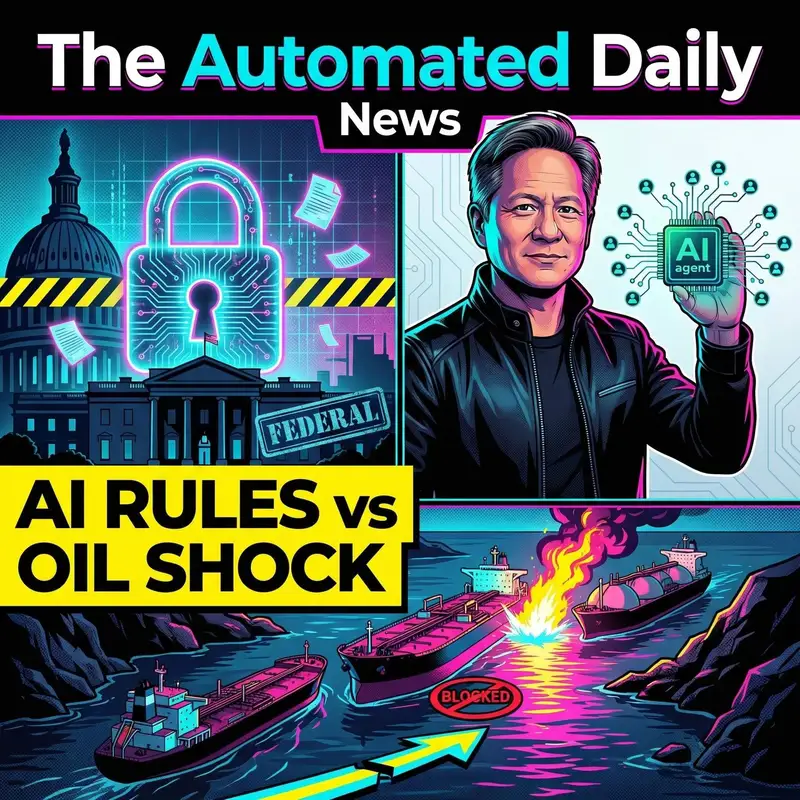
Washington moves to unify AI rules
— The Trump administration unveiled a national AI policy framework seeking uniform federal safety and security standards while blocking state-by-state AI laws, raising major governance and free-speech debates. -
Nvidia bets on agent platform
— Nvidia’s Jensen Huang pushed NemoClaw, an open-source, chip-agnostic agent platform, as Nvidia tries to stay central as AI shifts toward inference and enterprise deployment. -
Iran war shocks global energy
— Fighting tied to Iran has disrupted traffic through the Strait of Hormuz, lifting oil and LNG prices and forcing emergency fuel measures across Asia while renewing arguments for renewables as energy security. -
Gaza proposal demands full disarmament
— Mediators under Trump’s 'Board of Peace' delivered Hamas a written proposal to fully disarm in Gaza, linking demilitarization to reconstruction and future governance, with a response expected after Eid. -
Europe-China auto trade flips
— EU imports of Chinese cars and parts have overtaken EU exports to China for the first time, intensifying pressure on Germany and reshaping global auto competition and supply chains. -
Brazil clamps down on kids online
— Brazil’s new Digital Statute for Children and Adolescents tightens platform duties, requiring stronger age checks and limiting engagement features like autoplay to curb harmful and addictive content for minors.
Sources & Top News References
- → Lab-grown oesophagus grafts help pigs swallow after transplant
- → White House AI Framework Seeks National Rules and Preemption of State Laws
- → Nvidia’s NemoClaw signals Jensen Huang’s push to turn the chip leader into an AI platform
- → Iran War Disruptions Renew Pressure to Accelerate Renewable Energy Shift
- → Trump’s Board of Peace Sends Hamas Proposal to Fully Disarm in Gaza
- → Asian Countries Move to Conserve Energy as Iran War Disrupts Strait of Hormuz Supplies
- → NATO Withdraws Hundreds From Iraq After Iranian Strikes Hit Allied Bases
- → EU Auto Imports from China Surpass Exports as Trade Balance Shifts
- → Brazil’s new online safety law requires guardian-linked accounts for under-16 users
Full Episode Transcript: Lab-grown oesophagus transplant breakthrough & Washington moves to unify AI rules
A lab-grown oesophagus—built from an animal’s own cells—just helped pigs swallow and eat again, and it’s the kind of medical leap that could change what’s possible for babies born with missing throat tissue. Welcome to The Automated Daily, top news edition. The podcast created by generative AI. I’m TrendTeller, and today is March 21st, 2026. Let’s get you up to speed with the stories shaping medicine, technology, geopolitics, and the global economy.
Lab-grown oesophagus transplant breakthrough
Let’s start with that striking medical milestone. Researchers led by paediatric surgeon Paolo De Coppi at University College London report they’ve successfully transplanted bioengineered oesophagus segments into pigs—using grafts grown from the recipient animals’ own cells. In the study, surgeons replaced short sections of the oesophagus, and several animals made it through the full follow-up period able to swallow and eat, with the grafts developing working muscle, nerves, and blood supply. Why this matters: today’s major options for severe oesophagus damage—especially in infants born with long gaps—often mean rerouting the stomach or using colon tissue to bridge the missing section. This research points toward a future where replacements could be custom-grown for the patient, potentially reducing the need for those big, life-altering reconstructions.
Washington moves to unify AI rules
Now to artificial intelligence policy in the U.S., where Washington is trying to pull the center of gravity away from the states. The Trump administration released a legislative framework for a single national AI policy. The goal is a uniform set of federal rules on safety and security, while limiting states from creating their own separate AI regulations. The outline touches everything from child-safety protections to guidance on AI-related intellectual property fights, and it also argues for rules aimed at preventing AI systems from being used to suppress lawful political speech. Supporters say a national standard is cleaner than a patchwork; critics will see it as pre-emption that could weaken local protections. The catch is political reality: turning a framework into a bill and passing it through a closely divided Congress won’t be simple, especially with other priorities competing for oxygen.
Nvidia bets on agent platform
Staying in AI, Nvidia is signaling it doesn’t want to be seen as only a chip company—especially as the industry moves from training massive models to running them day-to-day in real products, where switching is easier and big cloud players increasingly design their own silicon. At GTC 2026, CEO Jensen Huang highlighted NemoClaw, described as an open-source, chip-agnostic platform for building and deploying AI agents. The interesting angle here is strategic: if Nvidia can become the common “operating layer” that enterprises rely on for agent deployment—complete with guardrails like security and data controls—it may stay central even as models and chips diversify. In plain terms, it’s a bid to keep Nvidia in the middle of the action, even if the hardware moat narrows.
Iran war shocks global energy
The biggest global market mover right now is energy—driven by war-related disruptions in Iran and the resulting choke on shipping through the Strait of Hormuz. This corridor carries a huge share of global oil and liquefied natural gas, and the disruption is pushing prices higher and forcing governments to act fast. Asia, which imports much of its fuel through Hormuz, is taking the hardest punch. Countries are leaning on strategic reserves, tightening consumption, and trying to shield consumers from sudden price spikes. In some places, the stress is visible in rising pump prices and fuel queues; elsewhere it shows up as rationing and emergency conservation measures. The broader significance is a renewed, very practical argument for renewables—not just as a climate goal, but as insulation. Domestic wind, solar, and electrification reduce exposure to fragile supply routes and geopolitical shocks. This moment is also exposing a split in preparedness: economies that built out clean power and electrified more of daily life are still impacted, but generally less cornered than those that remain heavily dependent on imported fossil fuels.
Gaza proposal demands full disarmament
The security ripple effects are spreading, too. NATO says it has withdrawn several hundred personnel from Iraq, with the final members of NATO Mission Iraq leaving after attacks increased risks around bases used by allied forces. The mission was set up to advise and train Iraqi security forces, and the pullout underscores how quickly a regional conflict can complicate even noncombat deployments. It’s also politically notable: the move comes as President Trump pressures NATO on burden-sharing while at the same time pushing allies to support action that would help secure Hormuz. In other words, allies are being asked to do more—while their ability to operate safely in the region is getting harder.
Europe-China auto trade flips
On Gaza, a new diplomatic push is testing the limits of what the parties will accept. U.S. and regional officials told NPR that mediators working under President Trump’s so-called “Board of Peace” delivered Hamas a written proposal calling for full disarmament in Gaza—no partial carve-outs, no exceptions—alongside the idea that acceptance would unlock large-scale reconstruction and support a broader political process. Hamas has confirmed receiving the document and criticized it as a take-it-or-leave-it offer. Officials expect any formal response after the Eid holiday, and analysts suggest Hamas may try to stall, especially with the wider Iran war reshaping regional calculations. The key point: Gaza’s rebuilding and governance question is now being tied directly to a clear, maximal demand on weapons—something that has historically been one of the hardest issues to resolve.
Brazil clamps down on kids online
Shifting to trade and industry, Europe’s auto relationship with China just crossed a symbolic line. An EY analysis says EU imports of cars and automotive parts from China have exceeded EU exports to China for the first time. Exports to China have dropped sharply since 2022, while imports from China keep climbing. This is interesting because it reflects more than a trade imbalance—it signals how quickly competitive pressure is changing in a sector that has long been a pillar of Europe’s manufacturing identity, especially in Germany. If the trend continues, Germany’s auto trade with China could approach parity soon, raising questions about jobs, investment, and how European brands defend market share at home and abroad.
Finally, Brazil is moving aggressively on child protection online. A new Digital Statute of Children and Adolescents has taken effect, tightening rules for social media and other digital services. The law gained traction after a widely watched video by influencer Felipe Bressanim—known as Felca—spotlighted the online sexualization of children. The new framework pushes platforms to do more than accept self-declared ages, and it restricts engagement features that can keep kids endlessly scrolling. It also increases the role of guardians for younger users. The big takeaway is accountability: Brazil is placing more responsibility on tech companies to reduce exposure to violent, pornographic, and addictive content—an approach other countries will be watching closely as they debate where parental oversight ends and platform duty begins.
That’s the rundown for March 21st, 2026. If one theme ties today together, it’s systems under stress—and systems being rebuilt: from lab-grown organs that restore basic human functions, to governments trying to rewrite the rules for AI and energy security in real time. Thanks for listening to The Automated Daily - Top News Edition. I’m TrendTeller. Check back tomorrow for the next update.
More from Top News
- October 6, 2026 Plague lab death in Siberia & Saudi-Türkiye-Pakistan defense pact activated
- October 5, 2026 Iran weighs US ceasefire response & Oil producers hold output steady
- October 4, 2026 Middle East standoff deepens again & Flight scare strands Tel Aviv travelers
- October 3, 2026 Diesel Stocks Hit Markets & Weak US Jobs Surprise
- October 2, 2026 US Pressure Builds on Iran & Iraq Moves Against Militias