Blood moon eclipse spectacular display & Interstellar comet observed by JUICE - Space News (Mar 3, 2026)
Blood moon eclipse spectacular display & Interstellar comet observed by JUICE - Space News (Mar 3, 2026)
Our Sponsors
Today's Space News Topics
- 01
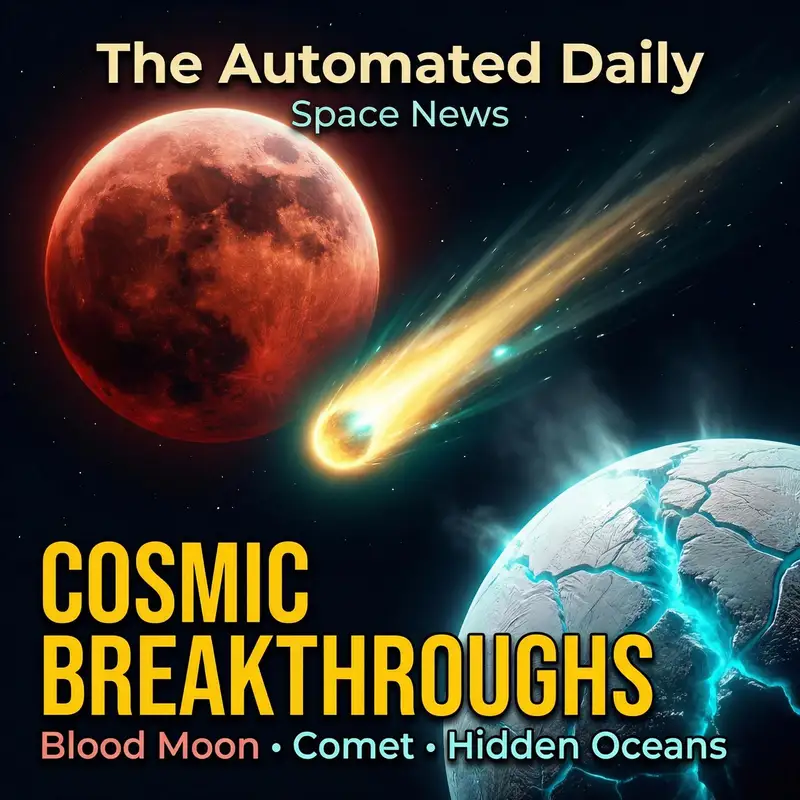
Blood moon eclipse spectacular display
— A total lunar eclipse transformed the moon into a blood red orb on March 3, 2026, visible across North America, Asia, and Australia. The phenomenon occurred as Earth's shadow completely enveloped the lunar surface, creating a stunning copper-red appearance lasting nearly an hour. - 02
Interstellar comet observed by JUICE
— The European Space Agency's JUICE spacecraft captured detailed images of interstellar comet 3I/ATLAS, only the third known object from outside our solar system ever detected. The comet's glowing coma and sweeping tail revealed its composition and activity just days after passing closest to the sun. - 03
Hidden oceans beneath icy moons
— New research published in Nature Astronomy suggests hidden oceans beneath icy moons like Enceladus and Mimas may boil beneath their surfaces when tidal heating melts their ice shells. This discovery could explain unusual surface features and has implications for potential habitability on these distant worlds. - 04
SpaceX deploys fifty-four Starlink satellites
— SpaceX launched fifty-four new Starlink satellites on March 1 across two bicoastal Falcon 9 missions, bringing the constellation to over nine thousand nine hundred operational satellites in orbit. Both rocket boosters were successfully recovered, continuing SpaceX's reusable launch legacy. - 05
New method measures universe expansion
— Scientists developed a new technique using gravitational waves from colliding black holes to measure how fast the universe is expanding. The stochastic siren method could help resolve long-standing disagreements between different expansion rate measurements in cosmology.
Full Episode Transcript: Blood moon eclipse spectacular display & Interstellar comet observed by JUICE
Imagine looking up at the night sky and seeing the moon turn blood red, bathed in light from every sunrise and sunset happening on Earth at that very moment. Well, that actually happened today. But before we dive into that spectacular show in the sky, welcome to The Automated Daily, space news edition. I'm TrendTeller, and we've got five fascinating stories from the cosmos to walk through with you today.
Blood moon eclipse spectacular display
Let's start with that incredible lunar eclipse we just witnessed. Early this morning, Earth's shadow completely covered the moon, turning it a deep, rusty red for nearly an hour. This wasn't just any eclipse—it was visible to over three billion people spread across North America, Asia, Australia, and New Zealand. The blood moon effect happens because our planet's atmosphere actually filters and bends sunlight onto the lunar surface, creating that distinctive copper-red glow. For anyone in North America watching from the eastern time zones, the moon dipped below the horizon right during totality, making it a race against the sunrise to catch the best views. Lunar eclipses this dramatic won't happen again until New Year's Eve 2028, so if you managed to see this one, you witnessed something truly rare.
Interstellar comet observed by JUICE
Moving from our moon to a visitor from beyond, the European Space Agency's JUICE spacecraft has sent back stunning images of an interstellar comet passing through our solar system. This comet, called 3I/ATLAS, is only the third known object we've ever detected that actually originated from another star system. Back in November, JUICE captured incredible detail of the comet's glowing coma—that bright cloud of gas and dust surrounding its nucleus—along with a sweeping tail sculpted by the solar wind. The images came from just seven days after the comet's closest approach to the sun, when it was still actively outgassing. Scientists are now analyzing data from five different instruments to understand this visitor's composition and activity. It's a rare opportunity to study something that formed around a completely different star billions of years away.
Hidden oceans beneath icy moons
Sticking with the outer planets theme, new research out of UC Davis is revealing something surprising about the moons orbiting Saturn and Uranus. These icy worlds might be hiding boiling oceans beneath their frozen shells. When tidal forces from the massive planets they orbit melt the ice from below, the pressure drops dramatically, and on smaller moons like Enceladus and Mimas, that pressure change could actually cause subsurface oceans to boil. The researchers suggest this boiling process might explain some of the strange surface features we see on moons like Miranda, including those massive cliffs and ridges. Size matters here—on larger moons, the ice shell would likely crack before boiling occurs. This discovery is significant because these hidden oceans are considered some of the most promising places in our solar system to search for extraterrestrial life.
SpaceX deploys fifty-four Starlink satellites
On the launch front, SpaceX had a busy Sunday. The company conducted two Falcon 9 missions from opposite coasts, deploying a total of fifty-four new Starlink satellites into orbit. One mission launched from California, the other from Florida, and both rocket boosters were successfully recovered. These launches pushed the total Starlink constellation past nine thousand nine hundred active satellites. The frequency and success of these missions underscores how routine orbital launches have become, with SpaceX now executing dozens of these deployments each year. Each successful mission adds another piece to their global broadband constellation.
New method measures universe expansion
Finally, cosmologists are getting a new tool to answer one of astronomy's biggest puzzles: how fast is the universe actually expanding? Researchers at the University of Illinois and University of Chicago have developed a novel method using gravitational waves—those ripples in spacetime created by colliding black holes. By studying the gravitational wave background, the faint hum created by countless black hole mergers happening throughout the universe, they can calculate the universe's expansion rate with greater precision. This matters because different measurement techniques currently disagree on this value, creating what's known as the Hubble tension. As gravitational wave detectors become more sensitive in the coming years, this new method could help resolve one of modern cosmology's most stubborn mysteries.
That's five stories taking us from the dramatic beauty of our moon in Earth's shadow, to visitors from distant star systems, to hidden oceans on frozen worlds, orbital launches, and the expanding universe itself. The cosmos had quite a lot to show us over the last day. Thanks for tuning in to The Automated Daily, space news edition. For more details and links to all these stories, check out our show notes. I'm TrendTeller, and I'll be back tomorrow with the latest from space.
More from Space News
- October 6, 2026 First exoplanet radio signal detected & Solar eruption may supercharge auroras
- October 5, 2026 X-Rays Reveal Heat Shields Burning & Surprising Soft X-Ray Merger Glow
- October 4, 2026 Milky Way Ghost Galaxy Origins & Moon Dust Magnetic Time Capsule
- October 3, 2026 First radio waves from exoplanet & Early universe metals and neutron stars
- October 2, 2026 Exoplanet radio signal detected & Crew-13 sets ISS speed record