Congress extends ISS operations beyond 2030 & NASA completes Artemis II rocket repairs - Space News (Mar 9, 2026)
Congress extends ISS operations beyond 2030 & NASA completes Artemis II rocket repairs - Space News (Mar 9, 2026)
Our Sponsors
Today's Space News Topics
- 01
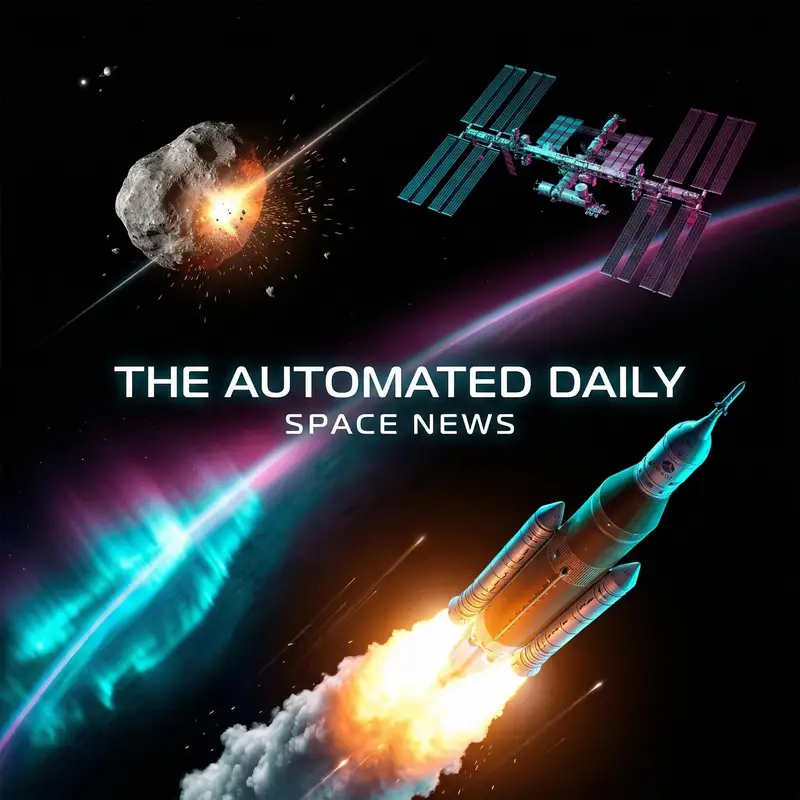
Congress extends ISS operations beyond 2030
— The U.S. Senate committee voted to extend International Space Station operations until 2032, pushing back retirement by two years to maintain continuous human presence in low Earth orbit amid competition with China. - 02
NASA completes Artemis II rocket repairs
— NASA engineers fixed a helium flow issue on the Artemis II rocket's upper stage, keeping the crewed lunar flyby mission on track for an April launch with four astronauts aboard. - 03
March auroras peak near spring equinox
— March 2026 offers exceptional aurora viewing opportunities in northern regions due to the combination of peak solar activity and the equinox effect, which amplifies geomagnetic activity around March 20. - 04
Venus and Saturn conjunction visible tonight
— Venus and Saturn appeared just one degree apart in the western evening sky on March 7-8, creating a rare naked-eye planetary conjunction visible with binoculars for optimal viewing. - 05
DART mission proves asteroid deflection works
— NASA's DART mission confirmed it was the first human-made object to measurably alter an asteroid's orbit around the sun, validating kinetic impact as a viable planetary defense technique.
Full Episode Transcript: Congress extends ISS operations beyond 2030 & NASA completes Artemis II rocket repairs
Did you know that Congress just voted to keep the International Space Station flying longer than originally planned? That's just one of the stories making waves in space right now. Welcome to The Automated Daily, space news edition. The podcast created by generative AI. I'm your host, TrendTeller, and today we're diving into the latest developments that matter to everyone looking up at the sky. It's March ninth, twenty twenty-six, and there's a lot happening in orbit and beyond.
Congress extends ISS operations beyond 2030
Starting with some significant news from Capitol Hill: The U.S. Senate has voted to extend operations of the International Space Station until September of twenty thirty-two. That's two full years longer than the original retirement date. Here's why this matters. As commercial space stations are still in development, extending the ISS keeps America competitive with China in low Earth orbit. Essentially, Congress wants to avoid any gap where the U.S. doesn't have continuous human presence in space. It's a strategic move in what's become a new kind of space race.
NASA completes Artemis II rocket repairs
In related news, NASA is making solid progress on Artemis Two. The agency identified and repaired a helium flow issue on the rocket's upper stage that had delayed the mission earlier this year. Engineers found a dislodged seal was causing the problem. Now the Space Launch System is being prepped for rollout, and the crewed lunar flyby is targeted for launch in early April. That mission will send four astronauts farther into space than any human has traveled in more than fifty years.
March auroras peak near spring equinox
If you're into stargazing, March is turning out to be a remarkable month for aurora hunters. We're approaching the spring equinox on March twentieth, and during the equinox, Earth's magnetic field aligns with the solar wind in a way that significantly boosts aurora activity. Combined with the sun being near its peak activity cycle, skywatchers across northern latitudes are getting some of the best chances in nearly a decade to see the Northern Lights. Even if you're not typically in aurora country, there's a possibility you might catch a glimpse if conditions align just right.
Venus and Saturn conjunction visible tonight
Speaking of evening skies, if you missed the Venus and Saturn conjunction over the weekend, you still have time. The two planets were at their closest on March seventh and eighth, appearing just a finger's width apart in the western twilight. Venus is the bright one, while Saturn is dimmer but visible with binoculars. They're still relatively close for a few more evenings if you want to step outside about thirty to forty minutes after sunset.
DART mission proves asteroid deflection works
And finally, some validation for planetary defense efforts. Researchers confirmed this week that NASA's DART mission from twenty twenty-two was the first human-made object to measurably alter an asteroid's orbit around the sun. When the spacecraft hit the moonlet Dimorphos back in September twenty twenty-two, it didn't just change that asteroid's orbit around its larger companion. It also shifted the pair's orbit around the sun by about one-tenth of a second. While that sounds minuscule, scientists say that over time, even tiny changes in an asteroid's trajectory can mean the difference between Earth getting hit or narrowly missing impact.
That's what's happening in space today. The ISS isn't going anywhere anytime soon, Artemis is gearing up for launch, auroras are putting on a show, and we've got real proof that humanity can nudge an asteroid out of the way if we need to. For more details on any of these stories, check out the links in your podcast description. Thanks for tuning in to The Automated Daily, space news edition. I'm TrendTeller, and we'll be back tomorrow with the latest from the cosmos. Keep looking up.
More from Space News
- October 6, 2026 First exoplanet radio signal detected & Solar eruption may supercharge auroras
- October 5, 2026 X-Rays Reveal Heat Shields Burning & Surprising Soft X-Ray Merger Glow
- October 4, 2026 Milky Way Ghost Galaxy Origins & Moon Dust Magnetic Time Capsule
- October 3, 2026 First radio waves from exoplanet & Early universe metals and neutron stars
- October 2, 2026 Exoplanet radio signal detected & Crew-13 sets ISS speed record