Saturn-mass exoplanet binary discovery & Artemis 2 moon rocket rollout - Space News (Mar 21, 2026)
Saturn-mass exoplanet binary discovery & Artemis 2 moon rocket rollout - Space News (Mar 21, 2026)
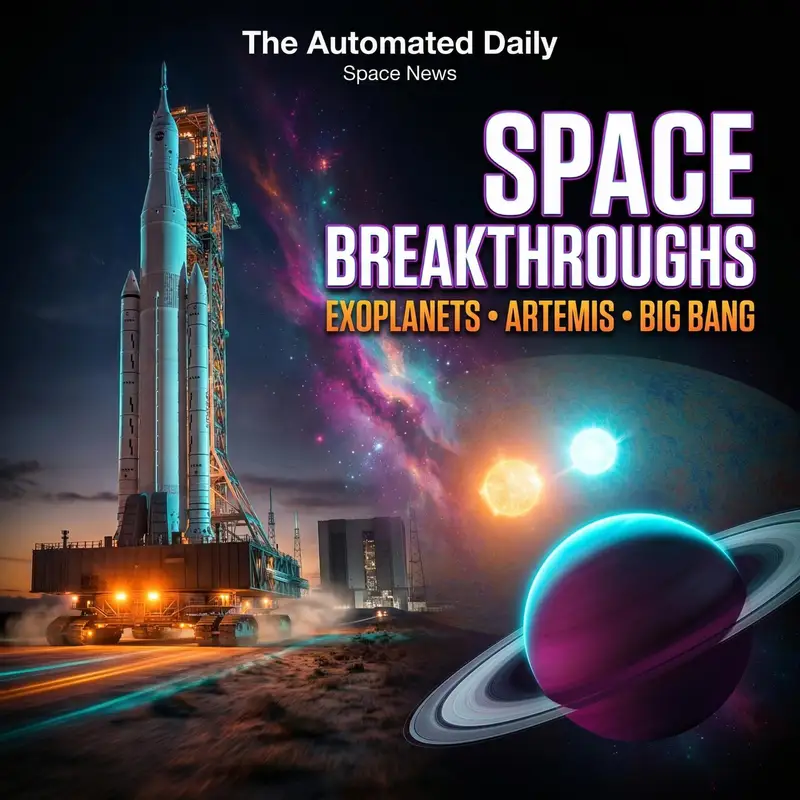
Our Sponsors
Today's Space News Topics
-
Saturn-mass exoplanet binary discovery
— Astronomers discovered a Saturn-sized exoplanet orbiting two low-mass stars using gravitational microlensing, revealing a new capability for detecting planets in complex stellar systems. -
Artemis 2 moon rocket rollout
— NASA's Artemis 2 Space Launch System rocket arrived at Kennedy Space Center's launch pad after a 4-mile journey, marking a major milestone toward sending astronauts around the moon in April. -
Proba-3 satellite resurrection
— Europe's Proba-3 Coronagraph spacecraft reestablished contact after a month of silence, with the mission team now conducting health checks to assess potential damage from the communication anomaly. -
Spring equinox astronomical milestone
— The March equinox occurred on March 20th at 14:46 UTC, marking the official start of spring in the Northern Hemisphere and autumn in the Southern Hemisphere. -
Space launch activity surge
— Multiple space launches occurred on March 20th including SpaceX's Falcon 9 Starlink mission and Rocket Lab's Electron carrying Synspective's StriX-6 Earth observation satellite. -
Big Bang Day celebration
— March 21st marks Big Bang Day, celebrating the anniversary of the Planck Collaboration's groundbreaking all-sky map that confirmed the standard model of cosmology.
Full Episode Transcript: Saturn-mass exoplanet binary discovery & Artemis 2 moon rocket rollout
Today we're diving into a discovery that challenges what we thought we knew about how planets form in the cosmos. But first, welcome to The Automated Daily, space news edition. The podcast created by generative AI. I'm your host, TrendTeller, and we've got some truly fascinating stories for you on this March 21st, 2026.
Saturn-mass exoplanet binary discovery
Let's start with that headline story. Astronomers have just announced the discovery of a Saturn-sized exoplanet orbiting not one star, but two. The planet, located about 22,800 light-years away toward the galactic bulge, was found using a detection method called gravitational microlensing. This technique essentially uses gravity itself as a magnifying glass to spot planets that would otherwise be invisible to us. What makes this discovery particularly exciting is that it demonstrates how we can find planets in complex multi-star systems, places where our traditional detection methods often hit a wall. The two host stars are much smaller and cooler than our Sun, making this a great example of how diverse planetary systems really are out there.
Artemis 2 moon rocket rollout
Now let's shift to something happening right here in our own solar system. NASA's Artemis 2 moon rocket, the Space Launch System or SLS, has successfully rolled out to the launch pad at Kennedy Space Center in Florida. This massive rocket, topped with the Orion crew capsule, completed a 4-mile journey from the Vehicle Assembly Building overnight. The rollout was delayed slightly due to high winds, but teams got it done. This is a crucial milestone. The mission is now targeted for launch in April, which will send four astronauts on a 10-day journey around the moon. It's humanity's first crewed lunar mission in more than 50 years.
Proba-3 satellite resurrection
We've got some good news from space about a satellite that had everyone worried. Europe's Proba-3 Coronagraph spacecraft, which generates artificial solar eclipses in space to study the sun's corona, phoned home after a month of silence. Back in mid-February, an anomaly caused the spacecraft to lose contact with ground control. The mission team was understandably concerned because Proba-3 actually consists of two spacecraft flying in precise formation just 150 meters apart. If one goes down, the entire mission is at risk. But the good news is the Coronagraph is stable and in safe mode. Ground stations are now running health checks to see if any components suffered damage during the silent period. It's a reminder of how resilient space technology can be, even after extended periods in the harsh vacuum of space.
Spring equinox astronomical milestone
On a more celestial note, today marks Big Bang Day. Every March 21st, the space community celebrates the anniversary of when the Planck Collaboration released its first all-sky map in 2013. That map traced the oldest existing light in the universe and basically validated the big bang theory with stunning precision. It's one of those moments that fundamentally changed our understanding of how the cosmos was born.
Space launch activity surge
If you looked up at the sky yesterday, you experienced something special. March 20th brought us the spring equinox, at least for those of us in the Northern Hemisphere. That's when the sun crosses the celestial equator, and we get roughly equal amounts of daylight and darkness. In the Southern Hemisphere, it marked the beginning of fall. It's one of those astronomical moments that connects us all to Earth's journey around the sun.
Big Bang Day celebration
And finally, space was busy in the launch department on March 20th. SpaceX sent another batch of Starlink satellites to orbit via Falcon 9 from Vandenberg Space Force Base in California. That same day, Rocket Lab launched an Electron rocket carrying Synspective's StriX-6 Earth observation satellite from New Zealand. These launches continue the ongoing effort to expand satellite constellations that provide everything from internet connectivity to detailed Earth monitoring. It's becoming routine now, but these launches represent significant engineering achievements that would have seemed impossible just a couple of decades ago.
That's what's happening in space today. We've got new planetary discoveries expanding our understanding of how worlds form, major milestones in returning humans to the moon, satellites coming back to life after emergencies, and the steady pace of launches keeping the machinery of space exploration in motion. There's never a dull moment in the cosmos. Thanks for joining us on The Automated Daily, space news edition. I'm TrendTeller. Stay curious about what's happening up there, and we'll catch you tomorrow with more updates from beyond our world.
More from Space News
- October 6, 2026 First exoplanet radio signal detected & Solar eruption may supercharge auroras
- October 5, 2026 X-Rays Reveal Heat Shields Burning & Surprising Soft X-Ray Merger Glow
- October 4, 2026 Milky Way Ghost Galaxy Origins & Moon Dust Magnetic Time Capsule
- October 3, 2026 First radio waves from exoplanet & Early universe metals and neutron stars
- October 2, 2026 Exoplanet radio signal detected & Crew-13 sets ISS speed record