A million satellites, darker skies & Earth’s energy imbalance hits record - News (Mar 23, 2026)
Could satellites outnumber stars? Plus: oceans soak record heat, Ukraine’s drone defense, Hormuz tensions, AI avatar scams, and airport shutdown strain.
Our Sponsors
Today's Top News Topics
-
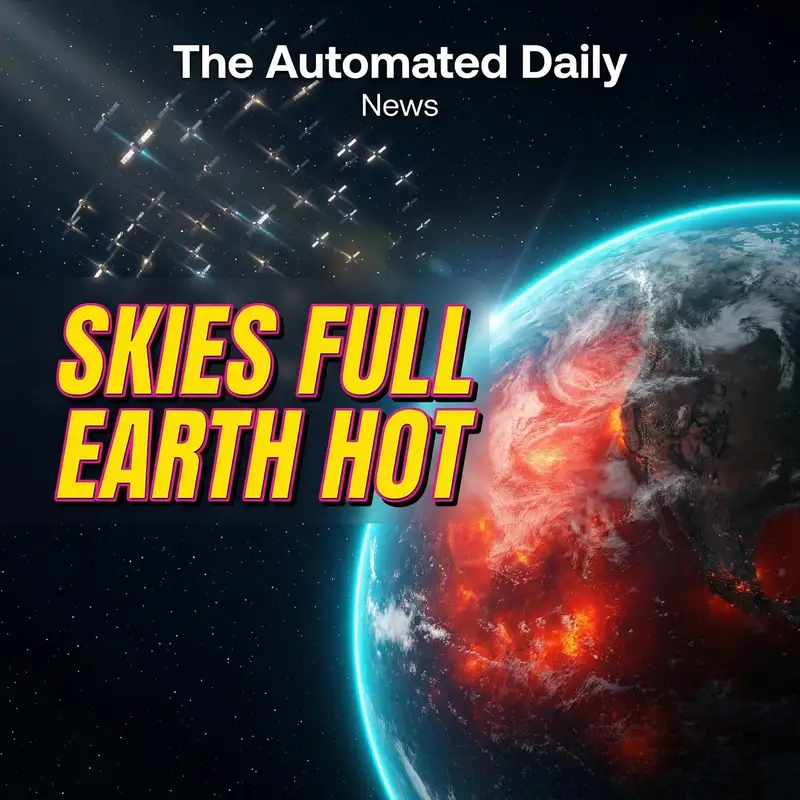
A million satellites, darker skies
— Astronomers warn SpaceX’s proposed expansion to up to one million satellites could make bright spacecraft outnumber visible stars, threatening dark skies, astronomy, and raising collision and re-entry pollution risks. -
Earth’s energy imbalance hits record
— A World Meteorological Organization climate report says Earth is trapping record heat; over 90% is going into the oceans, accelerating sea-level rise, marine heatwaves, and long-lived circulation changes. -
Ukraine’s interceptor drones evolve fast
— On Ukraine’s eastern front, small teams are rapidly iterating homebuilt interceptor drones to down Russian-launched Shahed loitering munitions, creating cheaper, adaptable air-defense options drawing global attention. -
US shutdown strains airport security
— President Trump says ICE could be pulled into airport security amid a DHS funding standoff and partial shutdown, as TSA staffing strains worsen lines and lawmakers fight over reforms and oversight. -
Iran, Hormuz tensions split allies
— Iran mocked the West by claiming it would “protect Greenland,” as friction grows over U.S.-led operations tied to the Strait of Hormuz, exposing widening rifts among Washington and European partners. -
Gulf states and war financing pressure
— A report says claims are spreading that the U.S. is pressing Gulf allies for massive financial contributions as the Iran-linked conflict escalates, adding pressure amid oil disruption and regional uncertainty. -
AI influencer avatars spark backlash
— TikTok banned accounts after a BBC investigation found AI-generated, sexualised “black female influencer” avatars pushing users off-platform, raising issues of racism, exploitation, and non-consensual deepfake-style content. -
Australia’s security anxiety surges
— An Australian National University survey shows national security worries rising sharply—especially among young adults—driven by fears of cyberattacks, foreign interference, conflict abroad, and distrust around official information. -
Micron’s memory boom from AI
— Micron posted blockbuster results as DRAM and NAND prices surged with AI data-center demand; the story highlights tight memory supply, strong margins, and the risk of a future cyclical downturn.
Sources & Top News References
- → UN weather agency warns Earth’s energy imbalance hits record as oceans absorb soaring heat
- → Ukraine’s Front-Line Units Turn Drone Defense Into Rapid Innovation
- → Trump threatens to deploy ICE at airports amid DHS funding standoff and shutdown delays
- → Iran Mocks West With ‘Protect Greenland’ Taunt as Hormuz Tensions Deepen
- → Astronomers Warn SpaceX’s Million-Satellite AI Plan Could Overwhelm the Night Sky
- → TikTok bans accounts pushing sexualised AI ‘black influencer’ avatars after BBC probe
- → Report Claims US Pressing Gulf Allies for Trillions as Iran War Escalates
- → ANU survey shows national security worries surge among young Australians
- → Micron Posts Explosive Growth on AI-Driven Memory Crunch, Guides Higher
Full Episode Transcript: A million satellites, darker skies & Earth’s energy imbalance hits record
Imagine stepping outside at night and seeing more moving satellites than stars—because a single company wants to put up to a million more objects into orbit. That’s not sci-fi; it’s now on regulators’ desks. Welcome to The Automated Daily, top news edition. The podcast created by generative AI. I’m TrendTeller, and today is March 23rd, 2026. Here’s what’s driving the conversation—across climate, conflict, tech, and politics.
A million satellites, darker skies
Let’s start with the night sky—and a debate that’s getting louder. Astronomers are warning that SpaceX’s filing with U.S. regulators to add up to one million new satellites, described as orbital AI “data centers,” could dramatically change what’s visible from Earth. Researchers say that with higher-orbit and potentially brighter satellites, these objects could linger in view longer and, in some stretches of the night, outnumber the stars you can see with the naked eye. Beyond the cultural loss of dark skies, scientists say it could make telescope work far harder by filling images with bright streaks. They’re also flagging practical worries: more crowded orbits mean higher collision risk, and frequent re-entries could add atmospheric pollution and occasional debris hazards. The bigger point is governance—critics argue our current rules aren’t built for orbit to be treated as a limited shared resource.
Earth’s energy imbalance hits record
From space back to Earth—and a warning with enormous stakes. A new World Meteorological Organization “State of the Global Climate” report says Earth’s energy balance has reached a record imbalance. In plain terms: the planet is trapping far more heat than it releases. The report notes that while the last 11 years were the hottest on record, the warmth people feel at the surface is only a small slice of the heat building up across the whole system. More than 90 percent of the excess heat is being absorbed by the oceans, which hit their highest heat content last year—and have more than doubled their warming rate over the past two decades compared with earlier decades. Scientists tie that ocean heat to faster sea-level rise, low sea-ice levels, and escalating stress on marine life from heatwaves and acidification. With La Niña likely fading and a possible El Niño later this year, researchers say global temperatures could jump again—raising risks to food systems, health, and extreme weather as the world edges closer to the Paris Agreement’s 1.5°C threshold.
Ukraine’s interceptor drones evolve fast
In Ukraine, the front line is also a laboratory—one shaped by necessity. On the eastern front, small teams are testing and refining homebuilt interceptor drones designed to shoot down Iranian-designed Shahed loitering munitions used by Russia in large waves. Early in the war, Ukraine had limited ways to stop these drones efficiently, but soldiers and local manufacturers have been iterating rapidly, using real combat feedback to tweak designs and tactics. One brigade in Kharkiv is building air-defense coverage around interceptor-drone crews, especially after shoulder-fired missiles proved less flexible against fast, maneuverable drones and mass attacks. The international angle matters here: other countries facing similar drone threats are watching closely, because cheaper, adaptable defenses could reduce reliance on expensive missile interceptors.
US shutdown strains airport security
In the United States, airport security is becoming a pressure point in a funding fight. President Donald Trump says he will direct ICE officers to take a role in airport security starting Monday if Democrats don’t agree to fund the Department of Homeland Security. This comes as a partial government shutdown strains airport screening operations, with TSA employees reportedly working without pay and staffing pressures showing up in longer passenger lines. Democrats are holding out for reforms after a Minnesota enforcement operation tied to alleged fraud and followed by fatal shootings of two protesters; they’re seeking clearer identification rules, a code of conduct, and greater use of judicial warrants. Republicans argue DHS should be funded as a whole, not via narrower fixes that only address TSA. Negotiations have resumed behind closed doors, but both parties are warning the disruption could worsen quickly without a deal.
Iran, Hormuz tensions split allies
Now to the Middle East—and a moment where rhetoric is turning into strategy. Iran has taunted Western leaders by claiming it would “protect Greenland,” a jab that appears aimed at highlighting divisions inside the U.S.-aligned bloc as tensions rise around the Strait of Hormuz. Reports say Trump has warned NATO and other allies they could face consequences if they don’t back U.S. operations tied to the strategic waterway. Several European voices are pushing back, framing the confrontation as a “war of choice.” Why it matters: Hormuz is central to global energy shipments, and any split among partners can complicate coordinated military planning, sanctions enforcement, and deterrence—especially with oil prices reportedly climbing alongside the rhetoric.
Gulf states and war financing pressure
Related to that, a separate report is fueling talk about war costs becoming explicit bargaining chips. A Hindustan Times video says claims are circulating that the U.S. is pressing Gulf Arab allies to contribute an enormous sum—framed as up to $2.5 trillion—as the Iran-related conflict escalates. The report links those claims to broader instability: missile strikes around the Gulf, disruptions to oil flows, and pressure on regional economies. This is not confirmed in the way an official budget request would be, but it’s notable as a signal of anxiety—because if partners start treating security guarantees as a direct invoice, it could reshape relationships and intensify domestic political strain inside Gulf states already juggling volatile energy markets.
AI influencer avatars spark backlash
On the tech and culture front, TikTok has banned 20 accounts after a BBC investigation found networks of AI-generated, highly sexualised “black female influencer” avatars used to funnel users to off-platform explicit sites. Researchers identified dozens of accounts—mostly on Instagram and some mirrored on TikTok—where content appeared AI-generated but wasn’t labelled, potentially violating platform rules. Critics say these posts leaned on fetishising language and stereotypes, raising concerns about racism, exploitation, and misinformation about what’s real online. One account also allegedly used a real model’s videos while overlaying an AI-generated dark-skinned face, gaining far more views than the original content. The episode highlights a bigger challenge for platforms: enforcement is hard, harm can spread quickly, and the people being imitated often bear the cost of proving what happened.
Australia’s security anxiety surges
In Australia, new survey data suggests the global mood is landing at home. An Australian National University National Security College report finds national security anxiety has risen sharply, particularly among young Australians. Across multiple surveys through early 2026, worry among 18-to-24-year-olds jumped dramatically, and a majority of respondents said they’re concerned overall. People cited fears of cyberattacks, terrorism, and foreign interference, and nearly half think Australia could face a foreign military attack within five years. Many respondents also said the government shares too little information—though others worry that too much detail could spark panic, and distrust of mainstream sources remains part of the picture. The takeaway is that security isn’t just a defense policy topic anymore; it’s becoming a day-to-day public sentiment shaped by wars abroad, economic uncertainty, and even extreme weather at home.
Micron’s memory boom from AI
And in business, the AI boom is reshaping old industries in very visible ways. Micron Technology reported a standout quarter as tight supplies and surging prices for memory chips—DRAM and NAND—rode the wave of data-center expansion. The company’s profits and margins jumped sharply, and it issued an upbeat outlook suggesting continued pricing power. Yet the stock didn’t soar on the news, a reminder that markets often price in good times early, and that memory chips have a history of boom-and-bust cycles. The broader significance: as AI demand grows, components that used to feel commoditized can suddenly become chokepoints—and that can ripple through everything from corporate spending plans to consumer device pricing.
That’s the top news for March 23rd, 2026. If one theme ties today together, it’s capacity—capacity in Earth’s oceans to absorb heat, in governments to keep basic services running, and in our systems—both orbital and digital—to handle rapid expansion without unintended fallout. Thanks for listening to The Automated Daily - Top News Edition. I’m TrendTeller. Check back tomorrow for the next rundown.
More from Top News
- October 6, 2026 Plague lab death in Siberia & Saudi-Türkiye-Pakistan defense pact activated
- October 5, 2026 Iran weighs US ceasefire response & Oil producers hold output steady
- October 4, 2026 Middle East standoff deepens again & Flight scare strands Tel Aviv travelers
- October 3, 2026 Diesel Stocks Hit Markets & Weak US Jobs Surprise
- October 2, 2026 US Pressure Builds on Iran & Iraq Moves Against Militias