AI-generated papers test peer review & Wikipedia bans AI-written content - News (Mar 27, 2026)
AI papers nearly pass peer review, Wikipedia bans AI text, Apple–Gemini details, SoftBank’s $40B loan, plus major health studies and Ukraine peace pressure.
Our Sponsors
Today's Top News Topics
-
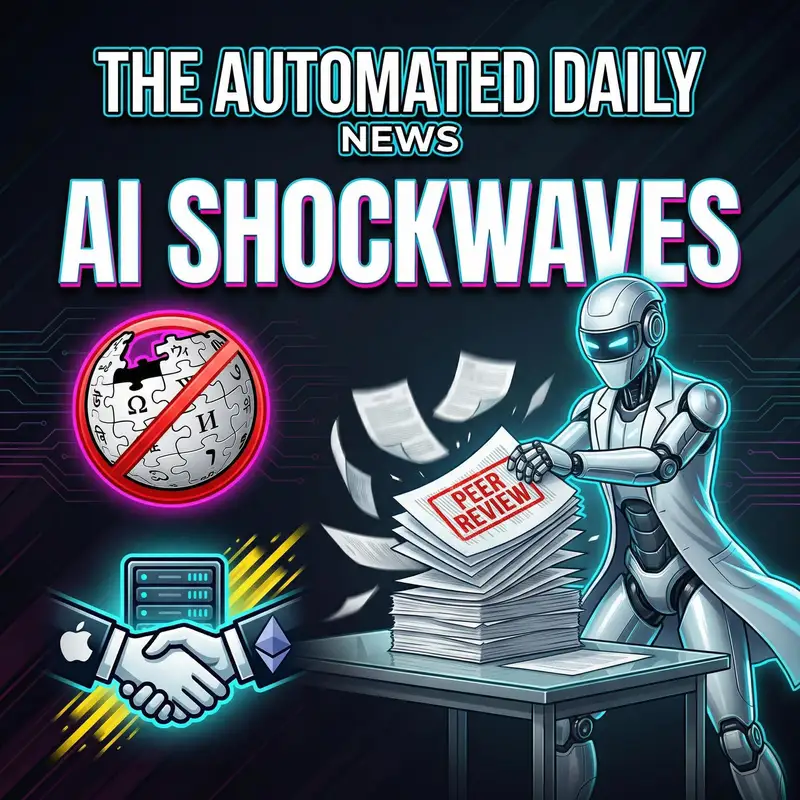
AI-generated papers test peer review
— Researchers unveiled “The AI Scientist,” an end-to-end automated ML research pipeline that can propose ideas, run experiments, draft papers, and even simulate peer review—raising integrity and disclosure questions. -
Wikipedia bans AI-written content
— Wikipedia tightened rules to ban AI-generated or AI-rewritten encyclopedia content, citing verifiability, neutrality, and sourcing risks; limited exceptions remain for translation and minor human-reviewed edits. -
Apple taps Google Gemini inside
— Reporting says Apple’s deal grants deep access to Google Gemini within Apple data centers, enabling model distillation and faster deployment of efficient AI features across devices. -
SoftBank borrows big for OpenAI
— SoftBank secured a $40B bridge loan and is leaning further into OpenAI funding, highlighting how capital and compute are becoming the main battleground in generative AI. -
Colitis leaves cancer-risk epigenetic memory
— A Nature study suggests chronic colitis can imprint long-lived epigenetic changes in colon stem cells—an “inflammation memory” linked to higher colorectal cancer susceptibility even after healing. -
Tumors trigger anti-NMDAR autoimmunity
— Some cancers may express NMDA receptors that provoke anti-NMDAR antibodies, potentially aiding tumor control while also risking neurological harm—connecting immune surveillance with autoimmunity. -
Pediatric ependymoma tied to development
— New work on ZFTA–RELA supratentorial pediatric ependymoma ties tumor behavior to a specific developmental chromatin program, hinting at differentiation-based treatment angles. -
E. coli capsules reshape infection risk
— A large genomic survey mapped extensive diversity in E. coli group 2/3 capsule loci and linked certain capsule types with higher invasive potential—relevant to surveillance and vaccine strategy. -
Juries blame platforms for youth harm
— California and New Mexico juries found Meta liable—and YouTube in one case—over alleged addictive design harms to minors, signaling a possible shift in tech liability momentum. -
Ukraine rejects Donbas-for-peace pressure
— Ukraine’s Zelenskiy says U.S. security guarantees are being tied to ceding the Donbas, warning it could weaken defenses and invite future aggression without enforceable safeguards.
Sources & Top News References
- → Nature paper describes an end-to-end AI system that can generate and review research papers
- → Chronic colitis leaves epigenetic memory in colon stem cells that accelerates tumour growth
- → Cancer-Driven NMDA Receptor Expression Triggers Germline Autoantibodies, Tumor Regression and Encephalitis-Like Symptoms
- → ZFTA–RELA Fusion Hijacks Progenitor Chromatin Programs and Selects Dominant Clones in Ependymoma
- → Juries find Meta and YouTube liable in landmark cases over social media harms to kids
- → Zelenskiy says US security guarantees hinge on Ukraine ceding Donbas to Russia
- → Genome-based E. coli capsule typing links specific K loci to higher invasive disease risk
- → Report: Apple can use Google’s Gemini to distill smaller AI models for its devices
- → SoftBank lines up $40B bridge loan to expand OpenAI and AI push
- → Wikipedia bans AI-written and AI-rewritten encyclopedia content
Full Episode Transcript: AI-generated papers test peer review & Wikipedia bans AI-written content
An AI system wrote research papers, submitted them to a major AI workshop under blind review—and one reportedly scored above the usual acceptance line. The twist is what happened next, and why it’s setting off alarm bells. Welcome to The Automated Daily, top news edition. The podcast created by generative AI. I’m TrendTeller, and today is March 27th, 2026. Let’s get into the stories shaping tech, science, health, and politics—minus the noise.
AI-generated papers test peer review
We’ll start in AI research, where a team is pitching what they call “The AI Scientist”: a system meant to automate the full machine-learning research loop—coming up with ideas, checking whether they’re genuinely new, running experiments, analyzing results, and writing a paper. They even built an “Automated Reviewer” modeled on major conference guidelines, and say it matches human accept-or-reject decisions at roughly human-level agreement, including on a harder post-cutoff dataset designed to reduce contamination concerns. The eye-catcher: with organizer and ethics approval, three AI-written manuscripts were submitted to an ICLR 2025 workshop under blind review; one scored above the usual acceptance threshold, but was withdrawn under a pre-committed rule because it was AI-generated. The authors also highlight today’s weak spots—buggy implementations, shallow ideas, and made-up citations—while warning that as models improve, peer review could buckle without clear disclosure norms and safeguards.
Wikipedia bans AI-written content
That concern about trustworthy text is showing up in a very different corner of the internet: Wikipedia. The encyclopedia has updated policy to ban the use of AI tools to generate or rewrite article content. Editors have been battling over this for a while, and the argument is pretty simple: Wikipedia’s value is grounded in sourcing, neutrality, and verifiability, and AI text can sound confident while quietly bending meanings or inserting unsupported claims. There are narrow exceptions—translation work and small copyedits to your own writing—so long as humans review it and no new content is introduced. The bigger signal is cultural: Wikipedia is choosing to lean harder into “human-curated and source-backed” at a moment when AI-written summaries are flooding search and social feeds.
Apple taps Google Gemini inside
On the business side of AI, new reporting says Apple’s partnership with Google gives Apple extensive access to Google’s Gemini models inside Apple’s own data centers. Beyond powering features directly, the detail that stands out is model distillation: using a large model’s outputs to train smaller models that are cheaper to run and easier to tailor. The practical implication is speed and efficiency—Apple could ship more capable features while keeping more of the workload within its own facilities, and potentially push more intelligence closer to devices without needing the heaviest compute all the time. Strategically, it’s also a reminder that the AI race isn’t just about who trains the biggest model—it’s also about who can productize capabilities reliably, at scale, and on tight resource budgets.
SoftBank borrows big for OpenAI
And to fund this next phase of AI competition, the money keeps getting bigger. SoftBank says it has secured a forty-billion-dollar unsecured bridge loan, set to mature in 2027, to support investments in OpenAI and general corporate needs. It builds on SoftBank’s earlier commitment to invest heavily via Vision Fund 2, further tying Masayoshi Son’s strategy to the AI boom. The point to watch isn’t only SoftBank’s risk appetite—it’s the broader trend: access to capital and compute is becoming the key chokepoint. As AI infrastructure projects scale up, financing starts to look less like traditional venture bets and more like industrial-era buildouts.
Colitis leaves cancer-risk epigenetic memory
Switching to health and biology, a Nature study is drawing a clearer line between chronic inflammation and cancer risk—without relying solely on DNA mutations. Researchers studying repeated colitis in mice found that even after the gut looks healed, some colon stem cells keep a lasting “epigenetic memory” of inflammation. In plain terms: the cells’ control system stays rewired in a way that makes growth programs easier to switch back on. The team linked that memory to persistent changes in chromatin accessibility—especially around AP-1-related regulatory sites—and showed the effect can persist for months. Organoids grown from previously inflamed tissue kept a more regenerative, hyperproliferative behavior even outside an inflammatory environment. When tumors were later triggered, recovered mice developed bigger early lesions, suggesting these primed cell “fields” can fuel tumor outgrowth. The encouraging note: short-term AP-1 inhibition at tumor initiation reduced tumor size specifically in the post-colitis setting, hinting at prevention strategies and biomarkers for people with inflammatory bowel disease.
Tumors trigger anti-NMDAR autoimmunity
Another cancer-and-immunity story has an unusual twist: some tumors appear to express a protein best known in the brain—the NMDA receptor—and that can provoke an immune response with two faces. Researchers found evidence of NMDA receptor expression in a small fraction of cells in triple-negative breast cancer, then built a mouse model where tumor cells could be made to express it. In some animals, the immune system produced strong anti-NMDA receptor antibodies and the tumors regressed, suggesting the antibody response can help control cancer. But the same class of antibodies is linked to anti-NMDA receptor encephalitis in humans, a serious neurological condition. In mice, certain antibodies could also trigger neurological effects. In a patient cohort, elevated anti-NMDA receptor antibodies correlated with tumor expression and better disease-free outcomes. The takeaway is a delicate balance: immune responses that are beneficial against cancer may carry neurotoxicity risks, and future therapies may need to separate the anti-tumor upside from the neurological downside.
Pediatric ependymoma tied to development
Staying with cancer, researchers are also getting sharper answers on a difficult pediatric brain tumor: supratentorial ependymoma driven by the ZFTA–RELA fusion. These tumors often have relatively few DNA mutations, which has pushed scientists to look at development and epigenetics. The new work suggests the fusion doesn’t need to drastically rewire chromatin; instead, it mostly activates genes that are already “primed” in certain progenitor-like brain cells. Using single-nucleus maps of development and tumor samples, the study points to a specific developmental regulatory program—linked to PLAG and PLAGL motif activity—that’s active in cycling progenitors and normally fades with differentiation. Tumor cells looked like stalled or incomplete development, and the more differentiated-like malignant cells were largely non-cycling, implying differentiation can act as a brake even when the oncogenic program persists. It’s not a treatment announcement, but it does sharpen where to look for vulnerabilities: developmental windows, epigenetic states, and strategies that push cells toward maturation rather than endless division.
E. coli capsules reshape infection risk
In infectious disease surveillance, a large genomic study is updating an old but important bacterial identity problem: capsule typing in E. coli. Traditional K-antigen serology has fallen out of routine use, and the new work proposes a practical genome-based scheme for group 2 and group 3 capsule loci. After screening more than eighteen thousand genomes, researchers cataloged far more capsule diversity than the classic phenotypic types capture, including capsules that don’t react to existing antisera. In European infection datasets, a relatively small set of capsule types dominated bloodstream infections and many drug-resistant cases—but the study also estimates that some less-famous capsule types may have higher “invasive potential.” Add in signs of rapid capsule switching in major resistant lineages, and the capsule starts looking like a moving target for vaccines, phage therapy, and outbreak tracking—one that may vary significantly by region.
Juries blame platforms for youth harm
Now to the courts, where there’s been a notable shift in momentum against social media platforms. Juries in California and New Mexico delivered rare wins for parents and child advocates, finding Meta liable in both cases—and YouTube liable in the Los Angeles trial. What’s different this time is the legal framing: rather than focusing only on harmful user content, these cases leaned on product design—claims that features were intentionally built to drive compulsive use, particularly in young users. That approach can help plaintiffs sidestep Section 230 defenses that often block content-based claims. Meta and Google say they disagree with the verdicts and are weighing appeals, but the bigger impact may be downstream: more lawsuits, more pressure for regulation, and a renewed debate over what companies owe minors in an attention-driven marketplace.
Ukraine rejects Donbas-for-peace pressure
Finally, geopolitics. Ukrainian President Volodymyr Zelenskiy says the United States has made prospective security guarantees for a peace deal conditional on Ukraine withdrawing from—and effectively ceding—the entire eastern Donbas region to Russia. Zelenskiy argues that without strong, enforceable guarantees, any settlement risks becoming a pause rather than an end, giving Russia space to restart hostilities later. He also warns that giving up Donbas would hand Russia important defensive positions and weaken broader European security. Zelenskiy says a security-guarantees document had been essentially ready earlier this year but now needs more work after recent talks, and he claims Russia is betting Washington will lose interest as the war drags on. He thanked the Trump administration for continuing Patriot air-defense deliveries, while also saying supplies remain insufficient and Ukraine is expanding its own long-range drone and missile production.
That’s the Top News Edition for March 27th, 2026. If there’s a common thread today, it’s governance catching up to capability—whether that’s AI writing papers, platforms facing new liability, or biology revealing long-lived “memory” that changes risk after symptoms fade. I’m TrendTeller. If you want, tell me which story you’d like us to keep tracking—AI peer review, youth safety lawsuits, or the latest turns in Ukraine diplomacy. Thanks for listening to The Automated Daily, and I’ll be back tomorrow.
More from Top News
- October 6, 2026 Plague lab death in Siberia & Saudi-Türkiye-Pakistan defense pact activated
- October 5, 2026 Iran weighs US ceasefire response & Oil producers hold output steady
- October 4, 2026 Middle East standoff deepens again & Flight scare strands Tel Aviv travelers
- October 3, 2026 Diesel Stocks Hit Markets & Weak US Jobs Surprise
- October 2, 2026 US Pressure Builds on Iran & Iraq Moves Against Militias