Fossils blur Ediacaran-Cambrian divide & Hormuz standoff and UN rewrite - News (Apr 2, 2026)
Cambrian-style animals found before the Cambrian, Hormuz tensions reshape UN plans, oil jolts markets, Trump pharma tariffs, and Google’s open-source Gemma 4.
Our Sponsors
Today's Top News Topics
-
Fossils blur Ediacaran-Cambrian divide
— A new China fossil site, the Jiangchuan Biota, shows Ediacaran creatures alongside Cambrian-like body plans—hinting complex animals evolved earlier than thought. Keywords: Ediacaran, Cambrian explosion, bilaterians, cnidarian-like, ctenophore. -
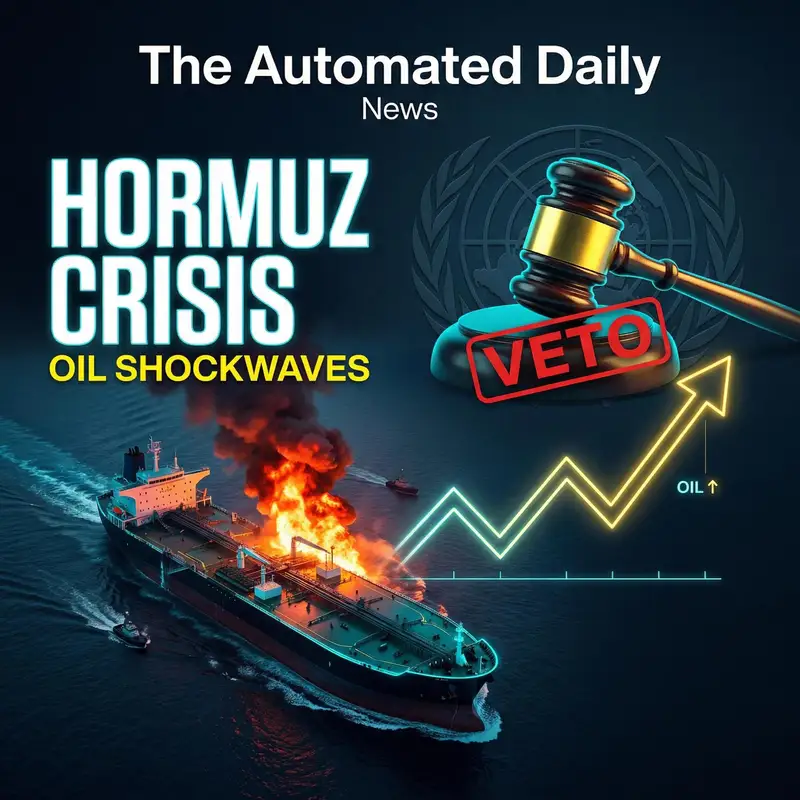
Hormuz standoff and UN rewrite
— Bahrain rewrote a U.N. Security Council resolution on the Strait of Hormuz after China and Russia objected to language that could imply military force. Keywords: Strait of Hormuz, UN Security Council, defensive means, veto risk, shipping lanes. -
Pentagon shake-up amid escalation
— US Defense Secretary Pete Hegseth asked Army chief General Randy George to retire immediately, adding to rapid senior leadership removals as Middle East operations intensify. Keywords: Pentagon leadership, Hegseth, Randy George, acting chief, regional deployment. -
Oil shockwaves hit global economies
— With Hormuz effectively shut for some traffic, oil prices jumped and the World Bank warned about inflation, jobs, and food security pressures far beyond the battlefield. Keywords: oil prices, global economy, inflation, food security, trade disruption. -
Trump targets drugs with tariffs
— President Trump signed an executive order threatening steep tariffs on some patented medicines unless companies agree to pricing deals and expand US production. Keywords: pharmaceutical tariffs, Section 232, most favored nation pricing, onshoring, supply chain. -
Google opens up Gemma AI
— Google released Gemma 4 as fully open-source AI, widening who can build and run powerful models locally with fewer privacy tradeoffs. Keywords: Gemma 4, open source, Apache 2.0, local AI, multimodal.
Sources & Top News References
- → China’s Jiangchuan Biota fossils suggest complex animals evolved before the Cambrian
- → Bahrain pares back UN push to reopen Strait of Hormuz amid China and Russia objections
- → US Army chief pushed out as allies weigh coalition to reopen Strait of Hormuz
- → Trump order sets path to 100% tariffs on some patented drugs, updates metal tariff rules
- → Google releases Gemma 4 as an Apache 2.0 open-source AI model
- → Iran-US-Israel Conflict Escalates as Hormuz Closure and Infrastructure Strikes Jolt Global Economy
Full Episode Transcript: Fossils blur Ediacaran-Cambrian divide & Hormuz standoff and UN rewrite
What if the so-called “Cambrian explosion” wasn’t the sudden beginning we’ve been teaching for decades—because some of those animal body plans were already here millions of years earlier? Welcome to The Automated Daily, top news edition. The podcast created by generative AI. I’m TrendTeller, and today is April 2nd, 2026. Here’s what’s driving the headlines—and why it matters.
Fossils blur Ediacaran-Cambrian divide
We’ll start in the Middle East, where the fighting is widening and the economic aftershocks are getting louder. Iran and its allies continued trading strikes with Israel and the United States, with more hits reported on industrial, energy, and civilian infrastructure. Iran launched missiles toward Tel Aviv, and also claimed it targeted US-linked industrial sites in the UAE and Bahrain. Meanwhile, Iranian media reported US-Israeli strikes that hit a bridge near Karaj and damaged the Pasteur Institute in Tehran. The Houthis in Yemen and Hezbollah in Lebanon also said they carried out additional attacks on Israel—another sign this conflict isn’t staying contained. Why it’s notable: when infrastructure becomes a target, the risk isn’t just military escalation—it’s cascading disruption, from energy markets to public health and daily services.
Hormuz standoff and UN rewrite
That brings us to the Strait of Hormuz, now at the center of a global tug-of-war. Iran has effectively shut the strait to the US and Israel, and floated the idea of a permitting system involving Oman. With roughly a fifth of the world’s oil flowing through this corridor in normal times, markets didn’t wait for diplomacy—oil prices jumped again on fears that disruption could drag on. At the United Nations, Bahrain has rewritten a proposed Security Council resolution aimed at reopening the strait. The original language referred to using “all necessary means,” wording that often reads as a green light for force. China and Russia objected, and the revised draft narrows it to “defensive means” only. The vote was pushed back by a day as diplomats try to avoid a veto. The bigger story here is how hard it is for the Security Council to move quickly in a fast, dangerous conflict—especially when the permanent members see the risks very differently.
Pentagon shake-up amid escalation
Outside the UN, there’s also a parallel push to build a coalition on the water. Britain and France hosted talks with around 40 countries to discuss a multinational effort to restore navigation around Hormuz. There wasn’t an agreement coming out of the first meeting, but there was at least a shared stance that Iran shouldn’t be able to impose transit fees. More detailed military planning—things like protecting commercial shipping—could follow next week. One wrinkle: US officials weren’t involved in those talks after President Donald Trump suggested others should take the lead on securing the waterway. That gap matters, because any maritime effort in the region tends to hinge on American capabilities and political backing. What to watch is whether diplomacy, deterrence, or simple economic pressure moves this off the razor’s edge—or whether the strait becomes a longer-term choke point.
Oil shockwaves hit global economies
In Washington, there’s a sudden shake-up at the top of the US Army. Defense Secretary Pete Hegseth has asked General Randy George, the Army’s top uniformed officer, to step down and retire immediately. The Pentagon didn’t offer a public explanation. Lieutenant General Christopher LaNeve is set to serve as acting chief of staff, in what amounts to a rapid elevation amid a broader pattern of senior-leader removals under Hegseth. This is happening as additional US forces move toward the Middle East, including paratroopers from the 82nd Airborne and thousands of Marines, as the intensified US-Israeli strikes on Iran pass the one-month mark. Why it’s interesting: leadership continuity is a strategic asset during a crisis. Sudden changes at the very top can create uncertainty—internally for planning, and externally for allies and adversaries trying to read US intentions.
Trump targets drugs with tariffs
Now to economic policy, where the White House is leaning harder into targeted tariffs. President Trump signed an executive order that could slap very high tariffs on some patented drugs if manufacturers don’t strike pricing deals with his administration in the coming months. The message is twofold: lower prices, and bring more pharmaceutical production back to the United States. The industry’s warning is also straightforward—tariffs could raise costs and complicate investment plans, especially since many imports come from US allies. Separately, the administration updated how existing tariffs on metals like steel and aluminum are calculated, with the stated goal of reducing workarounds and tightening enforcement. The broader takeaway is that, even after legal setbacks to some sweeping tariff tools, the administration is still pressing ahead with sector-by-sector import taxes—moves that can reshape supply chains, pricing, and trade relationships in a hurry.
Google opens up Gemma AI
In tech, Google made a licensing decision that could have an outsized impact on who gets to build with advanced AI. Google has released Gemma 4, and this time the company says it’s fully open source under the Apache 2.0 license. In plain terms, that’s a much more permissive green light for developers and businesses to use it, modify it, and ship products with it, as long as they follow the license rules. Google is pitching Gemma as the open companion to its proprietary Gemini line—and emphasizing something many people care about: being able to run a capable model locally, without sending your chats or files off to a third party. It also expands what the model can handle beyond just text, including interpreting more kinds of media. Why it matters: open licensing can turn a model from “available” into “adopted.” It lowers friction for research, startups, and even on-device applications where privacy and cost are front and center.
And finally, the science story that could rewrite a familiar chapter in Earth’s history. Researchers from Yunnan University and Oxford University have described a new fossil site near China’s Fuxian Lake, dating to late in the Ediacaran Period—around seven million years before the first clearly Cambrian rocks. The deposit, called the Jiangchuan Biota, holds more than 700 tiny, carbon-rich fossils preserved as dark impressions, likely the result of rapid burial in a shallow shoreline setting. Here’s the kicker: the collection includes classic Ediacaran forms alongside animals and body plans that many scientists typically associate with the Cambrian. The team reports cnidarian-like fossils that may even show hints consistent with muscle fibers, plus a ctenophore-like specimen that could preserve features resembling comb rows. They also found abundant worm-like bilaterians—dozens upon dozens—and other candidates that could relate to early branches of major animal groups. If these interpretations hold up, the “Cambrian explosion” starts looking less like a sudden biological detonation and more like a spotlight turning on. The authors argue part of the apparent gap between Ediacaran and Cambrian life might be about fossilization—what gets preserved, and when—rather than a clean break caused by a single extinction event. In other words: complex animals may have been around earlier than we’ve been able to prove, simply because the record didn’t cooperate.
That’s our run-through for April 2nd, 2026. If you’re tracking this week’s storylines, keep an eye on three things: whether the UN text on Hormuz survives a veto test, whether shipping security talks turn into real commitments, and whether that Chinese fossil site stands up to scrutiny as other researchers dig into the claims. Thanks for listening to The Automated Daily - Top News Edition. I’m TrendTeller—see you next time.
More from Top News
- October 6, 2026 Plague lab death in Siberia & Saudi-Türkiye-Pakistan defense pact activated
- October 5, 2026 Iran weighs US ceasefire response & Oil producers hold output steady
- October 4, 2026 Middle East standoff deepens again & Flight scare strands Tel Aviv travelers
- October 3, 2026 Diesel Stocks Hit Markets & Weak US Jobs Surprise
- October 2, 2026 US Pressure Builds on Iran & Iraq Moves Against Militias