HIV remission after stem transplant & South Africa rolls out lenacapavir - News (Apr 14, 2026)
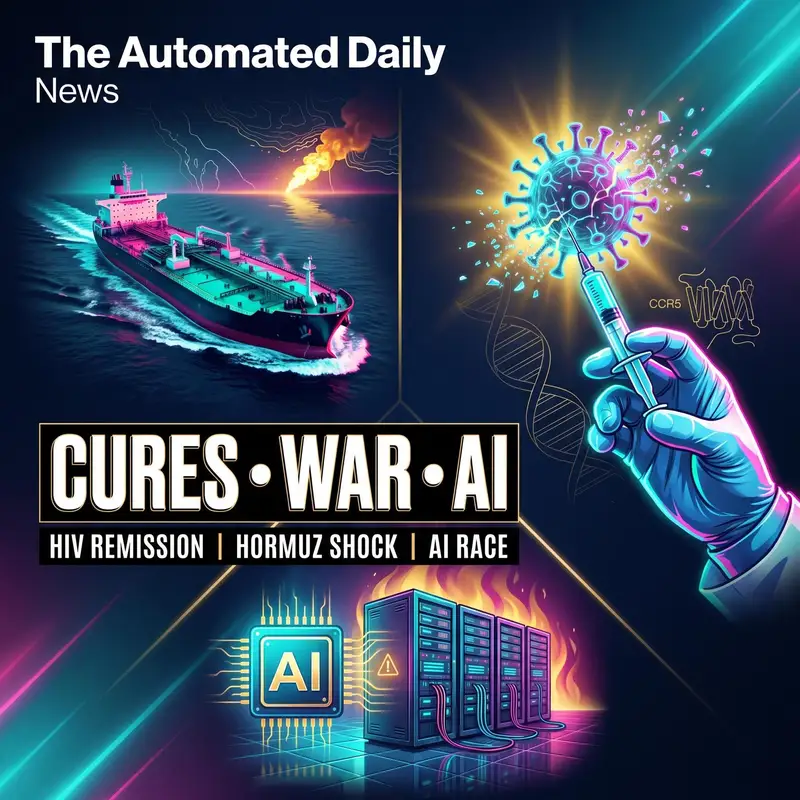
HIV remission without rebound, Iran’s Hormuz shock hits oil, AI race tightens, promising cancer trials, and Australia’s drone surge—Top News, Apr 14 2026.
Our Sponsors
Today's Top News Topics
-
HIV remission after stem transplant
— Researchers report a rare long-term HIV-1 remission after an allogeneic stem cell transplant from a CCR5Δ32 donor, with no viral rebound on extended treatment interruption and no intact provirus detected. -
South Africa rolls out lenacapavir
— South Africa received its first public-sector lenacapavir shipment, a twice-yearly HIV prevention injection, with rollout planned for late May and a focus on adolescent girls and young women alongside combination prevention. -
Iran war shakes energy markets
— The Iran conflict disrupted shipping through the Strait of Hormuz, lifting oil and gas prices and pushing import-dependent economies to accelerate renewables, storage, and electrification to cut fossil-fuel exposure. -
Chokepoints: rare earths and Hormuz
— New reporting highlights how China’s rare earth leverage and Iran’s control of Hormuz show rivals can weaponize economic chokepoints, reshaping trade policy, inflation risks, and supply-chain security planning. -
AI race, data centers, backlash
— Stanford’s AI Index finds the U.S.–China frontier-model gap has narrowed, while U.S. data-center capacity surges amid environmental costs, local opposition, and mixed evidence of productivity gains from AI tools. -
Novo Nordisk teams with OpenAI
— Novo Nordisk signed a partnership with OpenAI to apply AI to drug discovery and manufacturing, aiming to speed development in obesity and diabetes while emphasizing governance, data protection, and human oversight. -
Pancreatic cancer drug trial breakthrough
— A Phase 3 trial from Revolution Medicines suggests a major survival improvement for a new oral pancreatic cancer treatment, raising expectations for FDA review and a potential shift in second-line care. -
Off-the-shelf CAR-T for lymphoma
— Allogene reported interim Phase 3 results indicating its off-the-shelf CAR-T approach may clear minimal residual disease in high-risk B-cell lymphoma earlier, potentially reducing relapse if benefits hold with longer follow-up. -
Australia expands drones and defenses
— Australia plans billions more for drones and counter-drone systems, citing battlefield lessons from Ukraine and the Middle East and aiming to build sovereign manufacturing and protect critical infrastructure. -
Trump frames Iran war outcome
— An AP analysis says President Trump is declaring an unequivocal win in the Iran war despite ongoing complexities, reflecting a broader communications pattern of repeating victory narratives to shape perception.
Sources & Top News References
- → Oslo patient shows sustained HIV remission after CCR5Δ32/Δ32 sibling stem cell transplant
- → Iran War Energy Shock Boosts China’s Clean-Tech Advantage
- → Revolution Medicines’ daraxonrasib boosts survival in Phase 3 pancreatic cancer trial
- → AP Analysis: Trump Casts Iran War as a Victory as He Maintains a Never-Lose Narrative
- → Allogene’s Off-the-Shelf CAR-T Hits Phase 3 Interim Goal in B-Cell Lymphoma
- → South Africa Receives First Lenacapavir HIV-Prevention Shipment as Public Rollout Nears
- → Stanford AI Index: China Closes the Gap as Data Centers, Costs, and Jobs Drive Pushback
- → China and Iran Use Economic Chokepoints to Counter U.S. Pressure
- → Novo Nordisk partners with OpenAI to accelerate obesity drug discovery
- → Australia to spend billions more on drones and counter-drone defences after Ukraine and Iran lessons
Full Episode Transcript: HIV remission after stem transplant & South Africa rolls out lenacapavir
A man with HIV stopped his meds after a stem-cell transplant—and three years later, doctors still can’t find the virus coming back. What does that mean, and why is it so rare? Welcome to The Automated Daily, top news edition. The podcast created by generative AI. I’m TrendTeller, and today is April 14th, 2026. Let’s get you caught up—starting with health and science, then the Iran conflict’s ripple effects, and the latest on AI, defense, and more.
HIV remission after stem transplant
In medical news, researchers have documented a new case of long-term HIV-1 remission in a 63-year-old man—after he received a stem cell transplant for a blood disorder. The striking twist: the donor, his HLA-matched brother, turned out to carry two copies of a rare genetic mutation known as CCR5 delta 32. In simple terms, that change makes many immune cells far harder for most common HIV strains to infect. The patient stayed on standard HIV therapy through the transplant process, then stopped treatment two years later under close monitoring. Since then, clinicians have watched for years—and they’ve seen no viral rebound in the blood using extremely sensitive testing. Even more notable, extensive sampling in both blood and gut tissue—where HIV often hides—didn’t find intact viral DNA, and lab work failed to coax out replication-capable virus from a very large number of immune cells. This is not a scalable cure strategy—stem cell transplants carry serious risks and are reserved for life-threatening cancers and disorders. But scientifically, it strengthens a key idea: if you replace the immune system with HIV-resistant donor cells, and combine that with transplant-related immune effects, you may be able to clear deep viral reservoirs. Researchers also stress a practical takeaway: we still need much better biomarkers to predict who will sustain remission before anyone even considers stopping medication.
South Africa rolls out lenacapavir
Staying with HIV, South Africa says it has received its first public-sector shipment of lenacapavir for prevention—a twice-yearly injection designed to reduce the risk of acquiring HIV. The doses are being stored while samples undergo additional safety testing, and officials say initial rollout at selected public clinics is planned for the end of May. Health leaders are emphasizing where the impact could be biggest: adolescent girls and young women, who remain among the highest-risk groups in many communities. The plan includes youth-friendly services, outreach beyond traditional clinics, and a clear reminder that this is not a standalone shield—lenacapavir does not prevent other sexually transmitted infections, so it’s meant to sit inside broader “combination prevention.” The rollout also arrives after disruptive international funding cuts that forced hard decisions about how donor-supported programs get absorbed into the public system. In short: the medicine is promising, but the system around it—staffing, trust, consistent access—will decide how much it changes real-world infection rates.
Iran war shakes energy markets
Now to geopolitics and the global economy, where the Iran war has been jolting energy markets. The Strait of Hormuz—one of the most critical routes on Earth for oil and gas shipments—saw traffic curtailed during the fighting, squeezing supplies that heavily feed Asian economies. The knock-on effects have been immediate: higher fuel costs, pressure on shipping, and growing inflation risks that can ripple into everything from food prices to manufacturing. One of the more interesting second-order effects: the shock is reinforcing how quickly the world can pivot when fossil fuel supply feels unstable. Analysts quoted by the Associated Press argue China is positioned to gain because it dominates supply chains for electric vehicles, batteries, and solar panels. Even though China also buys Iranian oil, Beijing’s long-running strategy has treated energy security as national security—pumping investment into electrification and renewables. If governments and consumers in import-dependent regions accelerate purchases of solar, storage, and EVs to escape price whiplash, Chinese manufacturers could see stronger demand and greater leverage in the transition technologies powering the next energy era.
Chokepoints: rare earths and Hormuz
A related theme is the growing power of economic chokepoints—where a single region or country can squeeze the world. The Washington Post points to two recent examples that cut in different directions for Washington. First, China’s dominance in rare earth minerals—inputs that matter for both civilian and military manufacturing—has become a tool of pressure in trade negotiations. Second, Iran’s ability to disrupt the Strait of Hormuz underscored how quickly control of a narrow passage can shock global markets, strand ships, and raise costs. The broader point is that globalization created deep interdependence, and that interdependence is now strategic leverage. The response many policymakers are leaning toward is diversification: more renewables, alternative routes for energy transport, and more domestic or allied production of critical minerals. But those shifts take time—and in the meantime, consumers may feel the effects through higher prices and more volatility.
AI race, data centers, backlash
On U.S. politics, an Associated Press analysis says President Donald Trump has been portraying the U.S. role in the Iran war as an unambiguous victory—declaring success quickly and repeating it even as events on the ground looked more complicated, including strikes on U.S. and allied targets and the turmoil around Hormuz. With a ceasefire now in place, Trump argues American objectives were achieved, pointing to major claims about Iran’s leadership and nuclear ambitions, even as questions remain about what Iran still retains and how much control it continues to exert over key chokepoints. The article frames this as part of a long-running Trump communications style: never concede, keep the message simple, and repeat it until it sticks. Whatever one’s politics, this matters because the “scoreboard” a leader presents can shape public expectations, alliance dynamics, and how the next crisis is sold—or avoided.
Novo Nordisk teams with OpenAI
Turning to artificial intelligence, Stanford’s latest AI Index report paints a world where the U.S. still leads in model releases and private investment, but the performance gap with China at the frontier is narrowing. The report also highlights China’s strength in publications, patents, and industrial robot installations—signals of broad, sustained capacity. But one of the most tangible takeaways isn’t about clever models—it’s about physical infrastructure. The U.S. has built out far more data center capacity, and that buildout is now colliding with local opposition and concerns about energy use, emissions, and water demand. In several communities, large projects are being delayed or blocked, turning AI’s expansion into a real-world fight over land, utilities, and quality of life. And on jobs and productivity, the report’s tone is cautious: AI helps with some tasks, but economy-wide gains still look limited. There are also early labor-market signals, including fewer opportunities for younger software developers and more firms openly contemplating workforce reductions—even as many enterprises admit they still haven’t seen clear returns on big AI spending.
Pancreatic cancer drug trial breakthrough
In that AI-meets-pharma space, Novo Nordisk has announced a strategic partnership with OpenAI, aimed at using AI tools across drug discovery, manufacturing, and commercial operations. The pitch is speed: faster interpretation of massive datasets, earlier identification of promising drug candidates, and shorter time from research to real medicines—especially in high-stakes areas like obesity and diabetes. The important context is that the drug industry has been talking about AI for years, but only a limited number of AI-shaped breakthroughs have clearly changed what reaches patients. So this partnership is noteworthy less as a guarantee of new drugs, and more as a signal that major players are doubling down—while also trying to reassure employees and regulators about governance, data protection, and human oversight.
Off-the-shelf CAR-T for lymphoma
Now to cancer research, where two trial updates are drawing attention. First, Revolution Medicines says its oral pancreatic cancer drug, daraxonrasib, delivered a notably large survival improvement in a Phase 3 study for patients whose disease had already progressed after earlier treatment. Pancreatic cancer is one of the toughest diagnoses in oncology, and many cases are driven by RAS-related pathways that have historically been hard to target effectively. If the full data hold up under peer review and broader scrutiny, clinicians say it could reshape second-line treatment and open doors to combination strategies. Second, Allogene Therapeutics reported interim Phase 3 results for an off-the-shelf CAR-T approach in B-cell lymphoma, aimed at wiping out minimal residual disease in high-risk patients right after first-line therapy. The big idea is prevention of relapse, not just rescue after the cancer comes back. These results are still early, and the real test will be whether deeper clearance translates into fewer relapses and longer survival. But it’s another sign that cell therapy is pushing beyond “last resort” medicine toward earlier, more strategic use.
Australia expands drones and defenses
Finally, in defense, Australia’s government is preparing to put billions more into drones and counter-drone capabilities, reflecting lessons from Ukraine and the Middle East: inexpensive, mass-deployed drones can force adversaries to spend heavily on defenses, and they can threaten bases and critical infrastructure in new ways. Australia’s plans include investment in larger uncrewed systems as well as smaller, cheaper drones, alongside stronger counter-drone measures. Beyond battlefield logic, Canberra is also pitching this as an industrial strategy—building sovereign manufacturing and technical expertise, with an eye toward exports. In a world where conflicts are increasingly shaped by scalable, rapidly produced systems, Australia is clearly betting that uncrewed tech will be central to deterrence and national resilience.
That’s the top news for April 14th, 2026. If you’re following the week’s big arc, it’s this: biology is offering rare glimpses of what “remission” might look like for HIV, while geopolitics is reminding everyone how fragile energy and supply chains can be—and those pressures are accelerating choices on clean power, AI infrastructure, and defense spending. Thanks for listening to The Automated Daily - Top News Edition. I’m TrendTeller. Come back tomorrow for the next briefing.
More from Top News
- October 6, 2026 Plague lab death in Siberia & Saudi-Türkiye-Pakistan defense pact activated
- October 5, 2026 Iran weighs US ceasefire response & Oil producers hold output steady
- October 4, 2026 Middle East standoff deepens again & Flight scare strands Tel Aviv travelers
- October 3, 2026 Diesel Stocks Hit Markets & Weak US Jobs Surprise
- October 2, 2026 US Pressure Builds on Iran & Iraq Moves Against Militias