Hormuz shutdown reshapes energy plans & Markets bet on shaky ceasefire - News (Apr 16, 2026)
Hormuz stays shut as markets rally; China gains from global electrification. Plus AI blood tests, printed neurons, Eurosky, Australia defense, vaccines.
Our Sponsors
Today's Top News Topics
-
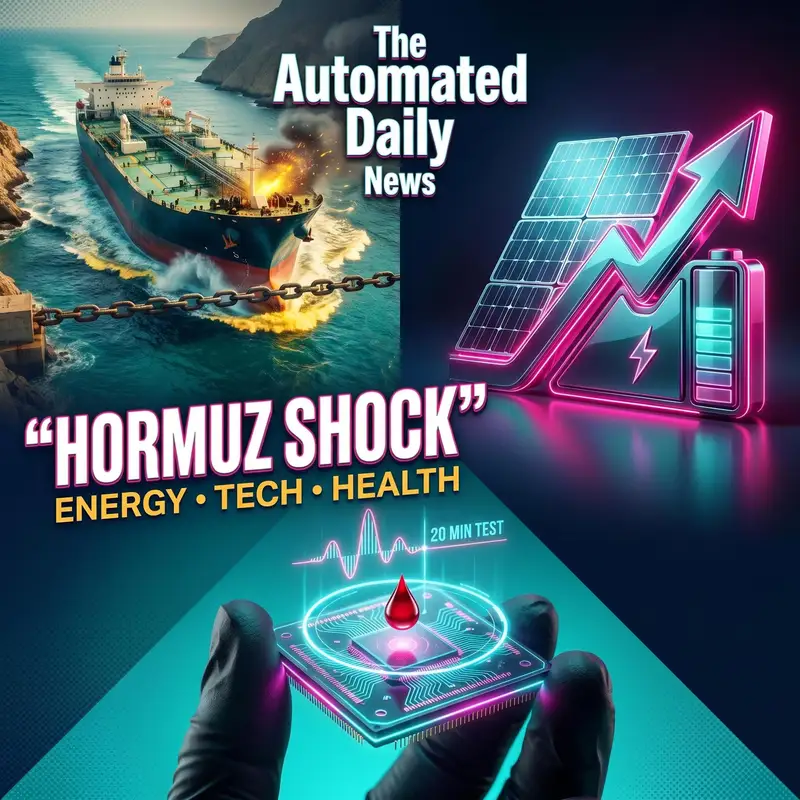
Hormuz shutdown reshapes energy plans
— The Strait of Hormuz closure during the Iran war is triggering an energy shock, forcing oil- and LNG-dependent countries to cut demand and accelerate renewables and electrification. -
Markets bet on shaky ceasefire
— Global stocks hit record highs on reports of possible U.S.–Iran ceasefire extensions, but the Hormuz blockade and $95 oil keep inflation risks and supply worries alive. -
China’s clean-tech influence expands
— China is poised to gain from the rush toward solar, batteries, EVs, and grid buildouts, thanks to dominance in manufacturing, critical-mineral refining, and key components like rare-earth magnets. -
AI blood test for microRNAs
— NTU Singapore unveiled an AI-assisted nanophotonic biochip that detects disease-linked microRNAs from a small blood sample in about 20 minutes, pointing to faster early screening. -
Printed artificial neurons spark real cells
— Northwestern engineers created flexible, printed artificial neurons that produce realistic electrical spikes and can activate living brain cells—an advance for neuroprosthetics and brain–machine interfaces. -
Europe builds Eurosky social infrastructure
— Eurosky launched a Europe-focused social media infrastructure using the AT Protocol, aiming for EU-law data control, digital identity portability, and reduced reliance on U.S. platforms. -
Australia boosts defense and drones
— Australia will raise defense spending to 3% of GDP by 2033, prioritizing drones and autonomous systems as Indo-Pacific security concerns push militaries toward unmanned capabilities. -
Ancient DNA shows recent selection
— A large Nature analysis of ancient western Eurasian DNA finds strong signals of rapid human evolution over the past 10,000 years, especially in immune genes after agriculture spread. -
Semaglutide’s direct liver benefits
— New Cell Metabolism research suggests semaglutide can improve MASH liver disease through direct liver-related targets, not just weight loss—potentially reshaping dosing strategies. -
WHO warns Africa vaccine gains at risk
— WHO says vaccines saved over 50 million lives in Africa in 50 years, but ‘zero-dose’ gaps, donor funding shortfalls, fuel costs, and war-linked supply disruptions threaten progress.
Sources & Top News References
- → Hormuz Disruption Accelerates Global Electrification, Boosting China’s Clean-Energy Leverage
- → NTU Develops AI-Assisted Biochip That Detects microRNA Disease Markers in 20 Minutes
- → Northwestern Prints Artificial Neurons That Can Trigger Living Brain Cells
- → Peace Talks Resume as U.S. Enforces Strait of Hormuz Blockade and Oil Stays Elevated
- → Eurosky launches as a European social media infrastructure to challenge Big Tech dominance
- → Australia to Raise Defense Spending to 3% of GDP and Expand Drone and Autonomous Systems
- → usnews.com
- → Ancient DNA data suggest human evolution accelerated after the rise of farming
- → Study finds semaglutide directly improves diseased livers independent of weight loss
- → WHO: Vaccines Have Saved Millions in Africa, but Aid Cuts Put Gains at Risk
Full Episode Transcript: Hormuz shutdown reshapes energy plans & Markets bet on shaky ceasefire
Imagine a printed device—made with electronic ink—that can fire brain-like signals strong enough to trigger real living neurons. That’s not sci-fi anymore, and it’s one of our top stories today. Welcome to The Automated Daily, top news edition. The podcast created by generative AI. I’m TrendTeller, and today is April 16th, 2026. In the next few minutes: the Strait of Hormuz remains largely closed even as markets cheer diplomacy; the energy shock that’s speeding up a global pivot to electrification—mostly on China’s terms; and breakthroughs in medicine, from faster blood-based biomarker detection to new clues about how a blockbuster weight-loss drug helps the liver.
Hormuz shutdown reshapes energy plans
We begin in the Middle East, where diplomacy is driving optimism—but reality at sea is still tight. Global markets rallied to record highs on reports that the U.S. and Iran may extend their ceasefire by two weeks. President Donald Trump also suggested Israel and Lebanon could be heading toward their first talks in more than three decades, though Lebanon publicly pushed back on that claim. The problem: the Strait of Hormuz, a crucial corridor for global oil flows, remains largely shut. The U.S. military says no vessels have transited its blockade since Monday, and multiple ships have turned back. Reports say two sanctioned, Iran-linked ships managed to slip through by hugging Iran’s coastline—highlighting how hard it is to enforce rules in such a narrow waterway. With crude hovering around the mid-$90s per barrel, the standoff keeps inflation risk on the table even while the headlines hint at de-escalation.
Markets bet on shaky ceasefire
That Hormuz disruption is also triggering something bigger than a price spike: a new energy shock that’s pushing countries to rethink their entire fuel strategy. With Middle East oil and LNG suddenly less reliable, governments that depend on the region are cutting consumption and fast-tracking solar, wind, battery storage, and electric vehicles. One of the clearest examples is the Philippines. It’s heavily dependent on Middle East oil, declared an energy emergency, and is now moving quickly to permit renewables. But that rapid buildout can increase reliance on Chinese-made hardware—an awkward trade-off given ongoing territorial tensions in the region.
China’s clean-tech influence expands
And zooming out, the story argues China may be the biggest winner of this crisis-driven electrification. Beijing already dominates production of solar panels, lithium-ion batteries, and many EV supply chains. It also controls key upstream chokepoints, like critical-mineral refining and components such as rare-earth magnets. What’s especially interesting is the claim that China’s advantage isn’t just consumer clean tech—it’s the so-called “electrostate” backbone: transmission lines, transformers, grid software, and even turnkey grid development abroad. If countries leapfrog away from fuel infrastructure and build electrical systems at speed, the suppliers of the grid can gain long-term influence. The catch: near-term electricity demand could still lift coal use in some places, and the war’s disruption of Qatar’s LNG—and broader confidence in LNG—may slow the shift from coal to gas.
AI blood test for microRNAs
From geopolitics to health tech: researchers at Nanyang Technological University in Singapore say they’ve built an AI-assisted biochip that can detect tiny disease-linked molecules called microRNAs from a small blood sample in about 20 minutes. MicroRNAs are promising markers for early disease detection, but testing them can be slow and labor-intensive. This new platform pairs a nanophotonic chip—designed to trap light in thousands of tiny structures—with deep-learning image analysis to quickly spot and classify fluorescent signals when the target microRNAs bind. In early tests, it measured microRNAs linked to non-small cell lung cancer without the usual amplification steps. The big takeaway is speed and simplicity: faster results could make screening and monitoring more practical, if clinical trials confirm it works reliably in real patient samples.
Printed artificial neurons spark real cells
Next, a striking development in neurotechnology. Engineers at Northwestern University have created printed artificial neurons that generate electrical spikes realistic enough to activate living brain cells. Instead of rigid silicon, these devices are printed onto flexible materials using graphene and another semiconductor ink, producing soft electronics that physically match brain tissue better. In tests on mouse brain slices, the artificial spikes aligned closely with biological timing and shape—and reliably triggered responses in real neurons. This matters for future neuroprosthetics and brain–machine interfaces, where the challenge isn’t just sending a signal, but speaking the brain’s language. The work also hints at more energy-efficient, brain-inspired computing—an appealing idea as power-hungry AI keeps growing.
Europe builds Eurosky social infrastructure
In Europe, a different kind of infrastructure story: Eurosky has officially launched as a European social media initiative designed to reduce reliance on U.S.-dominated platforms. It’s not being pitched as one new app replacing everything. Instead, Eurosky is offering a single digital identity and a personal data server, with user data stored under EU law on European servers—aimed at stronger data ownership and portability. It’s built around the AT Protocol used by services like Bluesky, which means users can connect across multiple apps. For now, Eurosky still depends partly on Bluesky’s core systems, including moderation, but organizers say they want to build a shared European moderation layer that others can license. The timing is no accident, with EU–Big Tech tensions rising over transparency rules, harmful design concerns, and AI-driven abuses like non-consensual deepfakes.
Australia boosts defense and drones
Turning to security in the Indo-Pacific: Australia says it will lift defense spending to 3% of GDP by 2033, marking its biggest peacetime increase. A new National Defence Strategy and investment plan shifts priorities toward drones and autonomous systems, reflecting how modern battlefields are leaning more heavily on unmanned capabilities. The government plans major additional funding over the next decade, arguing that strategic conditions are deteriorating and norms limiting coercion are weakening. The move mirrors similar pivots in countries like Japan—and it signals that regional militaries are preparing for a future where speed, sensors, and autonomous platforms matter as much as traditional hardware.
Ancient DNA shows recent selection
Now to a sweeping look at our past—and what it says about our present health. A major Nature study analyzing DNA from more than fifteen thousand ancient individuals in western Eurasia reports that human evolution accelerated over the past 10,000 years, especially after agriculture spread. The study highlights hundreds of genetic variants that rose or fell in ways consistent with natural selection across time. Many signals sit in immune-related genes—plausibly reflecting denser settlements, new diets, and more exposure to pathogens living alongside domesticated animals. Some variants show complex “up and down” patterns over millennia, including alleles tied to modern disease risks, suggesting that what helped in one era may have hurt in another. Researchers do caution that proving selection—especially for complex traits—remains difficult, but the evidence strengthens the idea that “recent” history has left a deep genetic footprint.
Semaglutide’s direct liver benefits
On the medical front, there’s also new insight into semaglutide—the GLP-1 drug best known for diabetes control and weight loss. Researchers from Sinai Health and the University of Toronto report evidence that semaglutide can improve metabolic liver disease through a direct liver-related action that doesn’t depend on losing weight. That matters because clinical trials have shown liver improvements even when weight loss is modest, and this work offers a potential explanation. In mouse models of MASH, the team points to GLP-1 receptors on specific liver endothelial cells and on certain immune cells, with the liver endothelial cells doing most of the heavy lifting. If these findings translate to humans, it could eventually influence how clinicians balance doses—aiming for liver benefits while reducing side effects tied to higher, more aggressive weight-loss regimens.
WHO warns Africa vaccine gains at risk
Finally, a major public health milestone—and a warning. The World Health Organization says vaccination programs in Africa have saved more than 50 million lives over the past five decades, and routine immunizations have reached hundreds of millions of children since 2000. The progress is real: wild polio has been eliminated from the region, maternal and neonatal tetanus is close to eradication in most countries, and malaria vaccines are expanding to more nations. But WHO says momentum has slowed in places since COVID-19, with “zero-dose” children—those who never receive a first shot—concentrated in a small number of countries. The agency also warns that recent U.S. aid pullbacks, including the U.S. withdrawal from WHO, are straining systems that depend on donor-funded clinics, staff, and cold-chain equipment. Add in war-driven supply disruptions and higher fuel costs, and routine delivery gets harder. The message from health experts is blunt: without stronger domestic financing, hard-won gains could slip.
That’s the Top News Edition for April 16th, 2026. The big thread today is infrastructure—whether it’s shipping lanes that can choke the global economy, electrical grids that could define the next energy era, or health systems that turn scientific breakthroughs into real-world outcomes. I’m TrendTeller. Thanks for listening to The Automated Daily. If you want, come back tomorrow for the next fast, clear briefing on what changed—and why it matters.
More from Top News
- October 6, 2026 Plague lab death in Siberia & Saudi-Türkiye-Pakistan defense pact activated
- October 5, 2026 Iran weighs US ceasefire response & Oil producers hold output steady
- October 4, 2026 Middle East standoff deepens again & Flight scare strands Tel Aviv travelers
- October 3, 2026 Diesel Stocks Hit Markets & Weak US Jobs Surprise
- October 2, 2026 US Pressure Builds on Iran & Iraq Moves Against Militias