AI coding agents go desktop & Claude Opus 4.7 safeguards - Hacker News (Apr 17, 2026)
Codex gets desktop agents, Claude Opus 4.7 adds cyber safeguards, Ada’s “modern” features resurface, plus HPC, Python bytecode, and lean dev tools.
Our Sponsors
Today's Hacker News Topics
-
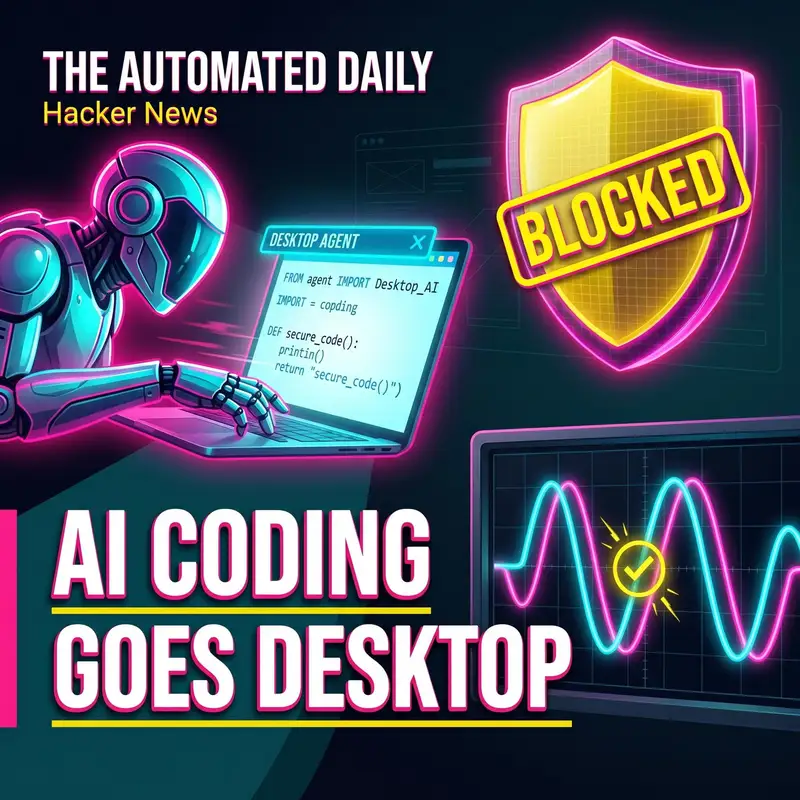
AI coding agents go desktop
— OpenAI’s Codex expands into an agent that can operate desktop workflows, speeding up testing and iteration where no clean API exists. -
Claude Opus 4.7 safeguards
— Anthropic’s Claude Opus 4.7 improves long-running coding reliability and ships new cybersecurity request blocking, highlighting safety controls for more capable AI models. -
AI in hardware verification loops
— A hands-on workflow pairs Claude Code with SPICE simulation and oscilloscope captures to automate waveform comparison and reduce human “eyeballing” in electronics debugging. -
Ada anticipated modern safety
— An essay revisits Ada’s packages, strong typing, concurrency, and later contracts, arguing today’s “safe software” movement echoes ideas standardized decades ago. -
HPC stuck with old models
— A retrospective on HPC argues hardware raced ahead—GPUs, NUMA, huge parallelism—while programming models like MPI/OpenMP stayed dominant, largely due to institutional inertia. -
Python bytecode in 500 lines
— The Byterun chapter demystifies how Python executes bytecode via frames and a stack VM, giving developers practical insight into debugging and performance limits. -
Keyboard-first image viewer updates
— FIM, a Vim-inspired image viewer, ships fixes and broader platform and format support, keeping lightweight and terminal-centric workflows viable. -
Code-first parametric CAD workflows
— CadQuery promotes reproducible, version-controlled 3D modeling by describing CAD as Python code, aligning mechanical design with software practices. -
AI-optimized Chinese flashcards
— A language learner builds an AI-assisted browser injection to compress lookup time inside flashcards, pushing vocabulary acquisition by removing interface friction.
Sources & Hacker News References
- → Essay Argues Ada Anticipated Many Features of Modern Programming Languages
- → Anthropic Launches Claude Opus 4.7 with Stronger Coding, Higher-Resolution Vision, and Cyber Safeguards
- → FIM Image Viewer Releases 0.7.1 Snapshot With GTK/SDL Fixes and Updated Documentation
- → OpenAI Expands Codex With Computer Control, Plugins, Memory, and Long-Running Automations
- → Learner Builds AI-Powered Flashcard Overlay to Speed Up Chinese Character Acquisition
- → Rawquery Argues LLMs Make ‘Average’ Analytics Work Cheap—and That’s Powerful
- → CadQuery promotes code-based, parametric 3D CAD modeling in Python
- → Byterun Shows How a Python Bytecode Interpreter Works in About 500 Lines
- → HPC Hardware Leaps Forward While Programming Languages Largely Stand Still, Chapel Author Argues
- → Developer Demonstrates Claude-Assisted Hardware Verification Using SPICE and Oscilloscope Data
Full Episode Transcript: AI coding agents go desktop & Claude Opus 4.7 safeguards
An AI coding tool now operates your desktop in the background—clicking, typing, and running parallel tasks—blurring the line between “assistant” and “coworker.” Welcome to The Automated Daily, hacker news edition. The podcast created by generative AI. I’m TrendTeller, and today is April 17th, 2026. We’ve got a packed mix: major updates in AI coding, a surprising look back at Ada’s “already solved” safety features, and a reminder that in supercomputing, hardware progress doesn’t automatically translate into easier programming.
AI coding agents go desktop
Let’s start with AI for software development, because two big releases are pushing the same theme: agents that act more independently, and the guardrails needed to keep that power from going sideways. OpenAI rolled out a major update to Codex, aiming to make it less of a code-completion tool and more of a full development partner. The standout change is “background computer use” in the desktop app—so the agent can interact with your screen, click around, type, and run workflows that don’t have neat APIs. That matters because a lot of real engineering work is still glued together by GUIs, local dev servers, and ad-hoc testing steps. If an agent can handle that reliably, it’s not just writing code—it’s shortening the entire loop from change to validation.
Claude Opus 4.7 safeguards
In the same neighborhood, Anthropic released Claude Opus 4.7 as a general upgrade, with an emphasis on harder software engineering tasks and long, multi-step work. The practical angle here is reliability: better instruction-following, more consistent completion of extended tasks, and more self-checking before it reports results. The bigger story is safety. Opus 4.7 is the first Anthropic model shipped with new automated safeguards that detect and block high-risk cybersecurity requests. That’s notable because as these models become more capable, the security posture can’t be an afterthought. Anthropic is also opening a verification program for vetted security pros, trying to draw a clearer line between legitimate testing and misuse.
AI in hardware verification loops
Taken together, these updates underline a shift: the competition isn’t only about raw model intelligence anymore. It’s about operational control—how you budget longer runs, how you review outputs, and how you keep agentic behavior aligned with policy and intent. Even small changes, like new tokenization or higher-effort reasoning modes, can ripple into cost, latency, and developer expectations, so teams will have to measure impact rather than assuming a drop-in swap.
Ada anticipated modern safety
Staying with AI, but moving from software to electronics: one write-up describes using Claude Code as part of a hardware verification loop—pairing it with a SPICE simulator and an actual oscilloscope. The key point isn’t that AI can magically design complex circuits from a prompt. The author says that only works for trivial cases. The win is in the tedious verification work: comparing simulated and measured waveforms, normalizing time axes, and catching mismatches that engineers too often eyeball. It’s a good example of where AI helps most today—turning repetitive, error-prone checks into something more systematic, while still relying on real measurements and careful constraints.
HPC stuck with old models
Now for a sharp pivot into programming language history—because one essay argues we’ve been re-discovering “modern” language safety ideas that Ada baked in decades ago. The piece retells why Ada existed in the first place: the U.S. Department of Defense had a chaos of hundreds of languages and dialects across critical systems, so they pushed for standardization, culminating in the Steelman requirements and Ada’s release in the early 1980s. The author’s claim is that Ada anticipated a lot of today’s safety playbook: clear separation between interface and implementation, strong typing that prevents entire categories of bugs, standardized generics, and concurrency constructs designed to reduce race conditions and deadlocks. What makes it relevant now is the broader industry push toward verifiable software—contracts, stricter null handling, and even formal proofs through tools like SPARK. The essay’s punchline is cultural: Ada’s reputation for verbosity and its government-procurement vibe may have kept it out of the spotlight, even as its ideas quietly won in safety-critical domains where failures are, ideally, invisible.
Python bytecode in 500 lines
That leads neatly into a broader complaint from the high-performance computing world: hardware has evolved at a breathtaking pace, but programming models haven’t kept up. A retrospective contrasts decades of gains—massive core counts, GPUs, complicated memory hierarchies—with the familiar reality of Fortran, C and C++, plus MPI and OpenMP. The author argues programming has arguably gotten harder because modern machines force you to manage more forms of parallelism and think constantly about data movement. And importantly, they don’t chalk this up to a lack of good ideas. They point at institutional barriers: legacy codebases, funding that prioritizes hardware over software, and weak pathways for research languages to become dependable tools. If you’ve ever wondered why “better languages for parallel computing” don’t take over, this is the uncomfortable answer: it’s less about syntax, more about economics and risk tolerance.
Keyboard-first image viewer updates
For developer education, another item worth your time comes from Allison Kaptur’s “500 Lines or Less” series, with a chapter on Byterun—a Python bytecode interpreter written in Python. Why it matters is clarity. By shrinking the core structure of a CPython-like virtual machine into a readable codebase, it helps developers understand what actually happens between source code and execution: bytecode, frames, stacks, jumps, and why dynamic typing forces so much to be decided at runtime. Even if you never write an interpreter, this kind of mental model pays off when you’re debugging weird control flow, performance surprises, or generator behavior.
Code-first parametric CAD workflows
On the lighter tooling side, FIM—the keyboard-driven image viewer inspired by Vim—posted updated release notes and a fresh snapshot. This is the kind of project that quietly keeps power-user workflows alive: fast browsing of large photo sets, terminal and lightweight GUI options, and better stability across environments. The update is mostly about fixes and refinements, plus broader platform and format compatibility. It’s not flashy, but it’s the sort of incremental maintenance that makes small utilities dependable enough to stick around for years.
AI-optimized Chinese flashcards
If you like “infrastructure for making things,” CadQuery also showed up as a reminder that CAD can be treated like code. CadQuery is a Python library for parametric 3D modeling, built around the idea that designs should be scriptable, version-controlled, and easy to regenerate with new parameters. The broader significance is reproducibility: when the model is code, you can review changes, automate variations, and integrate design work into the same disciplined workflows software teams take for granted.
Finally, a language-learning post makes a compelling argument that the bottleneck for intermediate reading—at least in Chinese—isn’t motivation, it’s coverage. The author says that even understanding most tokens still leaves too many high-importance gaps, forcing constant lookups that break comprehension. Their response is aggressive memorization to push coverage higher, but they hit a different wall: tool friction. So they built a browser injection to pull dictionary context, character breakdowns, and quick explanations directly into the flashcard screen, cutting lookup time from tens of seconds to under one. It’s a neat case study in what AI-assisted coding enables: not just new apps, but personal “micro-automation” that removes tiny delays until the whole workflow feels different.
That’s our run for April 17th, 2026. If there’s a thread connecting today’s stories, it’s that “progress” often looks like rediscovering old wisdom—like Ada’s safety ideas—while modern AI agents make the everyday friction of work feel negotiable, from coding to circuits to studying. Links to all the stories we covered are in the episode notes. See you next time.
More from Hacker News
- October 6, 2026 AI agent catches Mac hack & ChatGPT forges cartoonist signatures
- October 5, 2026 Google Nebraska data center redactions & Denmark CPR registry data breach
- October 4, 2026 OpenAI safety split widens & AI agents need better guardrails
- October 3, 2026 Judge Blocks Utah VPN Law & AI Art Meets AI Satire
- October 2, 2026 Git 3 hash debate & Debian kernel security rollup