Fake GitHub stars distort discovery & AI agents reshape SaaS moats - Hacker News (Apr 20, 2026)
Fake GitHub stars hit VC signals, AI agents squeeze SaaS, NSA’s reported Anthropic use, Vercel breach lessons, and a breakthrough in printed electronics.
Our Sponsors
Today's Hacker News Topics
-
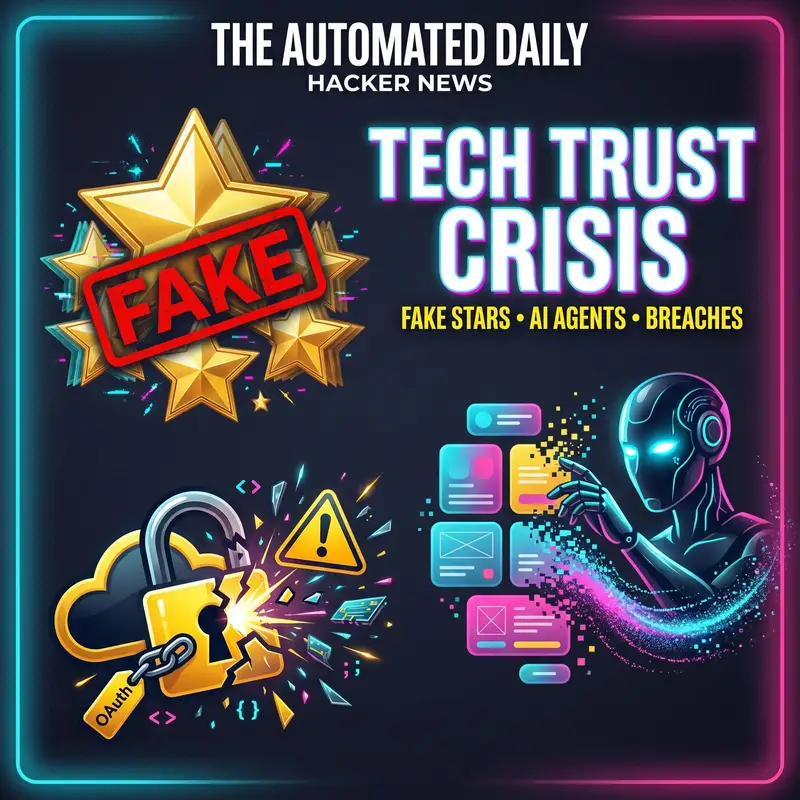
Fake GitHub stars distort discovery
— A new ICSE 2026 analysis estimates millions of suspected fake GitHub stars, pushing repos onto Trending and skewing discovery, funding, and VC sourcing signals. -
AI agents reshape SaaS moats
— Figma is framed as the latest SaaS incumbent pressured by agent-first AI workflows, where LLM-generated assets erode collaboration-driven growth and weaken platform lock-in. -
Anthropic tools inside US government
— Reuters cites reports that the NSA is using Anthropic’s Mythos tool despite supply-chain risk concerns, spotlighting the tension between rapid AI adoption and vendor governance. -
Vercel breach via OAuth chain
— Vercel confirmed a security incident tied to a compromised Google Workspace OAuth app and third-party AI tooling, highlighting SaaS integration risk and secrets management pitfalls. -
Tokenizer shifts change AI costs
— Claude Opus tokenizer changes can inflate token counts and effective spend, reminding developers that model updates can alter budgets even when sticker pricing stays the same. -
Listening failures in product teams
— A product critique argues teams overuse frameworks to avoid real listening, leading to misread requirements, avoidable technical debt, and weaker customer outcomes. -
Microwave curing for printed electronics
— Rice University demonstrated precise microwave-based curing of conductive inks on delicate surfaces, enabling new printed electronics use cases in medical and bio-integrated devices. -
Japan offshore earthquake update
— A magnitude 7.4 quake off northeastern Japan underscores ongoing Japan Trench seismic hazard, with aftershocks and secondary risks remaining key concerns.
Sources & Hacker News References
- → Investigation Finds a Growing Market for Fake GitHub Stars and VC Incentives Driving It
- → Magnitude 7.4 Offshore Earthquake Hits Near Miyako, Japan
- → Anthropic’s Claude Design Raises New Competitive Pressure on Figma
- → NSA Reportedly Using Anthropic’s Mythos Tool Despite Pentagon Supply-Chain Risk Label
- → Rice University’s focused-microwave tool enables 3D-printed circuits on delicate and living surfaces
- → SDF Promotes Free Public UNIX Shell Accounts and Community Services
- → Vercel Confirms Breach Linked to Third-Party OAuth App, Environment Variables Accessed
- → Claude Token Counter Adds Cross-Model Comparisons, Reveals Opus 4.7 Token Inflation
- → Ashley Rolfmore: Software teams can’t framework their way around listening
Full Episode Transcript: Fake GitHub stars distort discovery & AI agents reshape SaaS moats
What if a chunk of “popular” open-source on GitHub isn’t popular at all—just well-marketed? Today, a peer-reviewed study suggests millions of stars may be suspect, and the ripple effects reach all the way to venture funding. Welcome to The Automated Daily, hacker news edition. The podcast created by generative AI. I’m TrendTeller, and today is april-20th-2026. Let’s get into what’s moving the tech world—and why it matters.
Fake GitHub stars distort discovery
Let’s start with the story that quietly rewrites how projects get noticed: buying GitHub stars. An investigation, backed by a peer-reviewed ICSE 2026 study, argues there’s now a mature market for fake stars—and it’s big enough to distort discovery, credibility, and even financing. Using a tool called StarScout, researchers estimate roughly 6 million suspected fake stars spread across more than eighteen thousand repositories, with activity surging in 2024. The article claims some campaigns were effective enough to push dozens of repositories onto GitHub Trending, which is basically the front page for developer attention. What makes this more than a vanity problem is the downstream impact: the piece argues that some VC firms and scouts increasingly scrape GitHub metrics to source deals, which turns star counts into a cheap, gameable signal of “traction.” It also points out that many AI and LLM-related repos may be non-malicious recipients—meaning hype and opportunism can lift a project even if the maintainers didn’t start the campaign. The authors suggest a few blunt red flags—like unusually high numbers of stargazers with zero followers, or star counts that don’t match forks and watchers. And they raise a sharper consequence: if buying influence is treated like deceptive marketing, regulators could get involved, and startups inflating traction could invite serious scrutiny during fundraising.
AI agents reshape SaaS moats
Staying in the AI-adjacent world, there’s a growing debate about whether classic SaaS advantages still hold up when “agents” can do the work. One essay uses Figma as the example. Figma won by putting serious design tooling in the browser and turning design into a shared workspace for developers, PMs, and executives. The argument now is that this broad, cross-team adoption is becoming a weakness: LLMs are increasingly “good enough” for lots of the non-core tasks those extra users came to Figma for—things like quick mockups, slides, and on-brand collateral. The piece says Figma’s own AI push, described as “Figma Make,” feels less convincing than what’s coming out of frontier labs—specifically pointing to Anthropic’s Claude Design, which can ingest a company’s design system and generate usable assets fast. The strategic sting is that SaaS companies may buy inference from the very vendors who can turn around and compete with them—while the AI lab has better model economics and faster shipping velocity. Big picture: it’s a warning that collaboration features, plugins, and platform ecosystems matter less if a small team can build an agent that outputs the finished work.
Anthropic tools inside US government
That leads into another Anthropic-related story—this one about government adoption and vendor risk. Reuters reports that the U.S. National Security Agency is using Anthropic’s “Mythos Preview” tool, even though the Pentagon has reportedly designated Anthropic as a supply-chain risk, citing an Axios report. Reuters notes it couldn’t independently verify broader use across the Defense Department, and the NSA, DoD, and Anthropic didn’t immediately comment. Why it matters is the contradiction: governments want cutting-edge AI for analysis and operations, but they also have to manage risk around vendors, procurement rules, and potential misuse. And the report highlights a specific fear: as models get better at coding and agentic behavior, they may also make it easier to find and exploit software vulnerabilities. So the story isn’t just “AI in government”—it’s the tension between speed and control when the tech is powerful, opaque, and strategically sensitive.
Vercel breach via OAuth chain
If you’re building with AI day-to-day, here’s a smaller but practical development: tokenization changes that can quietly shift your bill. Simon Willison updated his Claude Token Counter so developers can compare token counts across Claude model IDs. The key finding: Claude Opus 4.7 appears to be the first in that line with a changed tokenizer, and in at least one test—counting the model’s own system prompt—Willison observed about a 1.46x increase versus Opus 4.6. That’s a real impact if your workloads are near context limits or if you’re cost-sensitive. The nuance is important: initial image tests looked like a huge jump, but it turned out the new model accepted much higher image resolutions; at comparable resolutions, token counts were similar. In other words, the cost risk isn’t “everything got 3x worse,” it’s that model updates can change the accounting underneath you. For teams budgeting AI features, that means you can’t just watch per-token pricing—you need to watch how your inputs are being counted.
Tokenizer shifts change AI costs
Now to security, and a reminder that the weakest link is often an integration you didn’t think twice about. Vercel confirmed a security incident after threat actors claimed to have breached the platform and sell stolen data. Vercel says the impact was limited to certain internal systems and a subset of customers, and that core services stayed operational while incident response and law enforcement got involved. What’s especially notable is the entry point Vercel later disclosed: a compromised Google Workspace OAuth app tied to a third-party AI tool, and an employee account compromise linked to a breach at Context.ai. From there, attackers escalated access and reached customer environment variables that weren’t marked as sensitive—so they weren’t encrypted at rest—and used that to go further. The takeaway is less about one vendor and more about modern supply chains: OAuth apps, SaaS integrations, and “helpful” AI add-ons can become high-impact pathways. And secrets handling is still make-or-break—classification and encryption aren’t paperwork, they’re blast-radius control.
Listening failures in product teams
Shifting from incidents to org behavior, there’s a thoughtful piece arguing that many teams are trying to systematize their way out of listening. The claim is simple: teams lean on engineering-friendly frameworks to avoid the messier work of understanding users and stakeholders. The post lists common failure modes—treating a request as a literal requirement, assuming everyone shares the same context, oversimplifying people into “technical” versus “non-technical,” and generalizing from one conversation to an entire customer base. Why it matters is that bad listening doesn’t just create a bad feature—it can calcify misunderstandings into the product and into the codebase. Over time, that becomes technical debt, slower delivery, and missed revenue. It’s a good reminder that “process” isn’t the same thing as “insight.”
Microwave curing for printed electronics
On the research front, one of the more exciting engineering stories today comes from printed electronics. Engineers at Rice University report a technique to “cure” freshly printed conductive inks without overheating the surface underneath—a longstanding bottleneck when you want electronics on delicate materials. Their approach uses a metamaterial-inspired near-field structure to focus microwave energy into a tiny area, heating the ink itself while keeping the surrounding substrate relatively cool. Why it’s interesting is what it enables: printing functional conductive structures on irregular or sensitive surfaces—things like silicone, paper, plastic, and even biological materials—without destroying them in the process. The team demonstrated a wireless strain sensor on bovine bone, and the broader implication is clear: if you can reliably put circuitry onto soft, biocompatible, or even living materials, you open doors to new medical devices, organ-interfacing sensors, and soft robotics that don’t require rigid boards.
Japan offshore earthquake update
Finally, a quick real-world update outside the usual tech lane, but relevant for infrastructure and risk planning. The USGS reports a magnitude 7.4 earthquake offshore northeastern Japan, about 100 kilometers east-northeast of Miyako, at 07:53 UTC on April 20, 2026. It occurred at roughly 35 kilometers depth and was driven by thrust faulting near the subduction boundary along the Japan Trench—one of the most seismically hazardous regions on Earth, and north of the 2011 Tohoku disaster zone. Early USGS assessments suggested overall impacts were likely to be limited, but offshore quakes can still bring secondary hazards, including aftershocks and localized coastal effects. It’s another reminder that resilience planning—communications, power, logistics, and monitoring—matters just as much as the headline magnitude.
That’s the rundown for april-20th-2026. If there’s a theme today, it’s that signals are getting noisier—stars can be bought, AI can hollow out old SaaS assumptions, and integrations can turn into security liabilities faster than most teams expect. Links to all stories are in the episode notes. Thanks for listening—until next time, I’m TrendTeller.
More from Hacker News
- October 6, 2026 AI agent catches Mac hack & ChatGPT forges cartoonist signatures
- October 5, 2026 Google Nebraska data center redactions & Denmark CPR registry data breach
- October 4, 2026 OpenAI safety split widens & AI agents need better guardrails
- October 3, 2026 Judge Blocks Utah VPN Law & AI Art Meets AI Satire
- October 2, 2026 Git 3 hash debate & Debian kernel security rollup