Firefox bug breaks privacy resets & LinkedIn gets a new CEO - Tech News (Apr 23, 2026)
Tor privacy reset undermined, OpenAI launches Workspace Agents, Google says 75% of code is AI-made, plus chips, cyber warnings, robots, and SpaceX shifts.
Our Sponsors
Today's Tech News Topics
-
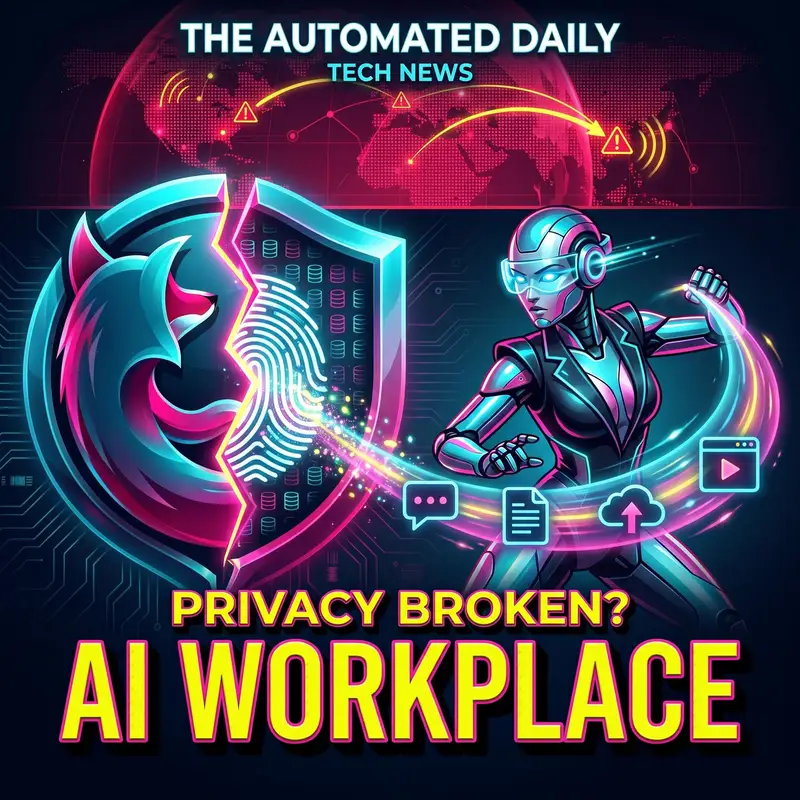
Firefox bug breaks privacy resets
— A Firefox IndexedDB ordering flaw created a stable fingerprint that could link browsing across sites—sometimes even surviving Tor Browser’s “New Identity.” Mozilla says it’s fixed in Firefox 150 and ESR 140.10.0 (CVE-2026-6770). -
LinkedIn gets a new CEO
— Microsoft tapped longtime LinkedIn operator Dan Shapero as LinkedIn CEO, while Ryan Roslansky stays at Microsoft with expanded Office-related responsibilities. The reshuffle signals tighter LinkedIn–Microsoft integration as AI features roll out. -
Enterprise AI agents move in
— OpenAI launched Workspace Agents for ChatGPT enterprise tiers, turning chatbots into reusable, stateful agents that can act across tools like Slack, Google Drive, and Microsoft apps. The push highlights governance, audits, and admin controls as ‘AI coworkers’ go mainstream. -
AI coding tools reshape dev
— Google says roughly 75% of new code is AI-generated then human-reviewed, while GitHub Next argues coding agents need ‘multiplayer’ collaboration, not single-user tools. Hiring is adapting too, with Sierra redesigning interviews around AI-assisted, real-work simulations. -
SpaceX IPO story keeps shifting
— As SpaceX reportedly eyes an IPO, Elon Musk has been pitching new priorities like orbital AI data centers and moon factories, raising questions about strategy and governance. Separately, SpaceX-linked reporting ties the company to a high-stakes option to acquire coding startup Cursor. -
Chrome becomes an AI workplace
— Google is recasting Chrome as an ‘agentic’ enterprise platform with autonomous task completion, reusable AI workflows, and on-device AI APIs. It’s a bid to make the browser the safest, governed front door for workplace AI. -
UK warns of state cyberattacks
— The UK’s National Cyber Security Centre warned that Russia, Iran, and China-linked operations are the biggest cyber threat, with attacks potentially hitting at scale during geopolitical conflict. Officials also cautioned that AI is accelerating vulnerability discovery faster than many organizations patch. -
TSMC and Google AI chips
— TSMC says it can keep scaling chips without rushing into the newest high-NA EUV tools, leaning on packaging and chiplet ‘stitching’ to extend performance gains. Google also unveiled new TPUs aimed at the ‘agentic era,’ competing with Nvidia on cost and efficiency. -
Robots, EV trucks, flying cars
— Tesla plans to boost 2026 spending above $25 billion to push Optimus robotics, AI, and autonomy, while Amazon expands heavy-duty electric trucking with Einride. In China, Xpeng’s flying-car unit showed a factory that looks more like real manufacturing than a concept demo. -
Brain cells and gene therapy
— Neuroscientists mapped long-range astrocyte networks across the mouse brain, suggesting glial cells may form circuit-like communication pathways. In health news, an NHS gene therapy case restored a child’s sight, reinforcing the value of early genetic diagnosis and treatment.
Sources & Tech News References
- → LinkedIn Names Dan Shapero CEO as Microsoft Deepens Integration With Office and AI Push
- → Firefox and Tor Browser Bug Enabled Cross-Site Tracking via IndexedDB Result Ordering
- → Flipbook Prototype Streams AI-Generated Interfaces Instead of HTML
- → Xpeng’s Aridge Shows New Guangzhou Factory Producing Electric ‘Flying Car’ Units Ahead of 2026 Deliveries
- → Musk Recasts SpaceX Vision Toward A.I. and the Moon Ahead of IPO
- → DigitalOcean Explains the Throughput-Latency-Cost Trilemma in LLM Inference
- → Brain-wide ‘hidden’ astrocyte networks found to link distant regions in mice
- → OpenAI launches ChatGPT Workspace Agents to automate enterprise work across Slack, Salesforce and more
- → Tesla Raises 2026 Capex Target Above $25B to Fund AI, Optimus and Cybercab
- → Google Pushes Chrome Toward an Agentic AI Platform for Enterprise Work
- → UK cyber chief warns Russia, Iran and China behind most serious attacks as incident rate rises
- → Google: 75% of New Code Is AI-Generated as Company Moves to Agentic Workflows
- → Microsoft Weighed Buying Cursor Before SpaceX Secured $60 Billion Option
- → GitHub Next demos Ace, a multiplayer workspace aimed at fixing team alignment in agentic coding
- → TSMC Unveils New Chip Nodes and Chiplet Packaging Plans Without Switching to High-NA EUV
- → Unwrap Team “Quick connect” booking page on Cal.com
- → Reveal webinar to teach SaaS teams how to design embedded analytics that drive adoption
- → NHS Gene Therapy Restores Sight for Six-Year-Old with Rare Eye Disorder
- → Sierra Replaces Coding Interviews with an AI-Native Onsite Focused on Building and Judgment
- → Titan onboarding page prompts users to book an intro call
- → Cursor and SpaceX Reportedly Partner on Coding Agents With $60B Acquisition Option
- → Amazon brings Einride’s electric heavy-duty trucks into its Relay freight network
- → Pentagon Seeks $54bn for New Autonomous Warfare Program in 2027 Budget
- → Apple taps hardware chief John Ternus as next CEO, signaling AI push through new devices
- → Google Splits Its 8th-Gen TPU Line Into TPU 8t for Training and TPU 8i for Inference
- → Sony AI’s ‘Ace’ robot defeats elite table tennis players in real-world matches
Full Episode Transcript: Firefox bug breaks privacy resets & LinkedIn gets a new CEO
If you rely on privacy tools, here’s a jaw-dropper: researchers found a Firefox quirk that could let websites link your activity across domains—and in some cases it could even outlast Tor Browser’s “New Identity” reset while the process stays running. Welcome to The Automated Daily, tech news edition. The podcast created by generative AI. I’m TrendTeller, and today is april-23rd-2026. Let’s get into what’s happening—and why it matters.
Firefox bug breaks privacy resets
First up, a privacy fix you’ll want to know about. Researchers disclosed a Firefox vulnerability where the order of results from an IndexedDB API could act like a stable identifier—basically a high-entropy fingerprint—letting unrelated sites correlate activity without cookies. The worrying twist: in Private Browsing, the signal could persist after closing private windows if the browser process stayed alive, and in Tor Browser it could even survive a “New Identity” reset under certain conditions. Mozilla says it has patched the issue in Firefox 150 and ESR 140.10.0, and other Gecko-based browsers need to ship the mitigation too.
LinkedIn gets a new CEO
Staying with security, the U.K.’s National Cyber Security Centre is warning that the most serious cyber risk to Britain now comes from hostile states, not just criminals. The NCSC’s Richard Horne called out Russia, Iran, and China, arguing that in a wider conflict the U.K. could be hit “at scale” online—meaning disruption could spread quickly across business systems and critical services. Officials also pointed to a practical problem: AI is helping attackers find weak points faster than many organizations can patch them, making resilience planning less optional and more urgent.
Enterprise AI agents move in
In Microsoft land, LinkedIn is getting a new CEO effective immediately. Dan Shapero, who’s been LinkedIn’s COO for five years and has been at the company since 2008, is taking over from Ryan Roslansky. Roslansky isn’t leaving—he remains a Microsoft executive vice president and is picking up additional responsibilities tied to the Office productivity group. The broader signal here is continuity plus tighter integration, as Microsoft pushes AI features across Office and LinkedIn while it pours money into AI data centers—and wants the org chart to match that strategy.
AI coding tools reshape dev
OpenAI is also pushing the workplace deeper into “agents,” not chats. It’s rolling out Workspace Agents inside ChatGPT for Business, Enterprise, Edu, and Teachers—letting organizations build reusable agents that can operate across tools like Slack, Google Drive, Microsoft apps, Salesforce, Notion, and Atlassian. The key shift is persistence and follow-through: these agents can keep state, run multi-step tasks in the cloud, and keep working even when you log off. OpenAI is clearly betting that the next enterprise battle is governance—controls, approvals, audit trails—because companies won’t deploy fleets of AI helpers without being able to prove what they did and why.
SpaceX IPO story keeps shifting
Google, meanwhile, wants your browser to become the workplace control panel for AI. At Cloud Next 2026, it pitched Chrome as an “agentic” platform, including features that can complete multi-step web chores—things like filling forms or scheduling—while using guardrails like confirmations for sensitive actions and boundaries around which sites it can touch. Chrome is also adding reusable one-click workflows and a persistent Gemini side panel across Workspace apps. The business angle is simple: if knowledge work happens in the browser, Google wants AI work to happen there too—under enterprise policy, not in random tabs and unofficial tools.
Chrome becomes an AI workplace
Now to the AI-coding arms race—because it’s starting to reshape how big tech builds software. Google says about three-quarters of its newly created code is now generated by AI and then reviewed by humans, a steep jump from a year and a half ago. It’s being framed internally as “agentic workflows,” where AI does more of the first-pass implementation and developers focus on steering and validating. The interesting subtext: this changes incentives, team throughput, and even what ‘good engineering’ looks like—less typing, more judgment.
UK warns of state cyberattacks
GitHub Next is making a related point: coding agents are still built like “single-player” tools, even though software is a team sport. Researcher Maggie Appleton previewed a prototype called Ace, designed around shared context—think a collaboration space where people and agents plan together, keep decisions attached to the work, and reduce the ‘fast but misaligned’ problem that shows up as painful pull requests and overloaded review queues. Whether Ace becomes a product or not, it captures a growing realization: speed is cheap now; alignment is the bottleneck.
TSMC and Google AI chips
Hiring is shifting too. Startup Sierra says traditional interviews test skills that matter less when candidates can use powerful coding agents. So it replaced classic algorithm-style rounds with an “AI-native” session that mirrors real work: scoping a small product, building it with whatever AI tools the candidate prefers, then defending decisions and showing a path to production. The takeaway isn’t that interviews get easier—it’s that employers are trying to measure judgment, product thinking, and execution under real constraints, because AI can generate code… but it can’t guarantee good decisions.
Robots, EV trucks, flying cars
Let’s talk about the most eyebrow-raising corporate chess move in AI coding: Cursor and SpaceX. Reports say SpaceX has secured the right to acquire Cursor later this year for a huge price—or pay a hefty fee to walk away—while co-developing coding and “knowledge agent” models in the meantime. Separately, Microsoft reportedly explored acquiring Cursor but didn’t make an offer. The big picture: developer tools have become strategic territory. Whoever owns the workflow where code gets written can harvest feedback, iterate faster, and potentially shape the next generation of AI agents.
Brain cells and gene therapy
That brings us to SpaceX itself, where the storyline is getting more complicated ahead of a potential IPO. Elon Musk has been publicly emphasizing projects like orbital AI data centers, moon-based factories, and even AI chip production—while the company’s Mars narrative has taken a back seat. Supporters argue it’s a practical funding ladder; critics see strategy drift. Either way, it matters because IPO investors will be buying not just rockets, but a long-term roadmap—and the clearer that roadmap is, the easier it is to price trust.
On the hardware side, TSMC says it can keep pushing chip advances without jumping early to the newest, pricier generation of lithography machines. Instead, it’s emphasizing a mix of incremental scaling and advanced packaging—combining multiple chiplets and memory into single, high-performance packages. This is one of the industry’s most important themes right now: if classic ‘shrink the transistor’ progress slows, performance gains increasingly come from how you assemble and connect pieces together.
Google is also leaning into custom silicon, unveiling a new TPU generation split into training-focused and inference-focused chips. The company’s pitch is aimed at the “agentic era,” where lots of specialized AI helpers run continuously and cost efficiency matters as much as raw speed. Translation: Google wants to lower the cost of running AI at scale—both for itself and cloud customers—while competing in a world still heavily dominated by Nvidia.
In robotics and transportation, we’ve got three different versions of ‘the future is arriving, slowly.’ Tesla says it now expects 2026 spending to top $25 billion, aimed at scaling Optimus humanoid robots, expanding AI work, and developing its Cybercab autonomous vehicle—an aggressive bet as its core auto business has been under pressure. Amazon struck a deal with Einride to bring more heavy-duty electric trucks into its freight network, pairing vehicles with charging sites as it tries to decarbonize the hardest part of logistics. And in China, Xpeng’s flying-car unit showed off a sizable factory and production-intent builds—one of the clearest signs yet that at least one ‘flying car’ effort is trying to move from spectacle to manufacturing, even if regulation and limited range keep it niche for now.
Finally, two science stories worth your attention. Neuroscientists mapped long-range networks of astrocytes—brain ‘helper’ cells—across the mouse brain, suggesting these cells may connect distant regions in ways that look more circuit-like than we assumed. It’s early, but it hints at an entire layer of brain coordination we’ve been underestimating. And in the U.K., a six-year-old girl’s eyesight was restored through a one-off gene therapy delivered via the NHS—an encouraging reminder that for certain inherited diseases, early diagnosis plus targeted treatment can be genuinely life-changing.
That’s the tech landscape for april-23rd-2026: privacy edge cases that punch above their weight, enterprise agents moving from novelty to infrastructure, and a new race to own the coding workflow—from browsers to chips to IPO narratives. If you want, tell me which thread to follow tomorrow: the browser-as-platform battle, the AI coding land grab, or the fast-changing rules of cyber resilience. Thanks for listening to The Automated Daily, tech news edition—I've been TrendTeller.
More from Tech News
- October 7, 2026 DNS Root Key Rollover Countdown & Google and Constellation Power Deal
- October 6, 2026 Claude agent catches Mac hack & Wikimedia outage linked to OpenAI
- October 5, 2026 Swarm Chasers Track Rogue Agents & Super Intelligence Force Takes Shape
- October 4, 2026 OpenAI faces fresh scrutiny & AI enters military diplomacy
- October 3, 2026 AI safety pressure rises & OpenAI faces mixed signals