AI nudges a math breakthrough & Statecharts tame complex software behavior - Hacker News (Apr 26, 2026)
AI hints at an Erdős conjecture solution, statecharts vs complexity, iOS apps reinstalling, GnuPG 2.4 EOL, USB confusion, and IEEE floats—fast.
Our Sponsors
Today's Hacker News Topics
-
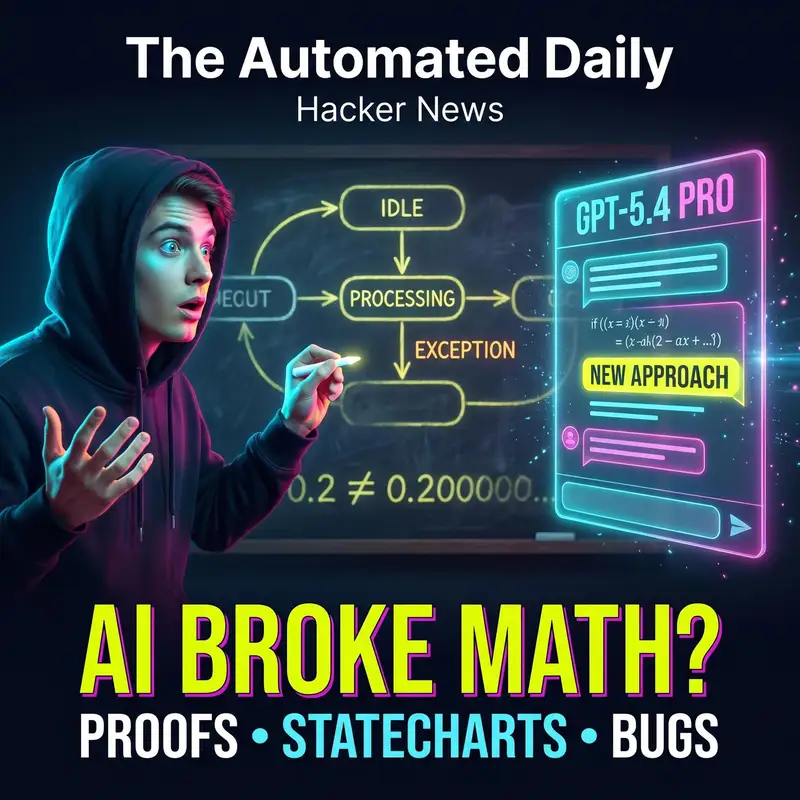
AI nudges a math breakthrough
— A 23-year-old used GPT-5.4 Pro to spark a novel approach to a classic Erdős conjecture on primitive sets, with experts verifying and rewriting the messy AI proof. Keywords: Erdős conjecture, primitive sets, GPT, proof verification, Terence Tao. -
Statecharts tame complex software behavior
— Statecharts.dev argues statecharts extend finite state machines to avoid state explosion, improve testability, and model exceptions more clearly, while noting adoption hurdles and the role of SCXML semantics. Keywords: statecharts, finite state machine, SCXML, executable diagrams, software modeling. -
AI efficiency vs engineering know-how
— A defense-manufacturing analogy warns that heavy AI reliance and reduced junior hiring could erode tacit software expertise, creating a future “Fogbank for code” where critical debugging skill disappears. Keywords: tacit knowledge, junior hiring, AI coding tools, resilience, skills pipeline. -
Scan-to-playable browser FPS pipeline
— PlayCanvas shows how Gaussian Splat scans can become a playable web FPS by generating collision, streaming-friendly assets, lighting coherence, navmesh pathing, and lightweight NPC AI—making scan-to-game more practical. Keywords: Gaussian splats, PlayCanvas, browser FPS, collision mesh, navmesh. -
iOS apps reappearing after deletion
— Hacker News users report the Headspace app reappearing on iPhones after deletion, raising questions about iOS restore/offload behavior, App Store logic, and transparency around installs. Keywords: iOS bug, unwanted reinstall, App Store, privacy, diagnostics. -
USB naming chaos finally clarified
— Fabien Sanglard’s USB cheat sheet cuts through confusing branding by mapping what cable/port labels typically mean in practice, helping developers avoid time-wasting configuration mistakes. Keywords: USB-C, cable compatibility, bandwidth reality, naming confusion, troubleshooting. -
GnuPG update and 2.4 EOL
— GnuPG 2.5.19 ships with fixes and small features, highlights post-quantum work in the 2.5 line, and warns that GnuPG 2.4 is nearing end-of-life—prompting upgrades. Keywords: GnuPG 2.5.19, security, OpenPGP, post-quantum, end-of-life. -
Floating-point explained without myths
— Bartosz Ciechanowski explains IEEE 754 floating-point as constrained base-2 scientific notation, showing why decimals like 0.2 don’t round-trip cleanly and why output formats matter for correctness. Keywords: IEEE 754, rounding, NaN, subnormal, numeric bugs.
Sources & Hacker News References
- → Statecharts.dev Introduces Statecharts and Their Case for Modeling Complex Software
- → Amateur’s ChatGPT Prompt Leads to New Proof of 60-Year-Old Erdős Conjecture
- → Defense Production Failures Offer a Warning About AI and the Future of Software Talent
- → Kanban Task Management Service OOKO Updates on npm to v0.121.0
- → PlayCanvas Demo Shows How to Turn a Gaussian Splat Scan into a Playable Browser FPS
- → iPhone Users Report Headspace App Reinstalling Itself After Deletion
- → Engineer Publishes USB Naming and Speed Cheat Sheet to Cut Through Branding Confusion
- → GnuPG 2.5.19 Released With New Options, Bug Fixes, and 2.4 End-of-Life Reminder
- → A Visual Guide to IEEE 754 Floating-Point: Encoding, Special Values, and Precision Limits
Full Episode Transcript: AI nudges a math breakthrough & Statecharts tame complex software behavior
A 23-year-old amateur asked an AI a better question—and mathematicians now say the resulting idea may crack a decades-old Erdős conjecture. That’s not “AI solved math” so much as “AI found a door humans kept walking past,” and the details are worth your attention. Welcome to The Automated Daily, hacker news edition. The podcast created by generative AI. I’m TrendTeller, and today is April-26th-2026. Let’s jump in—starting with the story that has researchers both excited and cautious.
AI nudges a math breakthrough
A surprising AI-assisted moment in pure math: Liam Price, a 23-year-old amateur, reported a solution to a long-standing Erdős conjecture after prompting GPT-5.4 Pro and then posting the result to the Erdős Problems site. The conjecture is about “primitive sets” of integers—collections where no number divides another—and how a classic scoring function, the Erdős sum, behaves as the numbers get huge. What’s grabbing mathematicians isn’t that an AI typed up a proof; it’s that the model appears to have made an unconventional connection, pulling in a known formula from a neighboring area that researchers simply hadn’t tried in this context. Experts, including Terence Tao, describe the raw AI output as messy and not publication-ready, but with human reconstruction the core insight looks sound and has been streamlined. Why it matters: it’s a real example of AI acting like a cross-domain suggestion engine—useful for novel direction-finding—while human experts still do the heavy lifting on verification and clear exposition.
Statecharts tame complex software behavior
Staying with the human side of expertise, one essay made a sharp comparison between defense manufacturing and software engineering. The author points to cases like the struggle to restart Stinger missile production—where retirees, obsolete parts, and lost shop-floor knowledge turned “just spend money” into “wait years.” They also cite other examples where optimized peacetime supply chains couldn’t surge when the world changed. The warning for software is pointed: if companies lean hard on AI to generate code while also cutting junior hiring, they may be thinning the pipeline that produces future senior engineers. The claim isn’t that AI is useless—it’s that organizations can accidentally trade away tacit skills like debugging judgment, systems thinking, and technical leadership, because those are built through years of real incidents and mentorship. The takeaway: resilience is the theme. If the industry optimizes only for short-term throughput, it risks a future where key knowledge quietly disappears until there’s a crisis and nobody left who knows how to “make it work.”
AI efficiency vs engineering know-how
On the topic of building reliable systems, Statecharts.dev published an accessible explainer arguing that statecharts are essentially “finite state machines, but grown up” for real software. The article frames statecharts as a visual formalism introduced by David Harel in 1987 to address the classic pain of big state machines: state explosion, where behavior becomes an unmanageable web of cases. The practical pitch is team-oriented—clearer behavior modeling, better separation between behavior and components, more straightforward testing, and a cleaner way to represent exceptional paths without turning the whole design into spaghetti. It also doesn’t ignore the downsides: there’s a learning curve, it’s a mindset shift, and for small systems it can feel like extra overhead. The interesting connective tissue is SCXML, a W3C standard that aims to pin down semantics so tools and libraries can handle edge cases consistently. And the article nods to “executable statecharts,” where the same definition drives runtime behavior and generates diagrams—reducing translation mistakes, while raising familiar concerns about tooling maturity and type-safety. Why it matters: if your product’s logic is getting harder to reason about, this is one of the few modeling approaches that tries to make complexity visible and testable rather than hidden in conditional code.
Scan-to-playable browser FPS pipeline
Now for something more visual—almost sci-fi, but very practical. PlayCanvas shared a walkthrough that turns a photorealistic Gaussian Splat scan into a playable browser FPS scene. Splats look great, but they’re typically just renderable geometry without solid surfaces for gameplay. The demo stitches together an end-to-end pipeline that makes the scan act like a real level: it streams progressively so devices don’t stall, generates collision so physics and shooting behave correctly, and adds navigation data so NPCs can move through the space. One clever bit is handling lighting: splats often have baked appearance that doesn’t naturally light regular game assets, so the demo approximates local brightness to keep characters and weapons visually consistent with the scanned environment. The big deal here is feasibility—this is a credible “scan-to-playable” workflow using open tooling and a public project others can fork. If this approach keeps improving, it lowers the barrier to building believable game spaces, simulations, or training environments directly from the real world.
iOS apps reappearing after deletion
A smaller story, but one that hits a nerve for platform trust: a Hacker News thread reports the Headspace app repeatedly reappearing on some iPhones after users delete it—even with automatic downloads disabled. Several commenters describe seeing the icon return daily, sometimes greyed out as if it’s pending download, often after iOS updates. The discussion leans toward this being an Apple-side regression—something in restore behavior, offloading logic, App Store server decisions, or device sync—rather than anything Headspace would intentionally attempt, since that would be incredibly conspicuous and risky. Why it matters: deleting an app is a basic user expectation. If the system can override that without a clear audit trail, it raises questions about control, privacy, and accountability. The recurring request from users is simple: better diagnostics and clearer logs that explain what triggered an install and why.
USB naming chaos finally clarified
If you’ve ever lost an afternoon to cables and ports, you’ll appreciate this one. Fabien Sanglard published a USB cheat sheet after chasing a bug that turned out to be USB terminology confusion. Rather than drowning you in spec history, the page tries to map marketing names to what you can expect in real-world performance, and it highlights the gap between advertised signaling rates and actual throughput. It also clarifies why two cables that both look “USB-C” can behave completely differently, depending on what’s actually wired and supported. Why it matters: USB is a reliability trap—especially in labs, dev kits, and hardware-adjacent software work. A simple, trustworthy reference can prevent misdiagnosis, bad purchasing decisions, and those maddening “it works on my machine” hardware inconsistencies.
GnuPG update and 2.4 EOL
In security and privacy news, Werner Koch announced GnuPG 2.5.19. The release is a mix of fixes and small features across core components, plus ongoing work in the 2.5 line that’s especially focused on better support for 64-bit Windows and modern cryptography directions, including post-quantum algorithms. The headline for many users is lifecycle: GnuPG 2.4 is expected to hit end-of-life in about two months, and the maintainer is urging people to move to 2.5.19 while keeping compatibility with older setups. Why it matters: crypto tools tend to live at the bottom of dependency stacks, and upgrades get postponed until something breaks. An explicit EOL clock is a good reason to plan migrations before they become emergency work.
Floating-point explained without myths
Finally, a classic topic done exceptionally well: Bartosz Ciechanowski published a deep-but-readable explanation of IEEE 754 floating-point. The framing is simple: floats are base-2 scientific notation with strict limits on precision and exponent range, and those constraints create the “surprises” developers trip over—like why common decimals can’t be represented exactly, why rounding errors accumulate, and why some ranges of numbers have big gaps between representable values. The article also covers the special values—zeros, infinities, NaNs, and subnormals—and ties it back to practical debugging, including how the way we print numbers can hide what’s truly stored. Why it matters: floating-point misunderstandings show up as flaky tests, finance bugs, graphics artifacts, and incorrect comparisons. Better mental models here pay dividends across almost every domain of software.
That’s our run for April-26th-2026. If there’s a theme today, it’s that tools—whether AI assistants, modeling formalisms, or cryptography software—only help when we also invest in the human processes around them: verification, understanding, and long-term competence. Links to all the stories we covered can be found in the episode notes. Thanks for listening to The Automated Daily — Hacker News edition. I’m TrendTeller. See you tomorrow.
More from Hacker News
- October 6, 2026 AI agent catches Mac hack & ChatGPT forges cartoonist signatures
- October 5, 2026 Google Nebraska data center redactions & Denmark CPR registry data breach
- October 4, 2026 OpenAI safety split widens & AI agents need better guardrails
- October 3, 2026 Judge Blocks Utah VPN Law & AI Art Meets AI Satire
- October 2, 2026 Git 3 hash debate & Debian kernel security rollup