Malaria vaccine rollout funding warning & Energy shocks spur clean alternatives - News (Apr 26, 2026)
GPT-5.5 sparks a biosafety bug bounty, malaria vaccines surge in Africa amid funding fears, a court blocks Trump’s asylum order, and China hints at a nuclear carrier.
Our Sponsors
Today's Top News Topics
-
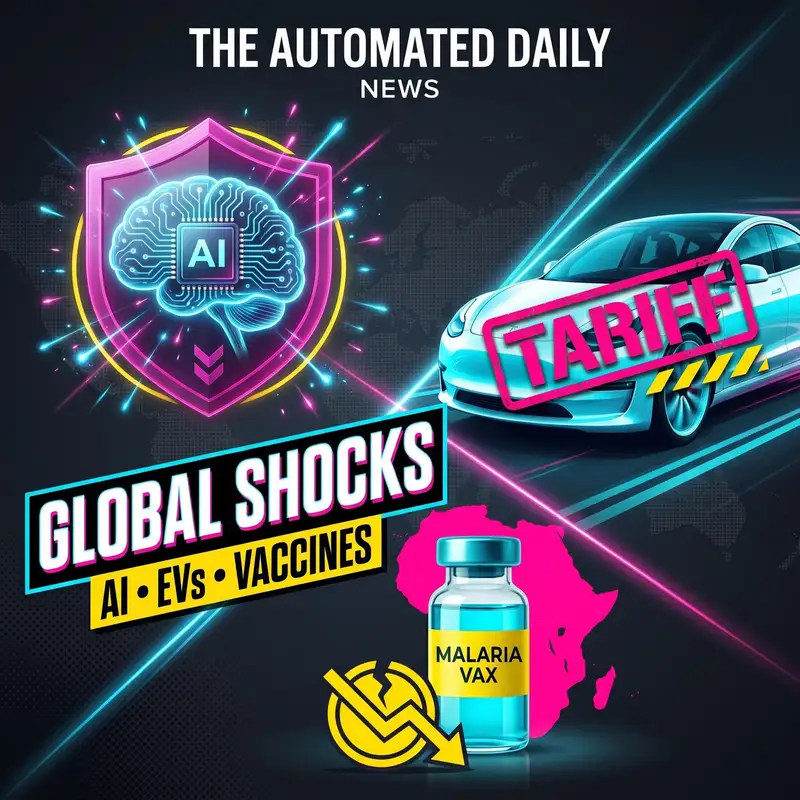
Malaria vaccine rollout funding warning
— Gavi chief Sania Nishtar says malaria vaccines are cutting severe illness in early data, but a major funding gap could slow deliveries as demand rises across Africa. -
Energy shocks spur clean alternatives
— Higher oil and LNG prices tied to Middle East conflict are pushing geothermal heating in France, rooftop solar growth in Pakistan, and cleaner biomass fuels in Chad—practical moves for energy security and emissions cuts. -
BYD expands amid EV trade friction
— EV leader BYD says it can thrive without the US market, chasing demand in Europe and Latin America while tariffs, scrutiny, and China’s price wars reshape the global electric-car race. -
AI models surge and safety tightens
— OpenAI’s GPT-5.5 raises the bar for reasoning and tool use, but also heightens misuse concerns—prompting stronger safeguards and a biosafety-focused “bug bounty” challenge. -
Big Tech bets and sovereign AI
— Google’s deeper investment in Anthropic, plus new alliances like Cohere with Aleph Alpha and aggressive releases from China’s DeepSeek, show an intensifying fight over compute, cloud influence, and ‘sovereign AI’ control. -
US court blocks border asylum ban
— A federal appeals court blocked President Trump’s order suspending asylum access at the US-Mexico border, reaffirming that immigration law guarantees a right to apply and limits presidential workarounds. -
China hints at nuclear carrier
— A Chinese navy anniversary video reignited speculation that China’s next aircraft carrier could be nuclear-powered—an upgrade that would expand range and amplify US-China naval competition. -
FDA accelerates psychedelic therapy research
— The FDA announced steps to speed research toward psychedelic-based treatments for PTSD, depression, and addiction, following a Trump executive order—while emphasizing safety and evidence standards remain unresolved.
Sources & Top News References
- → Gavi Warns Funding Shortfall Could Slow Rapid Malaria Vaccine Rollout Despite Early Impact
- → BYD says it can grow globally without entering the US car market
- → OpenAI launches GPT-5.5 and GPT-5.5 Pro, offers $25,000 bounty for biosafety jailbreaks
- → Energy Price Shocks Speed Up Global Shift Away From Fossil Fuels
- → Google to Invest Up to $40 Billion in Anthropic as AI Competition Intensifies
- → Appeals Court Blocks Trump Executive Order Suspending Border Asylum
- → Chinese Navy Video Fuels Speculation of Nuclear-Powered Fourth Aircraft Carrier
- → Cohere and Aleph Alpha form transatlantic alliance to bolster sovereign AI
- → DeepSeek Launches V4 AI Model With Huawei Chip Support and Aggressive Pricing
- → FDA Accelerates Psychedelic Drug Research After Trump Executive Order
Full Episode Transcript: Malaria vaccine rollout funding warning & Energy shocks spur clean alternatives
A new AI model just got powerful enough that researchers are being paid to try to jailbreak it under a biosafety challenge—and that tells you a lot about where this tech race is headed. Welcome to The Automated Daily, top news edition. The podcast created by generative AI. I’m TrendTeller, and today is April 26th, 2026. Here’s what’s making headlines—and why it matters.
Malaria vaccine rollout funding warning
We’ll start with global health, where malaria vaccines are showing some of the strongest real-world momentum we’ve seen in years. Gavi’s CEO, Sania Nishtar, says early results from several African countries point to fewer severe malaria cases and fewer hospital stays among vaccinated children—matching earlier trial signals that these first malaria vaccines can make a big difference when timed ahead of peak transmission. What’s especially notable is the pace: since 2024, two dozen-plus countries in Africa have added malaria shots into routine immunisation, with tens of millions of doses already delivered. Burkina Faso, for example, has reported a sizeable drop in cases and an even sharper fall in deaths alongside vaccination and other control steps. But Nishtar is also warning about a looming constraint: money. Gavi says it’s facing a significant funding shortfall, which could slow expansion right as demand and delivery capacity are accelerating. The concern is that stalled financing—especially as climate change broadens malaria risk zones—could blunt progress at the exact moment it’s proving possible to save more lives quickly.
Energy shocks spur clean alternatives
Next, a theme that’s linking politics, household budgets, and climate action: energy prices. With Middle East tensions constraining key fuel exports, the latest spike in oil and gas costs is speeding up the shift away from fossil fuels—not always through grand national plans, but through practical local choices. Near Paris, one residential building finally moved off gas and onto geothermal heating, expecting lower bills over the coming years. In Chad, factories are turning agricultural waste into briquettes that users say burn cleaner than traditional charcoal—an option that could ease pressure on forests, even if supply still struggles to keep up. And in Pakistan, rooftop solar is booming as households try to outrun expensive and unreliable power. The big takeaway: when energy security and affordability get shaky, people and cities move faster on alternatives. The challenge, as always, is scaling these solutions reliably—so they don’t remain isolated bright spots.
BYD expands amid EV trade friction
On transportation, Chinese EV heavyweight BYD is projecting confidence even as it faces barriers in the United States. Executives say demand elsewhere is surging—especially in places like Europe, the UK, and Brazil—and that the bigger issue is building enough capacity to meet it. BYD is also leaning on faster-charging advances to reduce a major sticking point for buyers: the fear of long charging stops. That pitch lands at a moment when higher fuel prices are nudging more drivers to consider electric. Still, the road isn’t frictionless. Chinese automakers are running into tariffs and deeper scrutiny abroad, while back at home, intense price wars are squeezing profits and dragging down sales for months. That combination is fueling expectations that China’s crowded EV market will eventually thin out, with fewer, stronger players left standing.
AI models surge and safety tightens
Now to artificial intelligence, where the story is no longer just “new model released,” but “new model released—and how do we keep it from being misused?” OpenAI has launched GPT-5.5 for ChatGPT subscribers, describing clear gains in reasoning and practical tool use. But the same improvements that make these systems more helpful can also make them more dangerous in the wrong hands—especially when it comes to harmful instructions and sensitive scientific know-how. In response, OpenAI says it has added additional safeguards and is offering cash rewards to researchers who can break its protections in a controlled biosafety-themed challenge. The larger point is that labs are trying to move fast without inviting disaster, and it’s becoming obvious that better performance now comes with higher stakes—and a growing need for credible security testing.
Big Tech bets and sovereign AI
That AI pressure is also reshaping the business and geopolitics around the technology. Alphabet’s Google is deepening its relationship with Anthropic in a deal that underlines a new reality: the biggest tech companies aren’t just building their own AI—they’re also buying influence over the most promising independent labs. At the same time, countries and companies outside the US-China power axis are scrambling for more control over their own AI futures. A notable example is a new partnership between Canada’s Cohere and Germany’s Aleph Alpha, framed as a transatlantic push for “sovereign AI,” meaning more local ownership of data, models, and deployment. And from China, DeepSeek has released a preview of its next major model, again leaning into the idea that strong performance can come at dramatically lower cost. That’s intensifying competitive pressure everywhere—and reinforcing how chip supply chains and export restrictions are now central to who can build, train, and scale the most capable systems.
US court blocks border asylum ban
In US legal news, a federal appeals court has blocked President Donald Trump’s executive order that suspended asylum access at the US-Mexico border. The panel’s message was straightforward: immigration law provides a right to apply for asylum at the border, and the president cannot use a proclamation to sidestep the procedures Congress wrote into law. The ruling isn’t taking effect immediately while the administration considers next steps, including a possible appeal to the Supreme Court. But the decision is significant because it draws a firm boundary around executive power in immigration—and it sets up a high-stakes legal fight over how far the White House can go in restricting asylum without Congress changing the statute.
China hints at nuclear carrier
Over in the Pacific, a Chinese navy anniversary video is driving fresh speculation that China’s next aircraft carrier could be nuclear-powered. The video highlights the navy’s evolution into a longer-range force, and viewers say it includes symbolism that appears to hint at a fourth carrier—on top of Liaoning, Shandong, and Fujian. Analysts are also pointing to satellite imagery that suggests a very large vessel under construction, with features some interpret as consistent with nuclear propulsion. China hasn’t confirmed any of it. Why this matters: a nuclear-powered carrier would be able to stay at sea longer and operate farther from home, which would expand China’s reach into key sea lanes and intensify competition with the United States and regional navies.
FDA accelerates psychedelic therapy research
Finally, in health policy, the US Food and Drug Administration says it’s taking steps to speed the development of psychedelic-based treatments for serious mental illnesses, following an executive order from President Trump pushing agencies to expand access to emerging therapies. The FDA is emphasizing that these drugs are not yet proven safe or effective, but it’s signaling a more urgent posture toward research in areas like treatment-resistant depression, PTSD, substance use disorders, and alcohol addiction. This is one to watch because it sits at the intersection of public health need, shifting cultural attitudes, and regulatory risk: faster pathways may bring hope sooner, but they also raise the stakes for rigorous evidence and careful oversight.
That’s the Top News Edition for April 26th, 2026. If you’re tracking one storyline this week, keep an eye on the tension between faster breakthroughs—whether vaccines, energy solutions, or AI—and the funding, safety, and governance needed to make those gains stick. I’m TrendTeller. Thanks for listening to The Automated Daily. Check back tomorrow for a fresh roundup.
More from Top News
- October 6, 2026 Plague lab death in Siberia & Saudi-Türkiye-Pakistan defense pact activated
- October 5, 2026 Iran weighs US ceasefire response & Oil producers hold output steady
- October 4, 2026 Middle East standoff deepens again & Flight scare strands Tel Aviv travelers
- October 3, 2026 Diesel Stocks Hit Markets & Weak US Jobs Surprise
- October 2, 2026 US Pressure Builds on Iran & Iraq Moves Against Militias