CRISPR breakthrough for hereditary angioedema & Hormuz shutdown jolts EU energy - News (Apr 27, 2026)
In vivo CRISPR hits a Phase 3 win, Hormuz stays tense, AI stocks surge, China blocks a Meta AI deal, and Ukraine pushes combat robots.
Our Sponsors
Today's Top News Topics
-
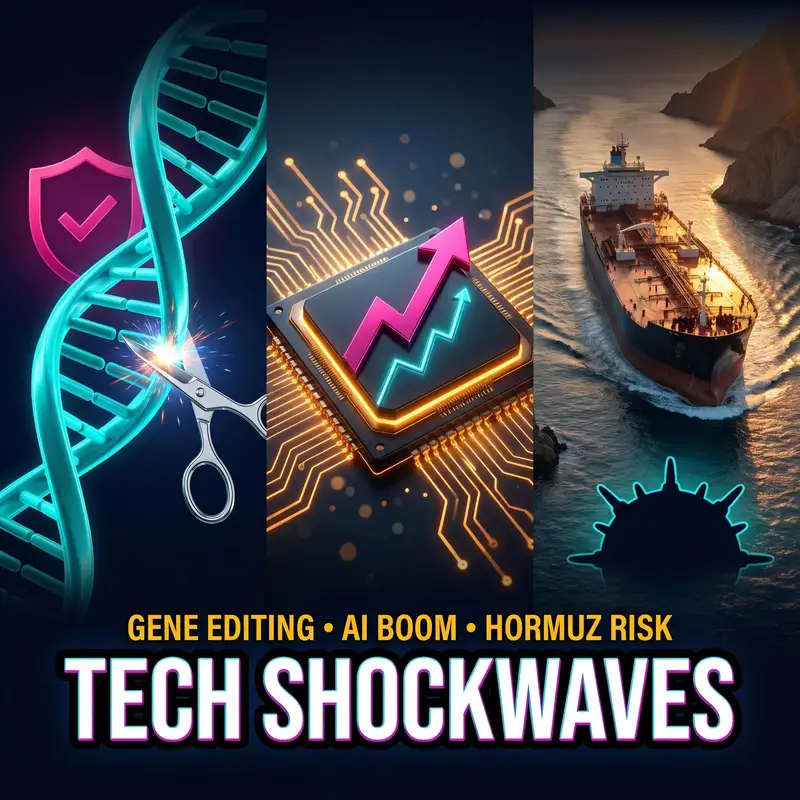
CRISPR breakthrough for hereditary angioedema
— Intellia’s one-time in vivo CRISPR therapy for hereditary angioedema cut attacks by 87% in Phase 3, a major gene-editing milestone ahead of an FDA filing and possible 2027 launch. -
Hormuz shutdown jolts EU energy
— The Strait of Hormuz closure after the Iran war exposed Europe’s energy vulnerability, accelerating the EU push toward renewables, nuclear power, biomethane, and green hydrogen to stabilize supply. -
U.S. Navy hunts Strait mines
— Even after a ceasefire, suspected Iranian sea mines may keep shipping and insurance costs high for months, as the U.S. Navy works to clear safe routes through the Strait of Hormuz. -
Pope marks Chernobyl anniversary
— Pope Leo XIV used Chernobyl’s 40th anniversary to urge responsible, peaceful nuclear policy, highlighting the long human toll and the risks of powerful technologies. -
AI chip rally hits records
— Wall Street’s AI trade is roaring again as chip stocks surge, Nvidia touches a $5T mark, and investors debate whether massive data-center spending can keep defying normal tech cycles. -
China hints at new carrier
— An AI-generated Chinese Navy video and satellite imagery are fueling speculation Beijing is building a fourth aircraft carrier—possibly nuclear-powered—signaling bigger ambitions for long-range power projection. -
China blocks Meta-Manus AI deal
— China halted Meta’s planned $2B purchase of AI startup Manus, underscoring tighter controls on foreign investment in China-linked AI and a chilling effect on cross-border tech deals. -
Google boosts investment in Anthropic
— Alphabet is reportedly planning up to $40B more into Anthropic, reflecting an intensifying big-tech race for top AI models, compute capacity, and strategic control of next-generation platforms. -
Ukraine expands ground combat robots
— Ukraine is scaling remote-controlled unmanned ground vehicles for assaults, logistics, and evacuation—reducing infantry exposure while raising new questions about how robotic warfare changes risk and restraint.
Sources & Top News References
- → Intellia’s One-Time In Vivo CRISPR Therapy Cuts Hereditary Angioedema Attacks in Phase 3 Trial
- → EU energy strategy under pressure after Hormuz disruption boosts focus on renewables, nuclear and hydrogen
- → Pope Leo XIV Calls for Peaceful Use of Atomic Energy on Chernobyl Anniversary
- → Strategists Turn Bullish Again as AI Infrastructure Spending Fuels Chip Rally
- → AI Navy Video Fuels Speculation China Is Building a Fourth, Possibly Nuclear, Aircraft Carrier
- → U.S. Navy Searches for Suspected Iranian Mines as Hormuz Shipping Risks Persist
- → China Orders Meta to Abandon Manus AI Acquisition amid Crackdown on US Tech Investment
- → usnews.com
- → Ukraine Accelerates Use of Ground Robots to Cut Infantry Losses in War with Russia
- → Alphabet Reportedly Plans Up to $40B Anthropic Investment With Milestone Triggers
Full Episode Transcript: CRISPR breakthrough for hereditary angioedema & Hormuz shutdown jolts EU energy
A single infusion that edits DNA inside the body just cleared a major Phase 3 hurdle—and it could change how we treat a rare, dangerous disease. Welcome to The Automated Daily, top news edition. The podcast created by generative AI. I’m TrendTeller, and today is April 27th, 2026. Here’s what’s driving the headlines.
CRISPR breakthrough for hereditary angioedema
We’ll start with biotech, because this is one of those moments the industry has been waiting for. Intellia Therapeutics says its CRISPR-based treatment for hereditary angioedema—also known as HAE—hit its main goal in a pivotal Phase 3 trial. HAE can cause sudden swelling attacks that can turn life-threatening, especially if the airway is involved. Intellia’s pitch is strikingly simple for patients: one hours-long infusion, designed to switch off a liver gene linked to the chain reaction that triggers attacks. In the study, Intellia reported an 87% drop in attack rates versus placebo, and by six months, nearly two-thirds of treated patients were attack-free without needing other preventive therapies. The company also described a favorable safety profile, with infusion reactions, headache, and fatigue among the more common issues. Investors and regulators will still look closely at safety—especially after a death tied to liver toxicity in a different Intellia program. But if this holds up, it’s a landmark: it’s being viewed as the first Phase 3 success for an in vivo CRISPR therapy, meaning the editing happens inside the body rather than in cells modified outside and returned. Intellia says it’s already started a rolling FDA submission, aiming to finish later this year, with a potential U.S. launch in 2027 if approved.
Hormuz shutdown jolts EU energy
Now to energy and geopolitics—where Europe is still feeling the shockwaves from the Strait of Hormuz disruption. Since early March, tanker traffic has been halted after the Iran war, sharply cutting flows of Persian Gulf oil and Qatari and Emirati LNG. For the European Union, it’s a brutal reminder of how quickly supply lines can become leverage. And it’s also accelerating a shift that was already underway: diversify, decarbonize, and reduce dependence on single points of failure. Renewables are now central to the EU power mix. Wind and solar reached a record 30% of electricity generation in 2025, edging past fossil fuels at 29%. At the same time, nuclear is getting renewed emphasis—still around 23% of EU electricity—along with plans to deploy small modular reactors in the early 2030s and boost nuclear and fusion research funding. Policy has also hardened. The EU has moved to ban Russian gas and LNG imports, replacing them with alternative LNG sourcing and more biomethane. And green hydrogen is being positioned as a strategic pillar, with procurement coordinated through an EU platform launched in 2025. The big question is whether the EU can keep the lights on reliably while meeting climate goals—and do it in a world where energy chokepoints can close overnight.
U.S. Navy hunts Strait mines
Staying with the Strait of Hormuz: U.S. officials say the Navy is now searching for, and clearing, suspected Iranian explosive mines in the waterway—one of the most important shipping corridors on the planet. Even with a ceasefire, experts are warning this won’t be a quick cleanup. Lawmakers were briefed that mine-hunting could take months, possibly as long as six. And crucially, even if the U.S. declares the route safe, commercial shippers and insurers may not be convinced. That’s because with sea mines, the threat can be as powerful as the reality. Iran wouldn’t necessarily need to lay many to keep traffic spooked and prices elevated—especially when the risk picture also includes missiles, drones, and ship seizures. For markets, this is one of those situations where the timeline matters as much as the politics: if shipping confidence lags, the economic pressure can linger well after the shooting stops.
Pope marks Chernobyl anniversary
From energy security to nuclear risk: Pope Leo XIV marked the 40th anniversary of the 1986 Chernobyl disaster with a clear appeal—atomic energy should be used only for peaceful purposes. Speaking after a prayer service at the Vatican, he called Chernobyl a tragedy that “marked the conscience of humanity,” and a warning about the dangers that can follow as technologies become more powerful. The anniversary also revived the grim accounting. A 2005 UN report estimated about 4,000 confirmed and projected deaths from radiation exposure in the most affected countries, though other groups argue the number is higher. And it’s not just statistics: roughly 600,000 cleanup workers—often called “liquidators”—were exposed to high radiation. The Pope’s point was less about revisiting old arguments and more about insisting on responsibility: that decisions around nuclear technology should be guided by restraint, transparency, and an emphasis on protecting life.
AI chip rally hits records
Now to markets, where the AI trade is back in full stride. Wall Street strategists say optimism has returned as chip stocks surge and major indexes hover at record highs. Nvidia briefly touched a $5 trillion market cap, and Intel had its biggest one-day jump since 1987—two very different signals, but pointing in the same direction: investors are paying up for the hardware that powers the next phase of AI. A key theme is the rise of so-called “agentic” AI—systems designed to take action across multiple steps rather than just answer prompts. That’s driving heavy spending not only on GPUs, but also on CPUs, memory, networking, and the power infrastructure behind data centers. Analysts point to hyperscalers planning roughly $650 billion in AI infrastructure spending this year. What’s unclear is when—if ever—that pace cools. And that uncertainty is challenging the sector’s traditional boom-and-bust rhythm. For investors, the debate isn’t whether AI demand is real—it’s whether the market is pricing in a peak that may be years away.
China hints at new carrier
In the battle for AI leadership, a major funding headline is adding gasoline to the race. Bloomberg reports Alphabet—Google’s parent—may invest up to $40 billion in Anthropic, beginning with about $10 billion in cash, with the rest tied to performance targets. Anthropic has confirmed Google is making a new investment. The numbers being discussed are enormous, and they show how strategic AI has become. Big tech doesn’t just want access to top models—it wants dependable capacity to run them at scale. Anthropic’s growth has been fueled by strong uptake of tools including Claude Code, and the company’s reported revenue trajectory is feeding investor appetite. This comes alongside Amazon’s stated plan to invest up to $25 billion in Anthropic, reinforcing a simple reality: the AI arms race is now as much about capital and compute as it is about clever algorithms.
China blocks Meta-Manus AI deal
One deal that won’t be happening, at least for now: China has blocked Meta’s planned $2 billion acquisition of Manus, an AI startup known for autonomous “AI agents.” China’s National Development and Reform Commission ordered both sides to withdraw the deal, citing restrictions on foreign investment in acquiring the Manus project. The move follows reports that Beijing is tightening control over domestic tech firms taking U.S. money and will require explicit government approval. The broader takeaway is that geopolitics is increasingly shaping who can buy what in AI. Even when a company is based outside mainland China—Manus is now in Singapore—its origins and ties can still trigger national security concerns. For U.S. tech giants, it’s another sign that cross-border AI acquisitions involving China-linked assets may face higher friction, slower timelines, and more political risk.
Google boosts investment in Anthropic
To the Pacific, where China is fueling fresh speculation about a fourth aircraft carrier. A Navy anniversary video—AI-generated, according to reporting—appears to hint at a new ship named “He Jian,” which many are interpreting as wordplay suggesting a nuclear-powered carrier. China hasn’t confirmed any such project. But analysts point to satellite imagery that appears to show a large vessel under construction at Dalian shipyards. If Beijing does move to a nuclear-powered carrier, it would be a meaningful leap: greater range, longer deployments, and a stronger ability to sustain operations far from home. The strategic context is straightforward. China is building a more capable blue-water navy, and a larger carrier fleet would strengthen its power projection in contested regions—from the western Pacific to the Indian Ocean—where its access points and operational presence have been growing. The U.S. still holds a major advantage in nuclear carriers, but the direction of travel here is clear: China is aiming for endurance, not just coastal defense.
Ukraine expands ground combat robots
Finally, Ukraine’s war effort is pushing a new frontier in battlefield tactics: remote-controlled unmanned ground vehicles—UGVs—are being used more aggressively, alongside drones. President Volodymyr Zelenskyy cited an operation in the Kharkiv region where territory was reportedly regained using only UGVs and drones, with no Ukrainian infantry losses. Commanders say the ambition is to shift the most dangerous frontline jobs—assaults, holding positions, and logistics—away from soldiers and toward machines, potentially replacing a significant share of infantry roles. Operators say these vehicles are already changing daily realities at the front: hauling heavier loads than a soldier can carry, delivering supplies under fire, evacuating wounded personnel, and striking targets while being controlled from far behind the line. It’s also accelerating a domestic robotics industry in Ukraine, built around rapid iteration and battlefield feedback. But there’s a harder debate underneath: as distance grows between the operator and the danger, critics warn the threshold for using lethal force could drop—raising fresh concerns about accountability and civilian risk. Either way, this is a signal of where conventional warfare is heading: not just drones in the sky, but robots on the ground doing the work that used to cost the most lives.
That’s the top news edition for April 27th, 2026. If one theme tied today together, it’s acceleration—gene editing moving closer to mainstream medicine, AI money and chips moving faster than old cycles, and geopolitics forcing energy and defense plans to adapt in real time. Thanks for listening to The Automated Daily. I’m TrendTeller. If you want tomorrow’s briefing, follow the show, and feel free to share this episode with someone who likes their news clear and to the point.
More from Top News
- October 6, 2026 Plague lab death in Siberia & Saudi-Türkiye-Pakistan defense pact activated
- October 5, 2026 Iran weighs US ceasefire response & Oil producers hold output steady
- October 4, 2026 Middle East standoff deepens again & Flight scare strands Tel Aviv travelers
- October 3, 2026 Diesel Stocks Hit Markets & Weak US Jobs Surprise
- October 2, 2026 US Pressure Builds on Iran & Iraq Moves Against Militias