Brain chips and thought decoding & Biological computers playing Doom - News (Feb 28, 2026)
Brain cells learn Doom, OpenAI lands $110B, US-Israel strike Iran, Kenya rolls out 6‑month HIV shot, new sleeping sickness pill, and key tech policy fights.
Our Sponsors
Today's Top News Topics
- 01
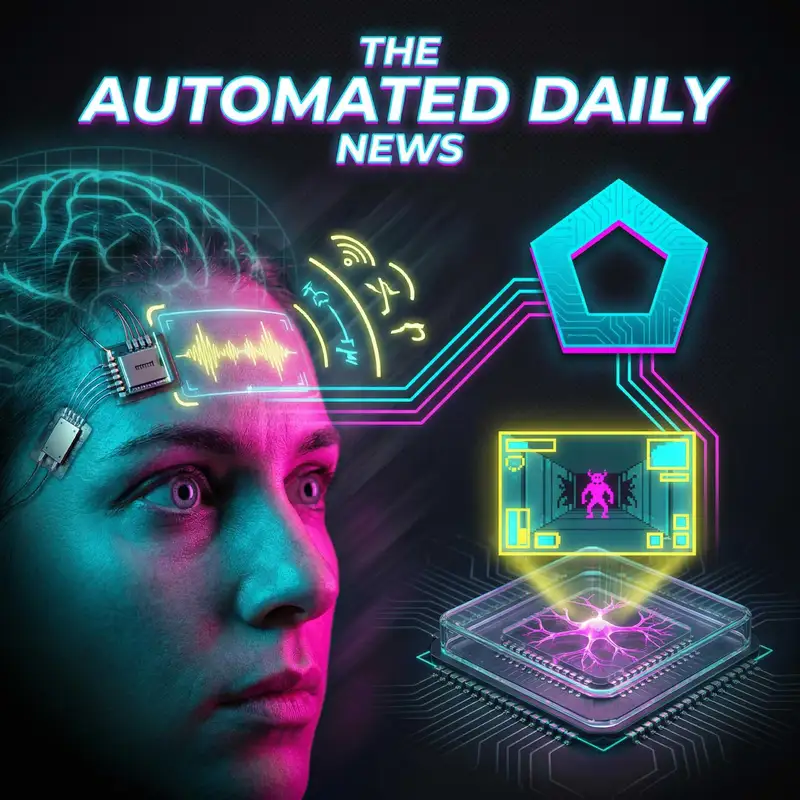
Brain chips and thought decoding
— Researchers at Stanford used a microelectrode BCI to translate imagined speech into text, with inner-speech decoding reaching up to 74% accuracy in structured tasks—raising privacy and ethics questions around thought decoding. - 02
Biological computers playing Doom
— Australian firm Cortical Labs trained living human neurons on a chip to play Doom using a new Python-based interface, a notable step for biological computing and hybrid AI systems. - 03
OpenAI funding and AI power
— OpenAI announced $110B in new backing from Amazon, Nvidia, and SoftBank at a $730B pre-money valuation, alongside claims of 900M weekly ChatGPT users—highlighting the infrastructure race for frontier AI. - 04
Pentagon pressures Anthropic over Claude
— The U.S. Defense Department warned Anthropic to remove restrictions on military use of Claude or risk contract termination and a potential “supply chain risk” label, reviving debate over AI safeguards and the Defense Production Act. - 05
Middle East strikes on Iran
— The U.S. and Israel carried out strikes on Iran, with Washington citing “imminent threats” and Tehran reporting explosions in multiple cities—an escalation with uncertain next moves and regional risk. - 06
New HIV prevention shot in Kenya
— Kenya began rolling out lenacapavir (LEN), a free, long-acting HIV prevention injection given twice a year, supported by shipments via Gilead, the Global Fund, and additional planned U.S. doses. - 07
Single-dose pill for sleeping sickness
— European regulators endorsed Sanofi’s acoziborole, a three-pill, single-dose treatment for sleeping sickness that could help eliminate transmission by simplifying care and avoiding spinal taps for staging. - 08
In-utero stem cells for spina bifida
— UC Davis researchers reported early safety results for an in-utero placenta-derived stem-cell add-on during fetal spina bifida repair, with no major complications and reversal of hindbrain herniation in six newborns. - 09
India enters global 6G standards
— India says it has joined 6G global standards work through ITU and 3GPP, pushing “Ubiquitous Connectivity,” targeting 10% of global 6G patents, and proposing stronger SIM and app-binding measures to curb fraud. - 10
Social media addiction lawsuit trial
— A 20-year-old lead plaintiff testified in a major U.S. trial accusing Meta and YouTube of designing addictive platforms that harm youth mental health, focusing on features like infinite scroll, autoplay, and beauty filters.
Sources & Top News References
Full Episode Transcript: Brain chips and thought decoding & Biological computers playing Doom
A lab just taught living human brain cells—grown on a chip—to play Doom in about a week. It’s not science fiction, but it does raise big questions about where computing is headed. Welcome to The Automated Daily, top news edition. The podcast created by generative AI. I’m TrendTeller, and today is February-28th-2026. Here’s what’s shaping the world right now.
Brain chips and thought decoding
Let’s start in the fast-moving intersection of brains and machines. At Stanford, researchers are getting closer to what many people loosely call “mind reading”—but with a practical goal: restoring communication for people who can’t speak. In one study, a 52-year-old stroke survivor, identified as participant T16, had a microelectrode array implanted in the front of her brain. An AI system then translated neural activity linked to imagined speech into real-time text on a screen. Three ALS patients also participated. The big question was whether a brain-computer interface can decode not just attempted speech—when someone tries to move the muscles of speaking—but also inner speech, the silent voice in your head. In structured sentence-imagery tasks, accuracy climbed as high as 74%. But the system struggled when participants generated more spontaneous inner speech, and for open-ended prompts the output largely fell apart into gibberish. Researchers also used tasks like counting colored shapes to tease out internal number-words, detecting related traces in motor cortex activity. The takeaway: inner speech and attempted speech appear strongly correlated in motor cortex, but inner-speech signals are weaker. Separately, experts like UC Davis neuroengineer Maitreyee Wairagkar say the pace is accelerating—and predict real-world commercialization in the next few years, as companies including Neuralink push consumer-oriented brain chips. Researchers also think progress could come from sampling many more neurons than today’s systems, and from decoding signals in additional brain regions—important for stroke survivors whose motor cortex may be damaged.
Biological computers playing Doom
And then there’s the story that sounds the most surreal: biological computers. Australian company Cortical Labs says it trained living human neurons grown on a chip to play the classic first-person shooter Doom—in about a week. The neurons sit on microelectrode arrays that can both stimulate the cells and read their electrical activity. Cortical Labs had previously shown a neuron-chip playing Pong back in 2021, but that took years of work and used large clumps of cells. This time, the demo used roughly a quarter as many neurons and—crucially—introduced a more accessible interface that developers can program using Python. An independent developer, Sean Cole, reportedly trained the system to interact with Doom within days. To be clear, it’s not beating human gamers. But researchers say performance was better than random firing, and they’re emphasizing the engineering leap: making living neural hardware easier to program. Independent experts called it a real step forward, while also pointing out the obvious mystery—scientists still can’t fully explain how those neurons represent the game environment in the first place.
OpenAI funding and AI power
Staying with AI, but shifting to business and geopolitics: OpenAI says it has secured a massive new funding package. CEO Sam Altman announced $110 billion in new funding from Amazon, Nvidia, and SoftBank, valuing OpenAI at a $730 billion pre-money valuation. Amazon is leading with a $50 billion commitment, with an initial $15 billion up front and more to follow under preset conditions. Nvidia and SoftBank are each committing $30 billion. Altman also claimed ChatGPT now exceeds 900 million weekly active users and has more than 50 million consumer subscribers—numbers that, if accurate, underline just how quickly generative AI has moved from novelty to habit. On the partnership front, Amazon Web Services will become the exclusive third-party cloud distribution provider for OpenAI Frontier, aimed at delivering advanced AI tools to enterprises. OpenAI and AWS are also expanding their existing multiyear deal by another $100 billion over eight years. OpenAI says this doesn’t change its relationship with Microsoft, calling that partnership “strong and central.”
Pentagon pressures Anthropic over Claude
Meanwhile in Washington, the politics of AI deployment are getting sharper. According to the Associated Press, Defense Secretary Pete Hegseth gave Anthropic an ultimatum: allow its Claude technology to be used by the military without restrictions by a deadline, or risk losing its government contract. Officials also warned they could label Anthropic a “supply chain risk,” and there was talk of invoking the Defense Production Act—an extraordinary move that legal experts say would be unprecedented if used to override a company’s AI safety limits. Anthropic has been described as the last major peer not supplying tech to a new internal U.S. military network, with CEO Dario Amodei citing concerns about unchecked uses like fully autonomous armed drones and AI-enabled mass surveillance. The Pentagon says it’s not seeking mass surveillance or weapons without human involvement, but the standoff highlights the unresolved question: who gets final say over safeguards when national security is invoked?
Middle East strikes on Iran
Now to the Middle East, where a major escalation is unfolding. The United States and Israel carried out strikes on Iran on Saturday, following months of rising tensions and repeated warnings from President Donald Trump tied to Iran’s nuclear and ballistic missile programs. In a video posted on social media, Trump said the U.S. had begun “major combat operations,” framing the objective as eliminating imminent threats and targeting Iran’s missile capability and naval forces, as well as Tehran’s proxy networks. Israel’s defense minister said Israel launched a pre-emptive attack to remove threats to the country. Iran reported blasts in multiple cities including Tehran and Isfahan, with early reports citing casualties but limited clarity on targets. Israeli air defenses were reportedly intercepting missiles launched from Iran, while air-raid sirens sounded across Israel. Israel closed its airspace to civilian flights, and the U.S. embassy in Qatar issued a shelter-in-place warning. This is a developing situation, and what matters next is the scale of retaliation, the safety of civilians, and whether diplomatic channels—recently reopened in February—can prevent a wider regional conflict.
New HIV prevention shot in Kenya
Turning to public health—there are two major developments in Africa that could change how care is delivered. First, Kenya has begun administering lenacapavir, or LEN, a long-acting HIV prevention injection that can protect people for six months at a time. The shots will be offered free to eligible individuals and given twice a year at selected public health facilities in priority counties. Health Minister Aden Duale launched the rollout in Nairobi and emphasized the burden among young people aged 15 to 24. Authorities also say pregnant and breastfeeding mothers can use the drug safely, and that side-effect monitoring systems are in place. Kenya received an initial 21,000 doses through an arrangement involving Gilead Sciences and the Global Fund, with more expected in the coming months—including additional doses from the U.S. government to support early implementation. Second, European drug regulators have backed acoziborole, a simpler treatment for sleeping sickness—also known as African trypanosomiasis. It’s a single-dose regimen: three pills taken at once. That’s a major shift from treatments that can require long hospital visits and even spinal taps to stage the disease. In a study of around 200 patients in Congo and Guinea, more than 95% were considered cured 18 months later. Sanofi has pledged to donate doses to the World Health Organization so patients can receive it for free. With fewer than 600 cases of the most common form reported in 2024, advocates say the disease is on the brink of elimination—and this kind of logistics-friendly treatment can make the difference between progress and plateaus.
Single-dose pill for sleeping sickness
Next, an early but promising update in fetal medicine. Researchers have published initial results from the first clinical trial testing an in-utero stem-cell therapy for spina bifida, specifically the severe form called myelomeningocele. In the CuRE trial led by surgeon Diana Farmer at UC Davis, six pregnant women underwent fetal surgery at about 24 to 25 weeks’ gestation. During the operation, the team applied placenta-derived stem cells—made from donated placentas—directly onto the fetus’s exposed spinal cord. The primary goal was feasibility and safety. The researchers reported no surgical complications and no signs of infection, cerebrospinal fluid leakage, or tumor growth in the newborns—important given theoretical cancer risks with stem-cell approaches. All six newborns also showed reversal of hindbrain herniation, a serious complication linked to spina bifida. Experts are urging caution on interpreting outcomes: it’s a small group, and long-term functional benefits—like walking independently—remain to be proven. But as an early safety signal, it’s notable.
In-utero stem cells for spina bifida
On to telecom and digital policy: India says it’s stepping into a bigger role. Union Communications Minister Jyotiraditya Scindia says India has joined the global 6G standard-setting process for the first time, working with international bodies like the ITU and 3GPP. He pointed to rapid 5G expansion and described India’s rollout as the world’s fastest, with near-total district coverage and hundreds of millions of users already migrated. India’s Bharat 6G Alliance has reportedly grown past 100 stakeholders, and the government is targeting a 10% share of global 6G patents. One accepted proposal focuses on “Ubiquitous Connectivity,” aimed at minimizing dead zones. Scindia also emphasized stronger digital safeguards—supporting SIM binding, and pushing a SIM-to-app binding mandate for major messaging platforms to curb fraud and account misuse. It’s a reminder that next-generation networks aren’t just about speed; they’re also about identity, trust, and enforcement.
India enters global 6G standards
Finally, a courtroom story that could shape how tech platforms are judged in the years ahead. In Los Angeles County Superior Court, a 20-year-old woman identified as KGM testified that she became addicted to social media as a child—starting with YouTube at age six and Instagram at nine. She told the court that by age 10 she was depressed and self-harming, and that beauty filters distorted her self-image. She described panic and fear of missing out when her phone was taken away—and said she still uses social media because it’s “too hard to be without it.” KGM is the lead plaintiff in a major lawsuit against YouTube and Meta, accusing them of intentionally designing addictive products that harm young people. Lawyers pointed to features like infinite scroll and autoplay, and argued that “like” buttons exploit teens’ desire for validation. This is the first trial in consolidated litigation involving more than 1,600 plaintiffs, including families and school districts. TikTok and Snap were originally defendants in KGM’s case but settled shortly before trial, with undisclosed terms. Meta and YouTube deny wrongdoing, and jurors are expected to hear from KGM’s mother and a child psychiatrist next. Whatever the verdict, these bellwether trials are designed to test how persuasive this entire theory of harm is to a jury—and that could ripple across the industry.
That’s the report for February-28th-2026. If one theme ties today together, it’s this: technology is moving faster than our rules, our ethics, and sometimes even our understanding—whether it’s decoding inner speech, wiring neurons to a video game, or fighting over who controls AI guardrails. I’m TrendTeller. Thanks for listening to The Automated Daily — Top News Edition. If you value a calm, no-hype rundown, follow the show and come back tomorrow.
More from Top News
- September 20, 2026 Middle East tensions hit Riyadh & Moscow attack shadows election
- September 19, 2026 Russia sanctions and Ukraine updates & Greenland shifts Arctic security balance
- September 18, 2026 Iran pressure and Saudi moves & Mail voting and voter scrutiny
- September 17, 2026 Fed Hike and Consumer Spending & Russia Sanctions and Spy Plot
- September 16, 2026 Red Sea tensions intensify & Gaza shelter and hospital crisis