Living brain cells play Doom & Gamma-ray burst with tiny host - Tech News (Mar 12, 2026)
Living neurons learn Doom, AI agents move into the Pentagon and Senate, JavaScript fixes time with Temporal, and space + biotech deliver surprising new clues.
Our Sponsors
Today's Tech News Topics
-
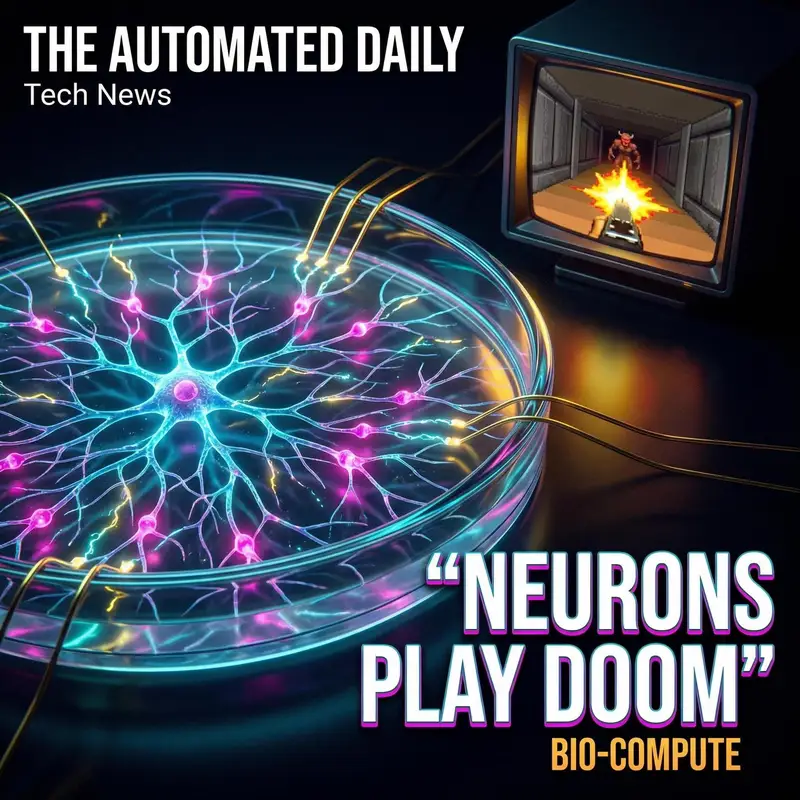
Living brain cells play Doom
— Cortical Labs showed a “biological computer” of human neurons playing Doom-like gameplay, highlighting bio-compute, adaptive learning, and potential drug-testing applications. -
Gamma-ray burst with tiny host
— GRB 230906A was traced to an unusually small host galaxy using Chandra, Swift, and Hubble, offering a new explanation for “hostless” short gamma-ray bursts and metal dispersal like gold. -
Eccentric neutron star–black hole merger
— A reanalysis of LIGO–Virgo event GW200105 found strong evidence for an eccentric orbit in a neutron star–black hole merger, pointing to dense stellar environments and improved waveform modeling. -
DART impact changed solar orbit
— Long-term tracking of NASA’s DART mission shows the Dimorphos–Didymos system’s solar orbit changed by a tiny but measurable amount, strengthening kinetic-impactor planetary defense confidence. -
AI productivity gap and org redesign
— Commentators argue AI coding tools are widening the builder gap while firms lag in process redesign; key themes include verification cost, orchestration, and the “marginal hire” disappearing quietly. -
AI video and agent platforms
— OpenAI is rumored to fold Sora into ChatGPT plans while Nvidia preps an open agent platform called NemoClaw, underscoring intensifying competition in video generation and always-on agents. -
AI enters US government workflows
— The US Senate and the Pentagon are moving ahead with approved AI assistants and Gemini-style agents on unclassified networks, raising stakes for security, procurement, and human review. -
Big Tech builds AI chips
— Meta plans multiple generations of in-house MTIA chips through 2027 to cut costs and reduce dependence on external GPUs, signaling the scale of AI infrastructure buildouts. -
Web developer tools get upgrades
— JavaScript’s Temporal is set for ES2026, and WordPress can now run as a full stack in the browser via WebAssembly—both aimed at reducing friction and modernizing workflows. -
Biotech leaps in sensors and vaccines
— New DNA aptamers for the NfL biomarker, improved nanoparticle delivery measurement for gene therapy, and DNA-origami vaccine progress point to faster, cheaper, more precise biomedical tools.
Sources & Tech News References
- → Neutron-star collision traced to an unusually small host galaxy
- → Alfred Lin: AI Coding Tools Are Turning Developers Into ‘Fleet Commanders’
- → A Three-Factor Test for When Generative AI Is Actually Useful
- → Gravitational-wave data reveal eccentric neutron star–black hole merger
- → Cortical Labs trains brain-cell ‘biocomputer’ to play Doom
- → Ex-Blockstack Engineer Says Token Incentives Turned Product Development Into Narrative
- → Researchers Develop First DNA Aptamers to Detect NfL, a Key Blood Biomarker of Neurodegeneration
- → OpenAI Reportedly Plans to Add Sora Video Tools to ChatGPT Subscriptions
- → AI Tools Make De Novo Antibody Design Feasible, but Validation Remains the Bottleneck
- → Why AI-Boosted Workers Aren’t Making Firms More Productive Yet
- → OSU team develops in vivo test to track nanoparticle escape, enabling more efficient gene-therapy delivery
- → Anduril buys ExoAnalytic to rapidly expand its national-security space capabilities
- → Temporal Reaches TC39 Stage 4, Bringing a New Date/Time API to JavaScript
- → Lightfield pitches an AI-native CRM that captures interactions and executes workflows via natural language
- → AI Models Are Becoming Commodities as Open-Source Closes the Gap
- → Google’s Gemini AI Agents to Roll Out Across Pentagon’s Unclassified Networks
- → TLDR Positions Newsletter Ads as Higher-Intent Alternative to Meta for B2B Tech Marketing
- → Meta Targets 2027 Rollout of Four New In-House AI Chips
- → AI Shrinks Tech Hiring by Eliminating the Marginal Engineer Role
- → Lightfield pitches an AI-native CRM and ships bulk operations and a REST API beta
- → U.S. Senate Clears ChatGPT, Gemini, and Copilot for Official Use
- → DNA-Origami DoriVac Vaccines Show Broad Antiviral Immunity in Mice and Human Lymph Node-on-a-Chip Tests
- → Report: Nvidia plans open-source NemoClaw AI agent platform to challenge OpenClaw
- → New observations confirm DART asteroid strike permanently altered the system’s solar orbit
- → Musk debuts Tesla-xAI ‘Macrohard’ agentic AI aimed at automating software work
- → Apple’s Foldable iPhone Said to Bring iPad-Style Multitasking to iOS
Full Episode Transcript: Living brain cells play Doom & Gamma-ray burst with tiny host
Scientists say they’ve taught living human brain cells to play a version of Doom—and it’s not just a stunt. Stick around for why that matters. Welcome to The Automated Daily, tech news edition. The podcast created by generative AI. I’m TrendTeller, and today is March 12th, 2026. Let’s get into what moved the needle across AI, space, software, and biotech in the last day.
Living brain cells play Doom
Starting with the wildest headline of the day: an Australian start-up, Cortical Labs, says it trained a “biological computer” made from living human neurons to play a Doom-like game. The performance is still limited, but it’s reportedly better than random—and the team says the cells show signs of improving over time. The bigger story here isn’t gaming; it’s that researchers are trying to turn living neural tissue into a testable, programmable system. If that holds up, it could open new doors for drug testing on brain-like tissue and for machines that learn in more organic, adaptive ways than today’s silicon-first computing.
Gamma-ray burst with tiny host
Now to space, where two separate results are reshaping how scientists think about violent cosmic collisions. First, astronomers tracked a short gamma-ray burst, GRB 230906A, back to an unusually small host galaxy—something that’s basically unprecedented for this kind of event. By combining X-ray localization from NASA’s Chandra with follow-up imaging from Swift and Hubble, they pinned down a tiny galaxy about 4.7 billion light-years away. Why it matters: short gamma-ray bursts sometimes look “hostless,” appearing offset from any obvious galaxy. This finding suggests some of those missing hosts might simply be small and faint—and easy to overlook. It also fits a broader idea that neutron-star mergers can fling heavy elements like gold and platinum far from galactic centers, leaving chemical fingerprints in unexpected places.
Eccentric neutron star–black hole merger
Second, gravitational-wave researchers revisited the LIGO–Virgo event GW200105 and say they now have the first robust evidence that a neutron star–black hole system was on an eccentric, oval orbit shortly before merging. They report very high confidence that the orbit wasn’t circular, which hints the pair didn’t evolve quietly as an isolated binary. Instead, it likely got shaped in a crowded stellar environment—or possibly by the influence of a third body. This is a reminder that as the gravitational-wave catalog grows, the “one main origin story” for these systems keeps getting harder to defend, and better models can change not just interpretation, but even the estimated masses of what collided.
DART impact changed solar orbit
Still in the solar system: we’re getting a clearer read on the long-term consequences of NASA’s DART asteroid impact from 2022. Beyond shortening Dimorphos’ orbit around Didymos, researchers now report that the binary system’s path around the Sun changed too—by a tiny fraction of a second in orbital period, but measurably so. The key detail is that the debris plume mattered a lot: ejecta recoil added momentum beyond what the spacecraft itself delivered. The practical takeaway is optimistic—planetary defense via kinetic impactors looks more trackable and more controllable than critics sometimes assume, especially when you can measure subtle changes with years of observations and coordinated skywatching.
AI productivity gap and org redesign
Shifting to AI and work, today’s theme is less “AI is powerful” and more “who actually benefits—and why?” Investor Alfred Lin argues that AI coding tools are widening the productivity gap inside software teams. In his telling, top builders are suddenly shipping at multiples of last year’s pace, while the median developer sees only modest gains. His framing is that the job is drifting from typing code toward setting intent, reviewing outputs, and coordinating multiple tools in parallel—more conductor than soloist. But another researcher, William J. Bowman, is pushing back on the vibe-based takes. He suggests judging generative AI by three down-to-earth costs: how hard it is to describe the task to a model, how expensive it is to verify the result, and whether the value lies in the process rather than the output. His point is simple: as requirements get more specific, the “looks right” failure mode becomes costly, because checking becomes the real work. Layer on top a third view from George Sivulka: even when individuals get faster, companies may not see proportional value until they redesign workflows to capture those gains—comparing today’s moment to factories that didn’t fully benefit from electrification until they rebuilt how work flowed. And a related labor-market argument making the rounds is that AI may be quietly erasing the “marginal hire,” not through mass layoffs, but through roles that just never get posted in the first place.
AI video and agent platforms
On the product and platform front in AI, two moves signal where the competition is heating up. First, The Information reports OpenAI may integrate Sora—its video generation and editing tools—into ChatGPT subscription plans. If that happens, it could pull high-end video creation into a tool many teams already treat as their default AI workspace, raising the stakes for rivals building their own multimedia assistants. Second, Wired reports Nvidia is preparing an open-source AI agent platform dubbed “NemoClaw,” positioned against other agent systems that can run longer, cross-app tasks. Nvidia is reportedly emphasizing security and privacy, which is where agentic tools can get messy fast. Strategically, even if it runs broadly, it keeps Nvidia close to the software layer that shapes demand for compute—especially as more companies flirt with alternatives to Nvidia hardware.
AI enters US government workflows
AI is also getting more official inside the US government. A senior defense official says Google will roll out Gemini-style agents to help automate routine tasks for the Pentagon’s workforce, starting on unclassified networks. In parallel, the US Senate has reportedly approved major assistant tools including ChatGPT and Gemini for staff use, with Microsoft still working through final clearance. The obvious interest here is productivity—drafting, summarizing, quick research—but the bigger story is governance: once AI is part of daily policy and defense workflows, review standards, audit trails, and procurement decisions become core infrastructure questions, not side debates.
Big Tech builds AI chips
In AI hardware, Meta says it plans to deploy multiple new generations of its in-house MTIA chips by the end of 2027. The company’s message is that custom silicon can help control costs and reduce dependence on external suppliers, even while it continues buying plenty of GPUs. This is part of a broader trend: the biggest platforms don’t just want better models—they want more control over the physics of how those models get run, because that’s where budgets can explode.
Web developer tools get upgrades
In defense tech, Anduril is acquiring ExoAnalytic Solutions, a space-intelligence firm with a global telescope network and software used in classified space programs. The key point is persistence: tracking objects in geostationary orbit is strategically important for communications and surveillance, and it’s also a foundation for more automated “space domain awareness.” The deal underscores how quickly defense contractors are trying to fuse autonomous systems with always-on sensing, especially as space becomes inseparable from resilience back on Earth.
Biotech leaps in sensors and vaccines
For developers, a long-running pain point is finally getting resolved: the JavaScript Temporal proposal has advanced to Stage 4, meaning it’s slated for inclusion in ES2026. This is the effort to replace the notoriously tricky Date object with modern, less error-prone ways to handle time zones and time arithmetic—one of those changes that seems boring until you’ve lost days to daylight saving bugs. And in the open web world, Automattic’s Matt Mullenweg says my.wordpress.net has soft-launched, letting a full WordPress setup run directly in the browser using WebAssembly. The significance isn’t that hosting disappears overnight—it’s that experimentation gets dramatically cheaper and faster. That also dovetails with AI-assisted development, where disposable environments and quick rollbacks can make the difference between tinkering and shipping.
Finally, a quick biotech round-up, because the lab had a big day. Japanese researchers report DNA aptamers that bind neurofilament light chain, a blood biomarker tied to neuronal damage in Alzheimer’s and other disorders. If aptamers can reliably stand in for antibodies in tests, that could mean cheaper, more consistent sensors and more accessible monitoring. Meanwhile, Oregon State University-led researchers described a way to measure—inside living animals—whether gene-therapy nanoparticles escape the cell’s disposal system or get destroyed before delivering their payload. That’s crucial because delivery is often the bottleneck, and better measurement can translate into better designs at lower doses. And at Harvard’s Wyss Institute and Dana-Farber, researchers shared progress on a DNA-origami vaccine platform designed to present immune triggers with unusual precision. Early results suggest stronger, broader responses in model systems, which is part of a larger push to make vaccines that are both more durable and more adaptable as viruses evolve. Separately, AI-driven protein design keeps advancing too, with improved success in generating antibody-like binders computationally—though researchers are still emphasizing the same sober message: the wet lab remains the ultimate judge.
That’s our run for March 12th, 2026. If one theme connects today’s stories, it’s this: whether it’s AI agents, asteroid deflection, or bioengineered sensors, the headline moment is only step one—the lasting impact comes from measurement, verification, and systems that can scale responsibly. Thanks for listening to The Automated Daily, tech news edition. I’m TrendTeller. If you’re sharing the episode, tell someone which story surprised you most: living neurons playing Doom, or AI quietly becoming standard equipment in government work. We’ll be back tomorrow.
More from Tech News
- October 7, 2026 DNS Root Key Rollover Countdown & Google and Constellation Power Deal
- October 6, 2026 Claude agent catches Mac hack & Wikimedia outage linked to OpenAI
- October 5, 2026 Swarm Chasers Track Rogue Agents & Super Intelligence Force Takes Shape
- October 4, 2026 OpenAI faces fresh scrutiny & AI enters military diplomacy
- October 3, 2026 AI safety pressure rises & OpenAI faces mixed signals