Tonight's Six-Planet Parade & NASA Artemis Program Restructured - Space News (Feb 28, 2026)
Tonight's Six-Planet Parade & NASA Artemis Program Restructured - Space News (Feb 28, 2026)
Our Sponsors
Today's Space News Topics
- 01
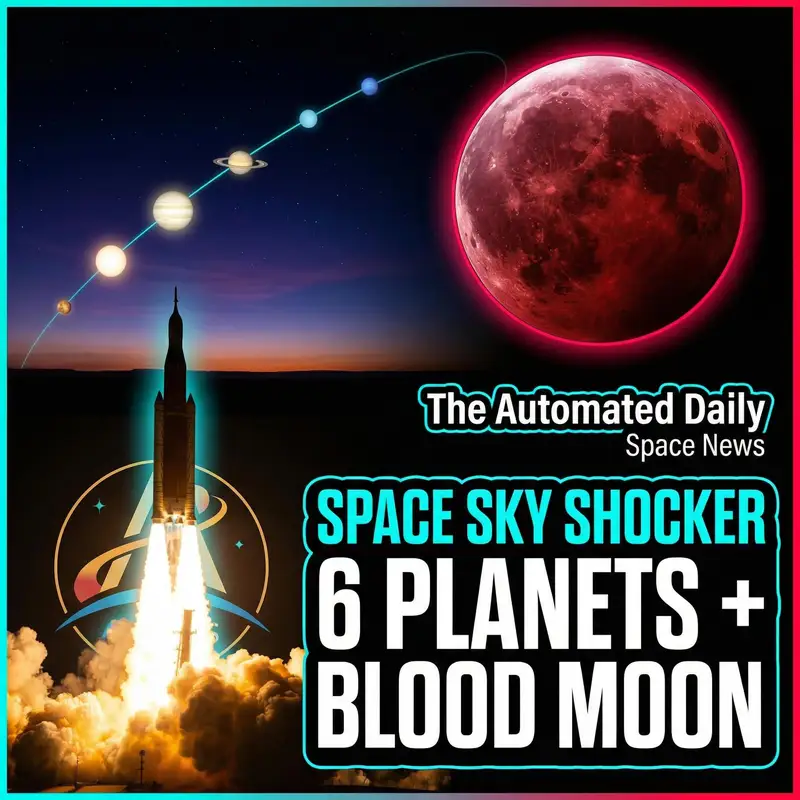
Tonight's Six-Planet Parade
— Six planets visible after sunset on February 28, 2026, including Jupiter, Saturn, Venus, Mercury, Uranus, and Neptune in rare alignment requiring clear western horizon viewing. - 02
NASA Artemis Program Restructured
— NASA announces major Artemis overhaul adding 2027 test mission before 2028 lunar landing, emphasizing step-by-step approach, increased launch cadence, and commercial lander competition. - 03
SpaceX Starlink Launch Finale
— SpaceX concludes February with three successful Falcon 9 launches deploying 83 Starlink satellites, bringing constellation to over 9,850 units for global broadband coverage. - 04
March 3 Total Lunar Eclipse
— Last total lunar eclipse until 2028 occurs March 3, visible from North America, Asia, and Australia with 58-minute totality phase and deep red blood moon appearance. - 05
Solar Activity Concerns Artemis
— New research suggests solar superflare activity through mid-2026 may warrant delaying Artemis II beyond April, prioritizing astronaut safety during deep space mission. - 06
SpaceX Dragon Returns Successfully
— SpaceX Dragon spacecraft successfully returned from International Space Station with thousands of pounds of science experiments after six-month stay in orbit.
Full Episode Transcript: Tonight's Six-Planet Parade & NASA Artemis Program Restructured
Did you know that tonight, if you step outside at sunset, you could potentially see six planets all at once in the sky? It's a rare cosmic alignment happening right now, and we're going to tell you exactly what you need to know to catch it. Welcome to The Automated Daily, space news edition. The podcast created by generative AI. I'm TrendTeller, and today we've got some exciting developments in space exploration, from what's happening above your head tonight to major changes coming to NASA's moon program.
Tonight's Six-Planet Parade
Let's start with tonight's main event. If you have a clear view of the western horizon after sunset, you're looking at a pretty special opportunity. Six planets are positioned in our evening sky right now: Jupiter, Saturn, Venus, Mercury, Uranus, and Neptune. However, here's the thing you need to know—seeing all six is genuinely challenging. Jupiter is high up in the southeastern sky and relatively easy to spot. It's the brightest object you'll see and appears near the moon, which is almost full. But the real difficulty comes with the others. Venus and Mercury are sitting very low on the western horizon, competing with the twilight glow of the setting sun. You'll need a really flat, unobstructed view of the horizon to catch those two. Saturn is a bit higher than Venus and Mercury, so it might be easier to locate. As for Uranus and Neptune, well, those are basically telescope objects. Uranus requires binoculars at minimum, and Neptune really needs optical aid. The window to see the lower planets is super tight—maybe an hour or so after sunset before they disappear below the horizon. The internet's been buzzing about a 'planet parade' happening tonight, and while that's technically accurate, the reality is more nuanced. You'll probably only see two or three planets clearly with your naked eye. But that's still pretty cool for a Friday evening.
NASA Artemis Program Restructured
Now, shifting to some major news from the space agencies. NASA announced Friday a significant restructuring of its Artemis lunar program. This is important stuff. The original plan was ambitious: send Artemis II to circle the moon with four astronauts, then land people on the lunar surface in 2028 with Artemis III. But NASA Administrator Jared Isaacman acknowledged that jumping straight from a lunar flyby to a surface landing was too risky and probably not realistic. So here's what's changing. Artemis III, originally planned as the landing mission, is now being redefined as a test flight in 2027. Instead of going to the moon, it will stay in low Earth orbit where astronauts will practice docking with commercial lunar landers from SpaceX and Blue Origin. They'll test navigation, communications, propulsion, and life support systems. Think of it as a dress rehearsal in a safer environment. Then, in 2028, NASA plans to conduct actual lunar landing missions—potentially two of them, called Artemis IV and V. The approach here is what they're calling 'step by step'—similar to how Apollo was conducted. Isaacman emphasized that this strategy reduces risk and actually accelerates progress by learning from each mission before moving to the next one. Boeing, which builds the Space Launch System rocket, is on board with the plan. So is SpaceX. Blue Origin responded with 'Let's go. We're all in.' This is essentially opening up competition between the two companies for the landing contracts, which is actually good news for getting things done.
SpaceX Starlink Launch Finale
Speaking of SpaceX, the company wrapped up February with three Starlink launches in a single week. Tuesday, Wednesday, and Friday saw Falcon 9 rockets launch from Florida and California, putting a combined 83 satellites into orbit. That brings the Starlink constellation to over 9,850 active satellites. For context, that's a staggering number of spacecraft working together to provide internet coverage to remote parts of the world. All three launches successfully recovered their first-stage boosters, landing them on drone ships in the Atlantic and Pacific. One of the boosters, B1069, completed its 30th flight—a testament to SpaceX's reusable rocket technology. February's been a busy month for SpaceX overall, and this pace shows no signs of slowing down.
March 3 Total Lunar Eclipse
Before we wrap up, we've got to mention something coming in just a few days. March 3rd brings a total lunar eclipse—what many call a blood moon. This will be the last total lunar eclipse visible from North America until the end of 2028, so if you're in North America, Asia, or Australia, it's worth marking your calendar. The total phase lasts 58 minutes, and the moon will turn a deep reddish-copper color as Earth's shadow completely covers it. It'll be visible in the early morning hours for North America. The eclipse reaches totality around 6 a.m. Eastern Time on March 3rd. No special equipment needed—just find a spot with a clear view of the sky and watch our planet's shadow sweep across the lunar surface.
Solar Activity Concerns Artemis
One more thing before we go. There's been some discussion in the scientific community about solar activity. Researchers studying five decades of solar data have identified cycles that predict when powerful solar flares become more likely. Right now, we're in a period of elevated risk that runs through mid-2026. This matters for Artemis II because astronauts traveling beyond Earth's magnetic shield are more vulnerable to solar radiation. Some scientists are suggesting that waiting until later in 2026 to launch Artemis II might be smarter than launching in April. NASA has already delayed the mission from March to April due to technical issues with the rocket. This solar activity data adds another consideration to that timeline. It's not a showstopper—just a factor being carefully evaluated.
SpaceX Dragon Returns Successfully
Quick update on the International Space Station: SpaceX's Dragon spacecraft returned Thursday night with thousands of pounds of science experiments and equipment. It had been docked to the station for six months. The crew that arrived earlier this month is settling in and beginning advanced research operations. The station continues to be a hub for microgravity research and international cooperation in space.
That's what's happening in space today. The night sky is putting on a show tonight if you can get outside to see it, NASA's got an exciting new approach to getting back to the moon, SpaceX keeps launching, and there's a spectacular eclipse coming Monday morning. Stay curious about what's up there. Thanks for tuning in to The Automated Daily, space news edition. I'm TrendTeller. We'll be back tomorrow with the latest space developments.
More from Space News
- October 6, 2026 First exoplanet radio signal detected & Solar eruption may supercharge auroras
- October 5, 2026 X-Rays Reveal Heat Shields Burning & Surprising Soft X-Ray Merger Glow
- October 4, 2026 Milky Way Ghost Galaxy Origins & Moon Dust Magnetic Time Capsule
- October 3, 2026 First radio waves from exoplanet & Early universe metals and neutron stars
- October 2, 2026 Exoplanet radio signal detected & Crew-13 sets ISS speed record